#spirituality #selfdevelopment #personaltransformation
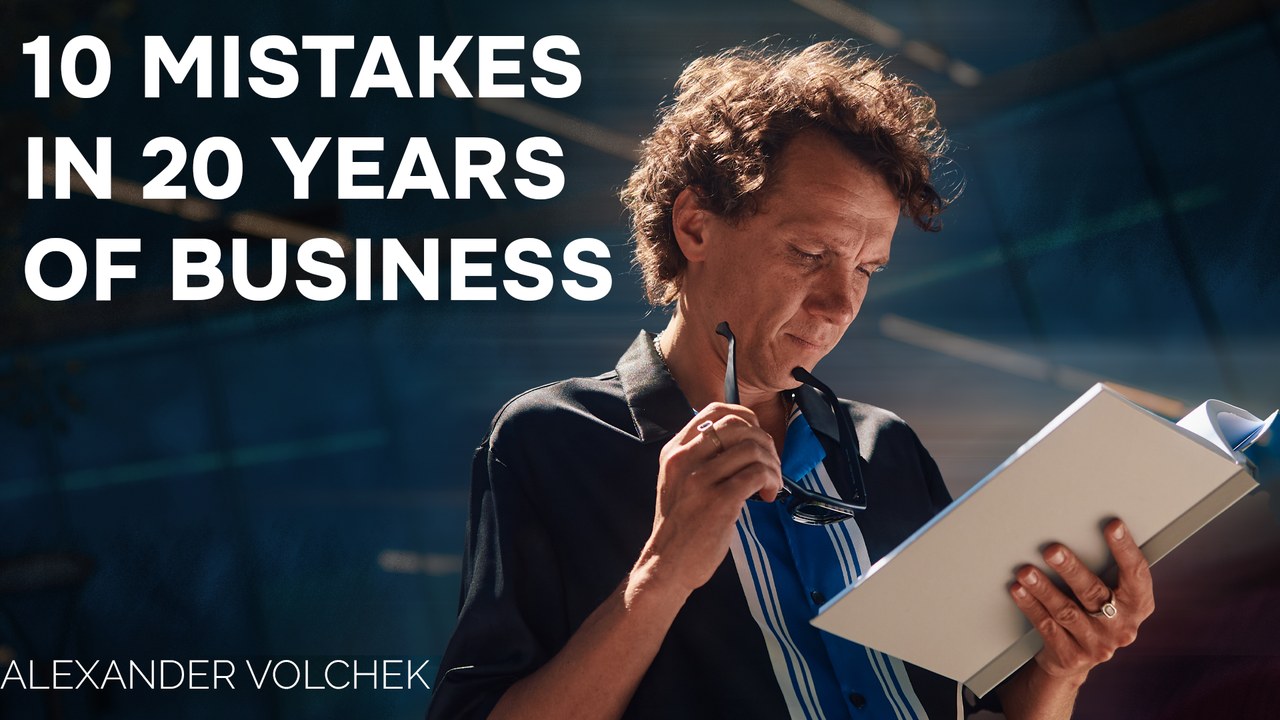
I want to talk about ten mistakes I have made in my professional life. I have a great deal of professional experience; a lot has happened, and a lot is still happening. I'll focus on a few striking, pivotal moments. What makes them worth looking at? They show us where problems arise and where we could have done things a little differently. I'll go through them in the order they happened in my life.
The first mistake was in 2003. My friends and I decided to sell cell phones. Four of us got together and said, ‘Let's start this business.’ Two of us went to Poland to buy phones. They came home—we lived in Minsk then—and we somehow managed to sell them. Someone scratched a phone along the way; someone else later said he didn't want to work. In the end, we went our separate ways.
The mistake was that four of us were doing it together. It was the energy of four people, not the energy of a real business, a real undertaking, and we had no idea whether we could work together. None of the things we needed to do had been done: no planning, no careful choice of a niche, no calculation of unit economics, no written agreements or partnership arrangements. It was simply a spontaneous action. It ended as quickly as it began.
The second mistake. In 2007, I started my first software development business. I launched it after agreeing to a contract in a café a month earlier. What was the contract? We said we would automate a company that sold furniture for $10,000.
Today, I wouldn't take on that automation project for a million dollars, or even two million—not under any circumstances. We had to automate everything, to build an enormous ERP system. I agreed to do it for $10,000. That was definitely my mistake. Perhaps it was the push I needed to start a business, but you mustn't take on contracts like that.
The third mistake. In 2010, I closed my first business, a company called IT Group, based in Belarus. We developed software for clients all over the world: Austria, France, Germany, England, the United States, and Taiwan. We also did some projects in Belarus.
What was the mistake? It wasn't closing the business: I'm very glad I left it. I originally started that business with a partner. I had a 60% stake and he had 40%. I came up with the business and proposed it to him. At the time, he was on my team, reporting to me at the company where I worked. We had studied together. Somehow, we settled on a 60/40 split, and it was probably reasonable. But in 2009, another person came along who wanted to work with us. We combined our businesses that year, and there were now three partners with 33% each. I reduced my stake significantly. My second partner reduced his a little, and a third partner came in. That was a huge mistake, but the mistake wasn't bringing in the third partner.
The mistake was changing my agreement with the person with whom I had a 60/40 split. I realized that very quickly, and in February 2010, I said I was no longer going to be in that business and left.
The fourth mistake. In 2010, I moved to Moscow and began running Megaplan. I was the commercial director at first and then became CEO. At the time, the company had 10,000 customers. By 2012, I had grown its B2B customer base to 120,000. The company was later bought by 1C; I sold it and left to become a partner in a new company, Business Molodost. Megaplan was a leader in software as a service in Russia, a leader in systems of that kind and in the cloud market overall. The shareholders came up with the idea of adding a CRM system alongside the task management system. As it happens, I have always been incredibly strong at automation, processes, and systems such as CRM. In plain language, these are systems that salespeople use in their work.
The mistake was that I built the CRM system around what the shareholders wanted, rather than what the market needed in terms of marketing and sales. As a result, Megaplan never became a leader in CRM. Bitrix24, a new company with a task management system, created a CRM system that overtook Megaplan in customer numbers in that particular segment. And most importantly, amoCRM came along, did what customers needed, and became the strongest player in the market.
The fifth mistake. In 2011, when I was running Megaplan, its shareholders included Mikhail Ukolov, who owned Utinet. It was the first marketplace and e-commerce company in Russia to go public, in 2011. I had made a close friend in China, Zhenya, and many of my later experiences involved China. We saw a video of flying fish that were controlled by a remote and floated through the air. They looked incredible. I suggested to Mikhail Ukolov that we bring in several containers of these fish to sell in Russia. We ordered them from a factory in China. They didn't sell: in real life, they turned out not to be that interesting, and nobody needed them. What's more, by the time we brought the fish over, a huge number of other people had imported them too.
Perhaps if we had done it earlier, perhaps if the fish had worked without problems or defects, perhaps if we had had a different distribution setup, it would have worked. But that didn't happen at the time, and of course it was a business mistake.
The sixth mistake was one of the fundamental mistakes of my life. In 2012, I became a co-owner of Business Molodost, and by 2013, I had a 33% stake: Mikhail Dashkiev had one third, Petr Osipov had one third, and I had one third. Mikhail Dashkiev's stake was actually shared among several people: his 33% covered five people. My big mistake in 2014 involved a conflict that had developed between me and the shareholders by the end of the year. I was no longer CEO.
In early 2015, Petya Osipov and I met in a café and decided to part ways in the business. It was a thoroughly unprofessional decision. Not all the partners were involved; Misha had disappeared altogether. Petya and I simply made the decision together and went our separate ways. Leaving was my mistake, because it caused an enormous problem for the business. There was tremendous room to develop it and move forward. Of course, without me, the business lost a great deal of strength and opportunity, and I, in turn, lost a business.
The seventh mistake. In 2016, Andrey Rogachev and I launched AGRO24, a B2B trading platform. It was a very strong technology startup and a company operating in wholesale food trading.
We made an enormous mistake in that business: we tested far too many hypotheses and an enormous number of features. Overall, the business didn't work out. At a certain point, we closed it.
The eighth mistake. At AGRO24, Andrey Rogachev and I had a 50/50 partnership. The mistake was that we didn't bring in another partner. We were constantly looking for financing, not to cover ongoing expenses, but to establish a valuation for the asset. My mistake came when someone who was quite well known in the Russian market for investing in various technology startups offered to become a partner.
When Andrey and I discussed the partnership, he said, ‘Sasha, listen, why do we need a third partner? We have enough money.’ I thought, ‘I suppose we do have enough money.’ That was a big mistake on my part, because he had enough money and I didn't. So ‘we have enough money’ wasn't true. Of course we should have brought in a third partner. A third partner would have balanced our relationship and the things that happened later because the two of us kept clashing. A third person would have brought us into balance, because Andrey and I had an incredibly good relationship.
The ninth mistake was a fairly big one, and a very interesting one. In 2015–2016, Andrey Rogachev and I came up with a business model that was probably similar to that of the American company BlackRock. We wanted to join various companies, take a small stake, scale them up, and exit. One of the companies we discussed joining was VseInstrumenti.ru. It is now one of Russia's largest e-commerce retailers.
What was our mistake? We reached an agreement that we would receive 10%. We insisted that the 10% be transferred to us immediately, while they proposed transferring it as certain milestones were reached. We would, however, have received dividends on that 10% from the outset. Andrey and I refused, thinking that arrangement was wrong. I have a feeling it was more my decision than Andrey's. It was a mistake, because the company now generates more than a billion dollars in revenue. And the goal going forward was to reach a billion dollars in revenue and grow many times over. In effect, as a company went from being worth $100 million to $1 billion—with the valuation already at least ten times higher—we would have received not 10% but 100% of the company. And that's an enormous amount.
My tenth mistake was that in many businesses, I foresaw certain things and acted on them too early. I did things whose time had not yet come, things that needed to happen a little later.
That was how we created an electronic ticketing system in 2009. At Business Molodost, we put a great deal of work into a technology platform and into structuring the business. Even then, all our salaries were on the books and we paid VAT. I made the same mistake at AGRO24 when I began making technology decisions the market wasn't ready for. At GeekBrains, we created an incredible system for the future of education in technology, one that a great many people cannot even understand. And of course, even the shareholders cannot understand it. From a business standpoint, that is a mistake.
Very often, to make money in business, you have to do things you don't like. You even have to do them with people you don't like. You have to do them in the right place, in the right niche, and above all, at the right time. Timing matters enormously. Mistakes aren't something to regret. They're something you can simply look back on, as I have done today.
⚡Subscribe. I regularly share thoughts on business, life, and spirituality on my YouTube channel.
Watch the video for this article
Original video · Russian audio