To add to the material on meditation, I want to discuss an interesting aspect that brings its essence into sharp focus: what is meditation, and can you drive while deeply immersed in a meditative state?
When we say that meditation is a state of expanded perception, a question arises: can you be in that state in a setting as particular as a car? People ask, ‘What happens if I lie down or sit during meditation? What if I move or run? Do I need to stay completely still? How do I reach that expanded perception?’
And what if I am driving? In that case, I need to remain attentive to the road.
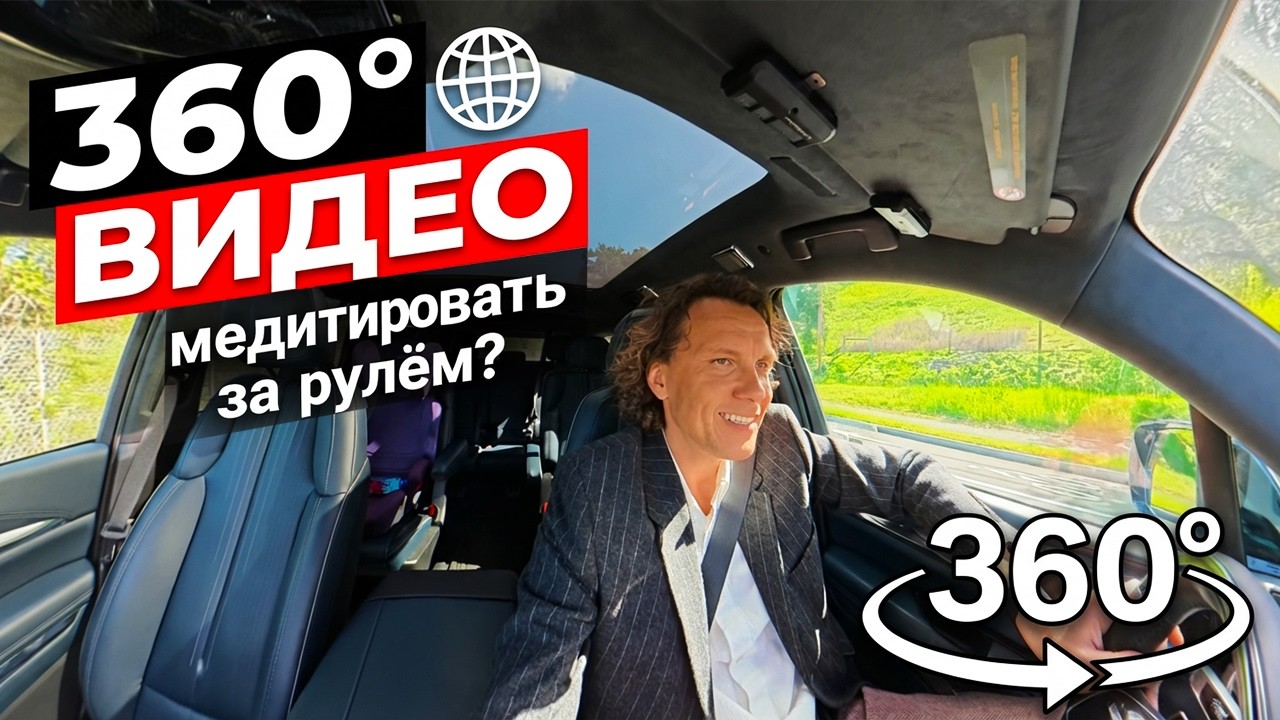
One experience comes to mind. Recently, I was driving back from San Francisco, and the car detected a state that required me to stop immediately. Although it was on autopilot, it began displaying messages saying I had become inattentive. It registered this ‘inattention’ because we were in a fairly deep meditative state. The car has sensors that track your eyes and face, and to the car, this looked like a loss of attention. In fact, I was fully attentive. I remember that moment clearly: I felt much better than on the drive to San Francisco, when I had been physically uncomfortable and there had been a lot of noise. At that moment, we had immersed ourselves in perceiving different realms and other worlds. At the same time, I was driving.
One of the key things to understand when considering meditation is that it is not tied to a separate exercise you perform. A meditative state is awareness in the moment.
For example, when I record a video in the car, I am in a particular state of awareness. On one level, I am driving and am aware of what is happening on the road. On another, I am broadly perceiving different states and the whole system of my soul and spirit. On a third, I am communicating this material, and it matters to me that I do so accurately.
When I communicate it, there are interruptions. How can you notice that? The very fact that I notice those interruptions is a meditative state, because I am aware of what is actually happening. I see that there are inaccuracies in my consciousness. For example, I decided to record this video spontaneously. I have to find some of the words as I go; this is not a fully formed stream of information from the outset. But it is still a meditative state, because I am perceiving a great many worlds at the same time.
Observing yourself and being able to enter different states in different spaces is an important skill. This applies not only when you are sitting at a concert and entering a state in which, as people say, ‘the energies are at work.’ When you are in a meeting, you enter a particular space as well. When you are at home watching television, you are in another space. When you talk to your husband or wife, you are in yet another. When you are at work with colleagues, another shift takes place.
It is important to learn to see and perceive this.
When I was young, from around age 14 to my early twenties, there was a period when I would enter a state I called ‘disappearing.’ I remember my mother's reaction very well. When I told her I ‘disappeared,’ she said, ‘Whatever you do, don't mention that when you apply for your driver's license.’ While talking to someone, I would feel for a moment that I was vanishing, as though I were not present in reality. I was somewhere, but not here.
That moment could feel as though it lasted different lengths of time. The time that passed here did not match my sense of being ‘absent.’ It is hard to convey, but I could clearly feel the difference. From the perspective of spiritual perception, this is explained by time being experienced differently in different realms. Moreover, there are realms where the concept of time does not exist. Some realms are experienced as timeless. Every spiritual being is present in a timeless realm. Even when we speak of a human being as an incarnated being, the connection with such a realm remains. There can be various nuances and qualifications.
I really did disappear. In essence, for a moment I entered a very deep meditative state. Many people seek these states: they travel to caves, spend enormous amounts of time meditating, and strive to reach them, feeling great joy when they do. For others, by contrast, this state is associated with fear. In my case, too, people tried to interpret it as something frightening, a state to fear rather than one to explore more deeply.
The only advice I would give myself is: go deeper.
This realm comes up in the subject of death. It is important to remember what you will do at the moment of dying. Establish that understanding within yourself and live with it. For that to happen, you need to accept death; to do so, you need to be close to that energy and feel it. But people are afraid. They are afraid even of simple symbols, attach significance to chance events, and perform rituals without understanding their essence.
People are afraid to discuss death, afraid that doing so will ‘attract’ it. But it is nearby. For people of the current generation—if we consider a generation in a broad, planetary sense—death is close at hand, and it is important to become aware of its presence. Rudolf Steiner spoke about this back in 1924: more and more people would feel the presence of death beside them, the sense that it was always close.
This aspect matters in Eastern traditions as well: approaching the transition properly. To do so, you need to feel the significance of life after death, to understand and believe that it exists. Here, though, we are considering this in the context of meditation and understanding the meditative state. We are talking about a calm, clear perception of what it is.
The example of ‘disappearing’ and the examples involving a sense of death's proximity illustrate something important: in such states, you need to move into awareness and become as aware as possible in that moment, rather than slipping into fears, psychosomatic reactions, and distress.
An encounter with a wild animal illustrates this well. If you see one, the first thing to do is stay calm, remain aware, and recall what you should do in that situation. Act consciously rather than impulsively. That is the key action.
To enter a meditative state, it is important to understand that you need to be aware within that state. A person cannot go deeply into meditation without being aware within it.
This is not about external awareness, but about inner awareness within the meditative states themselves. A spiritual being's awareness within the spiritual world is a different experience of energy.
People often think the physical body gets in the way of spiritual development. But it is important to understand that everyone has undeveloped levels—the etheric body, the astral body, and the ‘I’—which can block the processes of perception. For example, a person cries because their ‘I’ constricts the astral body, and laughs when the ‘I’ releases it. The person struggles with this at the level of the physical body. Many people see the spiritual world as something separate from the material world, as a completely isolated realm. In doing so, they assign mistakes and responsibility solely to the physical level.
If you look at descriptions of meditation online, you will often find it reduced to ‘calming the mind.’ The resulting approach turns calming the mind into a denial of the physical body's processes. That is the wrong orientation.
- There are meditative states in which you are in silence and your whole system becomes calm.
- And there are states in which you perceive many realms at once—ten, fifteen, or more.
In those states, there may be an intense stream of thoughts. That stream is alive. People want to ‘calm down,’ but what they are often really talking about is stopping dead thoughts.
To tell the difference, you need to understand what dead thoughts are and learn to recognize them.
There is a great deal to say about meditation. I have posted dozens of meditations on my channel, and each has its own meaning and provides access to different levels of perception. Some meditations bring the whole system together; some allow you to have an experience and look more deeply into particular realms; many are not directly related to a person's current life.
An important question arises: what does the person actually want to gain? Are they interested only in what concerns their personal life? Or are they also interested in what concerns their spiritual being?
The people around you are generally not interested in what concerns your spiritual being. What matters to them is attention to themselves. The realm of ego is everywhere. If you go deeper, you can perceive this layer as a kind of swarm of darkness. You can descend into it endlessly. It is not just a bottomless barrel; it is a bottomless multiverse from which it is hard to find a way out.
But there is always a way out. And when you find yourself in a space of silence, outside time, in a state of light, it is important to keep moving from that state into every new moment of life.
⚡️ Subscribe for new videos
🎥 Video for this article
Original video · Russian audio