
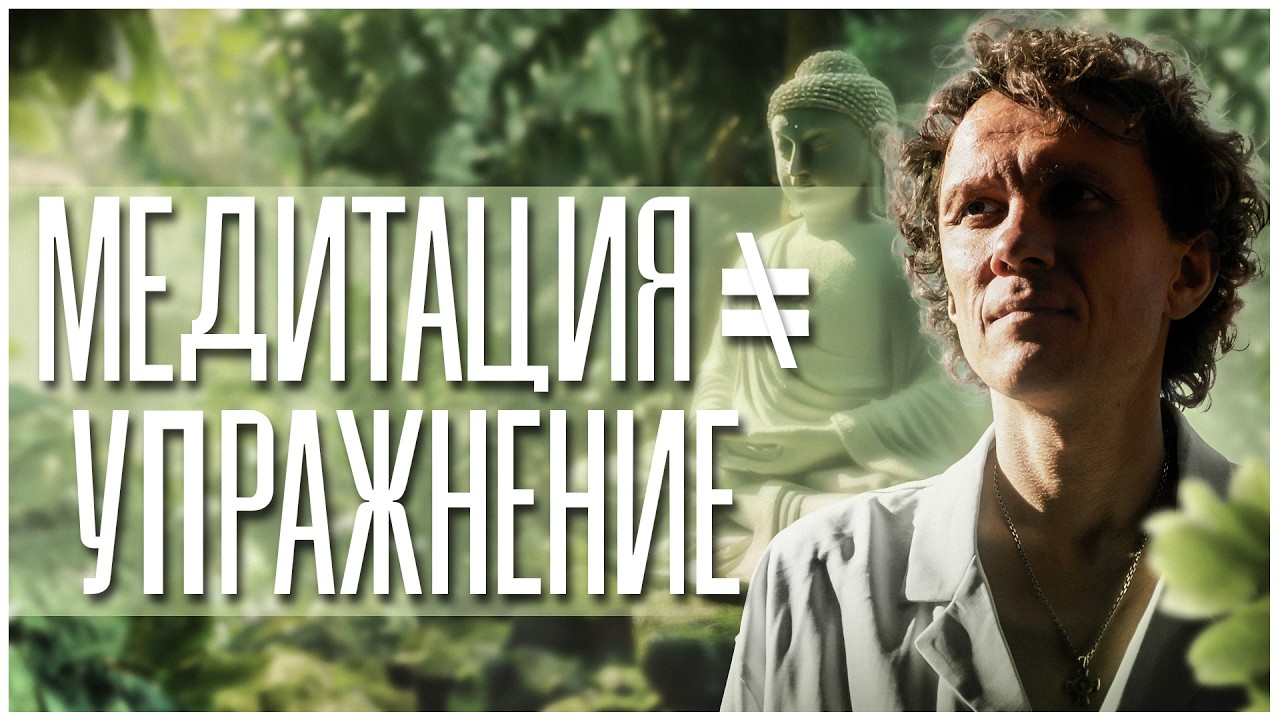
When we consider what meditation is, how to enter it, and what it gives a person, there is something important to establish from the start: everyone has their own sense of what the word means.
The problem is that people associate meditation with an exercise. If you see meditation as an exercise, all you can change is your experience of that exercise. One person thinks pull-ups are a good exercise; another thinks walking 10,000 steps a day is. These are simply substitutions, without understanding health as a whole or why you are doing it.
Some time ago, someone told me they had been given a natal chart as a gift. During the reading, the practitioner asked the young woman, “Do you meditate?” She answered, “I don’t know, but perhaps I do.” When asked what exactly she did, she said she sat down and tried to relax and enter a certain state. The practitioner replied, “You’re doing the wrong thing,” and suggested she come to him so he could show her the right way.
Can someone “show you how”? No. In meditation, it is important to understand that there is no such thing as “showing you how.” If you encounter an attempt to “show you how,” you are dealing with an exercise, an isolated part, not an understanding of the whole. In other words, you do not understand what health is; someone may tell you to walk 10,000 or 20,000 steps a day, or do pull-ups.
That is often how people approach meditation. It is as though someone said, “You need to learn to do push-ups,” and the whole world began discussing push-ups, even though they are just one exercise. Meditation is seen as a set of exercises, not as a whole. That is why you cannot show someone how to “do a meditation.” Yet that is what all the discussion is built around.
Some people offer meditation in the form of putting on headphones and going for a walk, along the ocean, for example. Or traveling to a special place where there is a guide to help you meditate.
I live in Silicon Valley, in California, not far from San Francisco. There is a town called Los Altos where you can see a building with a sign saying something like “Meditation, bowls, juices.” It also says, “We help guide you in meditation.” What, exactly, do they help you do? Where do they help you go? Do they help you calm down, regulate your breathing, restore your heart rhythm and blood pressure? Clear your thoughts, or organize them? Change the range of your thoughts? Prepare for the next stage of life? Start or stop certain internal processes? What, exactly, is happening?
That is why we see so many types of meditation and different techniques.
- They explicitly write, “Mindfulness technique: observe and notice everything that happens; watch your thoughts, breathing, sensations, and emotions.”
- Or “concentration on the breath,” where attention is held on inhaling and exhaling.
- Or “continually scanning the body.”
- Some practices are called meditation, such as vipassana, although it is a separate system of practices aimed at reaching particular states.
- There is also the concept of transcendental meditation. Everyone uses the terms in their own way. Some, for example, see it as a technique of silently repeating a mantra, a particular sound.
You find this in different cultures. In some places, it is called a mantra. But if you go to a Russian village and approach someone who removes warts, it will most often be an older woman who knows a particular spell. She whispers something and “removes” the warts. Is she whispering a mantra or not? The word “mantra” simply sounds more appealing. The world today loves appealing words. The question is how the names are used. Someone may dislike “spell” but like “mantra.”
The main point is that meditation cannot be understood through a single exercise. It can be understood through a true perception of the word, rather than the way it has become distorted over the past 500–700 years, or even a thousand years. People give the word different meanings. It is not “push-ups.” It is as though someone said “push-ups” but meant jumping out of a plane with a parachute while doing a push-up in midair. That is how different people’s understanding of the same word can be.
One crucial aspect is that meditation is very often associated with health. My sister focuses on nutrition. At one point, I began doing that too, and for many years I explored health in depth across different cultures and approaches: from the World Health Organization’s approach to Ayurveda, Vedic astrology, Jyotish, and modern methods, nutrition, and other comprehensive systems. These are different areas.
I remember discussing certain aspects with my sister. While she was studying, she said that stress has a strong effect on the gastrointestinal tract. When people look at digestive problems, they often say, “First, you may be stressed.” There is a very interesting question here: which comes first? Does stress arise from gastrointestinal problems, or do the problems arise from stress? That is a fundamental question.
I have a close friend who is a doctor in Moscow. I have always liked his approach to medicine. I remember when my mother fell and had a minor stroke. He said, “The most important question, which no one can answer with certainty, is whether she fell and hit her head first, then had a stroke, or whether a hemorrhage happened first, causing her to fall and hit her head.” That is where you need to start: with the causes of different things.
Returning to stress, in health-related fields such as nutrition, it is often treated as one parameter, almost like a lab result. It is like measuring vitamin D: if the level is 15 rather than 70, they say you need to take vitamins. They approach stress in a similar way, although they themselves have no methods for diagnosing a state of stress.
Modern methods of assessing stress rely on heart rate variability: the difference between the rhythm during inhalation and exhalation. Stress indicators are measured using those parameters. But do these things fundamentally explain what stress is? Or are they only one part of the measurement? What, exactly, do the data show? Do they show a person’s natural state in terms of stress in the physical body? Or does the system show stress in the spiritual bodies and the spiritual aspect of a person’s life?
This brings us to the key question about meditation: what is meditation to you?
- Is it a system of exercises that helps you get through your day in a better way?
- Or is it a system of development aimed at studying life, coming to know the world, seeking the truth, and expanding perception?
How you approach it is fundamental. Seeing meditation as a way to calm down or improve your fitness tracker readings—your pulse, stress level, or blood pressure, for example—is one approach. I have a fitness tracker myself.
Modern devices can be useful. Several times, I have suggested that my mother and wife look at my wristband’s data, because they trust medical readings. I said, “Look, at that moment I was as calm as could be.” Even during a conversation, you can check the readings and see whether there is stress.
When we talk about anger or aggression, the question is whether they must be accompanied by changes in physical indicators. Can you feel aggression without changing your pulse, rhythms, or other parameters? Then we are talking about controlling energy, not simply calming the physical body.
Can you be in a state of aggression without changing your body’s indicators—pulse, heart rate variability, brain activity, or the functioning of the nervous and circulatory systems? The question is which instruments to measure it with and over what period to observe it. How much time does it really take?
We live in a world of many claims, including claims based on medical data. For example, people say that coffee or tea makes many people’s systems function worse, causes dependency, increases stress, or impairs perception.
I have a modern wristband with artificial intelligence features. The advantage now is that you can identify relationships using your own data. I wear it around the clock without taking it off, and log everything I do. Yet it shows no relationship between drinking coffee or tea and disrupted sleep, heart function, or other parameters, either in the morning or in the evening. There is nothing of the kind; it has no analytical readings showing it.
That raises the question: what were the conclusions about harm based on? I am not promoting coffee or tea. They have their own nuances and issues, and their own energies. It is important to understand them.
There is a book by Concordia Antarova called Two Lives. One episode describes the characters in Constantinople drinking coffee, then saying they need to drink tea to bring their systems into balance. That is a very interesting statement. Normally, people do not drink tea after coffee; that is not how they think. Or people often say it is all the same: caffeine, tannins. Different terms are used.
I am not particularly familiar with those terms, but some people, especially in the media and on blogs, constantly use medical terminology: hormones, processes in the body, the system’s responses. They explain which hormone is responsible for what. But the question remains: what are the underlying causes?
Take the causes of depression, for example. Suppose normal gastrointestinal function requires the absence of stress or depression. But what if someone’s life circumstances mean they are supposed to spend the next seven years in a very difficult state that will lead to depression? Can they observe it, or is it inevitable? It will definitely happen.
- Some people find it quite easy to sit in a chair meditating for 40 minutes. It presents no difficulty for them.
- Others find it hard to sit for even two minutes.
- Some people naturally enter states of deep perception, even in everyday life, without realizing it.
- Others spend tens of thousands of hours meditating without coming close to those states.
I conduct many sessions, and I know people who instantly enter a state of absolute transcendence during our work. It is a complete transition. It is not you entering a world of inspiration or intuition; your spiritual being has entered spiritual vision, a true meditative state. Your entire spiritual system has entered it. You have long since ceased to be there.
So what does a person have in mind when they want to sit down to meditate? There is a major difference. Are they trying to restore their physical body by calming their breathing and pulse, or to come to know the world? It is important to distinguish the two.
Today, most people in both Western and modern Eastern cultures see meditation as a technique for improving their lives: achieving particular targets, states, or status. You can see many gurus listing the hours they have spent meditating, or the number of days or practices. All those measures show only that the person is not in a state of vision and perception. Any quantitative measure is either a marketing tool or a reflection of how the person understands the process. They see it as “I did this.”
Some time ago, I took a long trip to explore spirituality in Eastern countries. An interesting encounter happened there. Someone told me, “I am here in this country now, and there is a person here who guides people around these places. He sees everything, understands everything, and can guide you.”
Here is an interesting point: does being born in a country automatically make someone a guide to it? If a guru appeared in Belarus tomorrow and became the world’s most famous figure in spiritual development, it would be easy for me to show up in Silicon Valley and say I was a guide because I am Belarusian. People would believe me based on certain criteria.
People like that. The Western world has always been drawn to Eastern wisdom through images, clothing, and culture. All you need to do is arrive in Nepal, Tibet, or India and see someone in a monk’s robes for trust to arise, even without understanding what those clothes, colors, traditions, or that way of life mean.
You can see the same thing elsewhere. For example, if you go to Russia’s Altai Republic, drive away from the city, and someone says, “We have a shaman here,” many people immediately become engaged without looking into what it means. Yet real shamans do not put themselves on display or do this publicly; that is their approach.
It is similar with monks. When people see someone in monastic robes in Nepal, they often do not consider that this is a person just like someone who walks into a church in Moscow. It is simply a different culture of dress. Some people sincerely enter monastic life and are good at heart. Others go there to hide or avoid something. The fact that someone has become a monk tells you nothing in itself.
In the modern world, people also often become priests for social, political, or economic reasons, because of connections or conventions, rather than because they are connected with God. Take the pope, for example: he is the vicar of Christ on Earth, someone who is supposed to be connected with God. He is the person who hears absolutely everything, knows everything, and sees everything. Do the people who come into contact with this truly recognize that level or not?
There is an important point in both the Orthodox and Catholic traditions. Orthodox Christians go to church, and there are different holy days. At Christmas, for example, do people truly believe in the birth of Christ, or do they see it as a holiday? Do they truly believe in the Resurrection? People say, “Of course there was an energy that rose again.” Or is it a good myth for them? Do they really believe it? Not even simply believe it, but know and understand it as they know a person has two eyes? Or is their belief merely, “That’s the custom, and I accepted it”?
You can see this in practice. When everything is calm, a person does not go to church. But as soon as a problem arises—illness, someone’s death, a criminal case being opened—they go. They stand in church: women wearing headscarves, men with serious faces. They listen and look at something. What motivates them to do it? What is its true meaning? What is it? A person kisses an icon: what is that? What, specifically, is happening within them at that moment? What is their initial impulse?
When we consider meditation, it is important to understand that any state of expanded perception cannot be reduced to bodily actions—unless we are talking about meditation as physical exercise, as has happened with yoga, which in 99% of cases is a physical practice. Yoga exercises were not originally the foundation of spiritual development, growth, or knowing the truth and the world. They are supporting structures connected with human life.
In the same way, proper nutrition matters. If you asked an ancient yogi, he might say it was also a yoga exercise, as were communicating properly with people, doing the right work, and acting properly. It is not that the exercises themselves lead you to knowledge of the spiritual world. Enormous numbers of people perform physical actions that have nothing to do with meditative states.
Something happened in 2012. Two friends came to my home. I was discussing business with one while the other listened, and the conversation touched on spiritual development. He became interested and began asking questions. I said, “Would you like to try a simple exercise? Go sit on the couch for 30 minutes with your eyes closed and your back straight. Do nothing.” He said, “Easy,” and went off. Naturally, he felt as though three hours had passed. He reached many conclusions. It is obvious: when someone sits with their eyes closed for 30 minutes, they begin to experience different states—heaviness, a stream of thoughts, thoughts disappearing and returning, changing sensations. Flashes and images arise that have no significance. Whether thoughts disappear or arise does not, in itself, bring you closer to spiritual development.
If a person simply sits down to meditate, why should that bring them closer to spiritual development?
If you see a person as a physical being, then yes, it may bring them closer to a change in state. It is like drinking something: my state changes depending on what I drink and how much. If I drink ten liters, regardless of what it is, my body will respond with discomfort and the need to stop.
- If it is coffee, there will be one effect.
- If it is alcohol, another.
- If it is water, a third.
But that is simply some kind of influence.
Meditation is the same. Sitting in the rain is one thing. Sitting in the middle of a busy highway with fifteen lanes is another: you could be run over, splashed with mud, or taken away by the police. Sitting in a closed room with no light is a third state. It is like falling asleep: in a safe setting, you fall asleep more easily than somewhere with a snake crawling around, for example. Clearly, you will fall asleep faster where there is no snake—or at least where you know there is none.
Entering a meditative state—what people usually call meditation—does not carry that meaning if you see the world as exclusively physical. But if you see the world as spiritual, the first thing to understand is that being in meditation does not, by itself, lead to spiritual development.
That kind of meditation, when treated as an exercise, is simply an action. It is no different from doing push-ups or sitting in a chair for 20 minutes. Everyone needs to see that.
I put on headphones, listen to music someone has called meditative, walk along the ocean, and tears run down my face. That is no different from simply walking by the ocean with a dog, a child, or alone. Why not? If we see these as mere actions, there is no consistent connection between the action and the result. It is the same if I simply sit down and close my eyes. My own processes begin to unfold, while I am constantly seeing different worlds. How does a person usually “get ready”? They are told to sit with a straight back, so they straighten it. Do they need to lift the crown of the head, or can they relax?
I had a close acquaintance who was a Brahmin from India. Once, I asked him about yoga: could he show me exercises and help me prepare? He said he could. I replied, “There is one detail: I cannot sit in the lotus position. My body is built that way.” He said, “Then I will not teach you.”
The question is whether that really is a prerequisite. It is like trying to teach me to do pull-ups with my left arm when I have a contracture in that arm after several dislocations. The body may simply be unable to do it. When someone is told to perform an action, it is just an action. What does it have to do with spiritual development?
You can ask a different question: does having a particular conversation have anything to do with spiritual development? Can I be in a meditative state while talking?
I am constantly in different types of meditative states, including while communicating.
A meditative state is a state of conscious perception.
The next question is what conscious perception is and what types it has. When words such as “clairvoyance,” “intuition,” “inspiration,” and “imagination” are used, it is important to understand that each has many meanings. What is called intuition in everyday life often does not correspond to what it really is. So what do people mean by “intuition”?
Recently, during a session, I asked someone, “Can you see it now?” He replied, “No, I don’t see spiritually. I feel it.” I asked, “What do you mean, you feel it?” He said, “I feel that the world has moved from one point to another.” I answered, “That is not a feeling. It is knowledge.”
That raises the question of what “seeing” means. Seeing with your eyes is one thing; spiritual vision is another. Spiritual vision has hundreds or thousands of combinations of perception. They can be grouped under terms such as clairvoyance, inspiration, imagination, and intuition, but that will still be an abstraction.
Can you perceive many levels simultaneously? For example, while at home, can you see your surroundings, talk, feel people, track processes, be aware of your own state, observe thoughts, understand their source, and register the states of your body? From my home, I can see hills with one- and two-story houses. Can I simultaneously perceive all those houses and the people inside them? Can all of this be done at once? Think about what to say, watch the energies that arise, monitor the purity of my own energies, and see where I am transmitting thoughts from: my soul, a layer of dead thoughts I “switch on” through brain activity, or a particular world I draw them from? Where am I at that moment? Can all of this happen simultaneously? Am I in physical matter or in some isolated world? Am I in a world of spiritual beings of particular hierarchies and realms? Are those worlds isolated from all others or connected? Do I see the people who will read this article or not?
I lead a great many meditations on my channel. Some people attend live and listen “here and now.” They are in front of me, online, or I see them within the meditation. The energies of the people watching the meditation have come together in a single space, as have the energies of those reading this article. Who are these people? Who will read it in the future? Or are they spiritual beings present now? Or souls present now without watching? Can you hold all of this simultaneously?
That is a fundamental question. Is being present in all those realms at once not a true meditative state? This is what we mean by real meditation, rather than simply using “meditation” as a term.
If we look at the first definition a search engine gives for meditation, we find: “Meditation is work with consciousness in which a person tries to achieve deep concentration and inner peace. At its core is the effort to be consciously present in the current moment and detach from anxiety and unpleasant thoughts.”
Notice that the statement is not about being present in the current moment, or about concentration and peace. It is about freeing yourself from anxiety and unpleasant thoughts.
Does that mean people who are free of anxiety and unpleasant thoughts do not need meditation? That is a complete lie. If we look at people who have meditated for a long time, who are holy people in different states and whom everyone learns from, they say, “I do not have bad thoughts or anxiety. I have no problem with that. I do not see thoughts as bad.”
What are bad thoughts? Thoughts you perceive as “bad.”
- Seeing a snake may give one person bad thoughts and another none.
- Someone may see a snake and think it could kill them, and have bad thoughts; someone else may not. In other words, whether thinking that a snake could kill you is a bad thought or a good one is a discussion within your own mind.
What is anxiety? What if someone feels no anxiety about this, has no anxiety or bad thoughts? Does that mean a person without anxiety and bad thoughts should not meditate? That is the paradox. In fact, it is a distortion created by Luciferic forces.
That is why people often enter meditation from negative motivations. What does that mean? For example, in Eastern culture, someone may be told, “If you do not do this, you will have problems in life, health, and relationships. You will have the ‘wrong’ fate, the ‘wrong’ partner, a bad job. So you need to enter these states.” Or, “If you want more money, practice this.”
Look at how often this message is repeated. Many wealthy people say, “I already have money, and I have come to meditation and to understanding life properly.” But that does not prove a connection among money, meditation, and inner peace. Then look at that person’s state of peace over time—not at the moment they make the statement, but over the ten years before and the ten years after.
We live in an age with enormous numbers of recordings. You can see what state someone is really in: what they communicate, their beliefs, their real approach, and everything else. It can all be traced. Fundamentally, someone who comes to meditation as an exercise does so from suffering or other negative aspects of their experience.
I often repeat this: “The more deeply a person enters real spiritual exploration and knowledge of the spiritual world, and the more they remain in a state of conscious perception, the more they want to remain in that state.”
The levels of perception I described holding simultaneously are only a small part of it. Perceiving people in different houses is, in fact, a particular and challenging task: picking up triggers and differences among realms. You can compare it to driving along a road and seeing many cars. I always ask the people riding with me, “Can you perceive all these cars simultaneously in terms of energy and impulse?” Can you send an impulse to all those people at once? We can raise a hand in greeting. We can honk, and everyone around us will perceive it. You have said hello to absolutely everyone in the spiritual world, and to as many people as possible in the physical world too. Why not?
Some time ago, I attended a children’s school concert. A sixth-grade choir of 250–300 students was performing. There is a lot of music in the US public school system, especially in good areas. Could you give all those children an additional impulse? Everyone in that space carries a certain impulse. The parents were sitting in the auditorium. At one point, the teachers began involving the parents in particular activities. Everyone stood up and sang along, and so on. One teacher said it was a very beneficial practice because science had shown that people doing the same things together develop a synchronized heart rhythm. She then added that it was beneficial. Someone could have said, “Who told you I want a synchronized heart rhythm? Mine is already fine. Why should it match everyone else’s?”
Whenever things are brought into alignment, some people are in a bad state and others in a good one. In the process, everything becomes the same. So the teacher’s statement is relative. She explained it in terms of breathing, although that is very particular: everyone takes a different number of breaths per minute, and even if singing regulates it, breathing and heart rhythms remain different for each person. Of course, the audience as a whole may be in a particular state.
But the question is whether there are people within that space transmitting a particular energy from their spiritual beings and “covering” the whole auditorium with it. Can one person—a child, for example—affect the entire space? Some children clearly stood out. There are always people you notice. If there are 250 people in a room, you cannot remember everyone, yet certain people stay in your memory—fifteen, for example. Why were those the ones I saw and remembered?
Notice that as soon as you pay attention to someone, an energetic connection arises between you.
There was a boy who clearly stood out. He moved and expressed himself differently from the others. While most of the children were quiet, he drew the entire auditorium’s attention. What energies was he transmitting? Could some parents also influence the space, filling it with other kinds of energy? Can you establish a particular energy in a space—let’s call it “pink,” “blue,” or “green”? Every energy has its own structure and type. Could you open a “portal” of white, blue, or green light through the children, or a portal to extraterrestrial worlds?
Many people will be able to see this clearly: they can see shifts in consciousness and state, because this article is itself a meditation. Remember, meditation is an expansion of a person’s perception, which can happen in different ways. Some are external: watching a meditation or another person.
For example, there is a video called “This Is a Meditation.” The more “ancient” the person looks, the more views such a video gets. People say it is a meditation. Then the question is whether any video you watch is also a meditation. What is the difference?
Most people do not understand what working with consciousness means. They are told they need to achieve deep concentration and inner peace. But what is concentration? Is it a state of silence? You could be invited into a silence that provokes fear. There are many states of silence: a light, peaceful state like a breeze, and a more profound silence that becomes frightening as a person enters more deeply.
Many people have experienced this: you are alone in a room, and the silence begins to press down on you, causing fear. Is that meditation or not? People will say it is bad meditation because peace has not been reached. Or, on the contrary, has the person entered a true, ringing silence?
- Is silence when you isolate yourself from everything and stop hearing your inner dialogue? Or when, with that inner dialogue still present, you begin consciously perceiving everything?
- What is peace? A pulse of 50, 100, 70, 80, or 40? What are we paying attention to? The peace of the physical body? An aware person knows that within spiritual vision there are layers that provoke a fear incomparable to the fears present in the ordinary aspects of life. It is a very serious matter.
Losing your life “here and now” is one thing. That is a person’s greatest fear. Losing thousands of lives, or having your spiritual system, soul, spirit, and entire spiritual structure fall into dependency, is a different feeling. Losing your “I” is almost impossible, but even so, the difference is enormous.
We have come back to the idea that this article is a meditation, because meditation is aimed at expanding the spiritual state.
If we look at people in the world who convey true information on any subject, we see that they carry an incredible meditative flow that expands your perception. But I want to point out that some people expand your perception while putting manipulative energy into it and taking you over. All ancient treatises say that, at certain moments, you may receive an incredible power of perception from dark forces. You need to understand that Lucifer is a fallen angel. An angel is a higher level in humanity’s spiritual hierarchy. Lucifer has an incredible capacity to influence you, including doing so much good for you that you may not even realize it comes from him: grace, the opening of consciousness and perception, love—and planting a virus within it.
That is why so many spaces connected with music, and visits to various places, are sources of dependency. Some caves you can enter; others you cannot, or you will become dependent forever. There are examples in movies: people enter pyramids, carry out excavations, seek particular states, and touch artifacts, releasing a sleeping demon. The demon immediately takes them over and uses them completely, controlling their actions.
This is a fairly complex account, an explanation of things that can happen in different meditative states.
⚡️ Subscribe for new videos
🎥 Video for this article
Original video · Russian audio