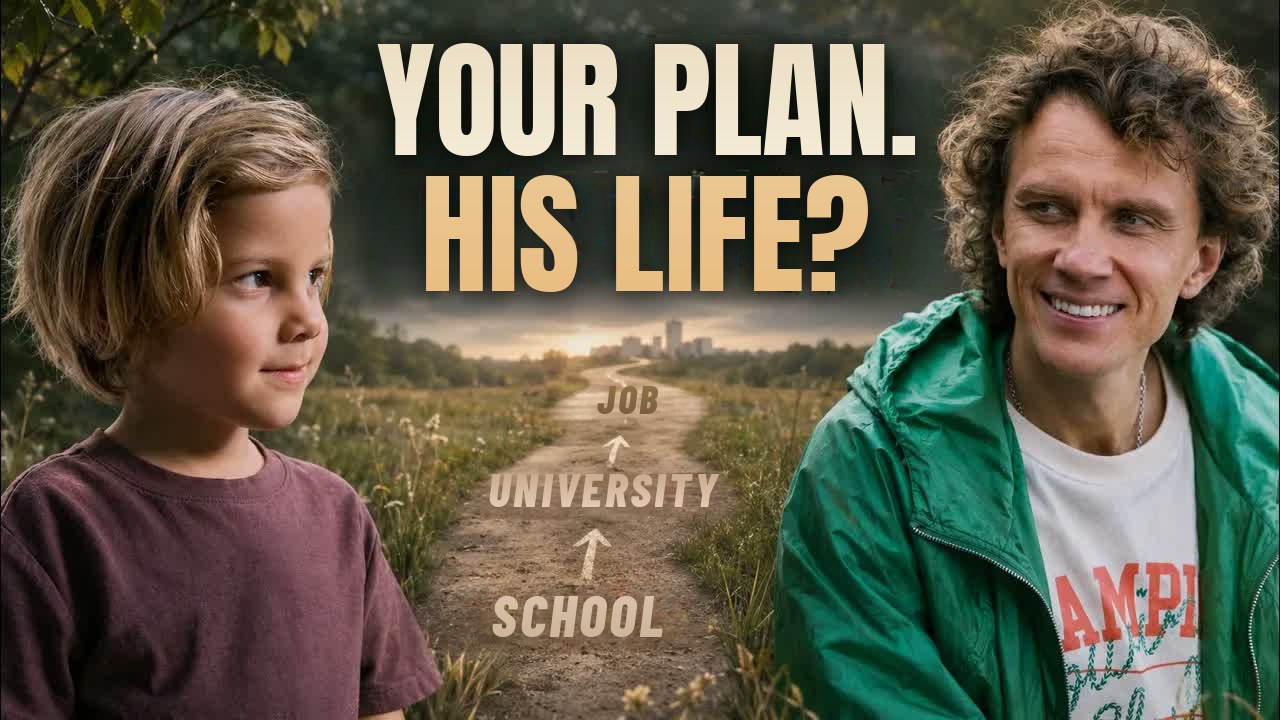
How do you choose an education for your child when the familiar path of "school, university, job" no longer gives a clear answer about the future? In this episode I talk about what parents rely on when they choose a school, after-school activities and a university.
Using my own family as an example, I look at the cost of education, student loans and the question of how to respect a child's choice while also taking the parents' own plans into account. What does it mean to help a child if their interests keep changing? And why talk with them about the real effort a dream requires, whether it's university or basketball?
Introduction. Who Chooses a Child's Path
We choose a school for our child, we choose after-school activities and a university. And it seems to us that we understand what kind of education they need and how their life should turn out. But how do we know that?
In the previous episode we discussed a similar question using artificial intelligence as an example: should a parent introduce their child to artificial intelligence? And the main problem here is that parents themselves don't understand this technology. Teachers don't understand it either, and people don't single out what goal they want to achieve with it. In other words, the question isn't whether to use artificial intelligence and new technologies or not, and from what age, but what for.
And now let's look more broadly. What does it actually mean to give a child a good education? What do we rely on when we choose a particular path for them? And where are we really helping the child, and where are we simply trying to realize our own ideas of the right way to live?
School, University, Job: The Familiar Life Plan
Imagine: you and I were born in the Soviet Union, and our parents lived within their own parents' system of upbringing, where there is a very clear, understandable life script for every person. This script is predetermined. And it's so understandable and predetermined that it's as if no other scripts exist in the world. Few of our parents truly, sincerely knew the script for raising children in Pakistan or in Italy.
And the life script was very heavily built on manipulative constructs that say the following: a child absolutely has to study at school, otherwise he'll be an idiot. He absolutely has to get into a higher education institution, because otherwise you won't find a job. And after that he absolutely has to find a job. And then, depending on their social status, parents allowed themselves to choose a worse or a better school. The criterion was this: which school to get into, a worse or better university and a worse or better job.
These are the manipulative characteristics of fear, of the ego computer, of the ego system, which simply push society forward recklessly.
Without understanding how life is actually arranged, what the causes and effects are, what will really happen, how it can affect a person's state, what is truly important or necessary for a person. Why does an impulse arise in one person and not in another?
And why does someone play in the NBA? Someone will say: "It's all clear. He just trained ten hours every day." But you and I will say: no, there are millions of children in the world who train ten hours every day, and they don't make it into the NBA. The probability of getting there is zero. You're looking for a needle in a haystack. If you set that kind of goal, that needle is a losing bet.
But in the Soviet Union the probability that what people planned would come true was fairly high. You study at a certain school, or your parents worked in a certain profession, you get into a certain university — and where everything comes from is more or less clear to you.
The Price of Education and My Daughter's Choice
And now look at what happened in the States with the student loan system. A great topic!
On the whole, I like it when there is both free and paid education at the same time, rather than everything only free or everything only paid. Both systems have big advantages — like the fully paid healthcare system in the US or the fully free one in Canada. It's the same with education.
In the States, the education system at the university level is paid. And at the same time, a very interesting concept of the loan has existed there for a long time. It is beyond, for example, the basic perception, the basic thinking of a person who was born in Belarus, like me. It's so far beyond it, Dima, that you and I never even discuss this topic. You were born in Russia, and my wife is from Belarus. I discuss this topic with her, but I see that she doesn't understand at all what I mean.
We were driving recently, and the conversation turned to the fact that Iolanta had shared a thought with my wife: she would like to become a doctor, but she won't become one, because a doctor's education is very expensive, takes a long time, and we would supposedly have to spend a lot of money — including money we could spend on her brothers and sisters. We do have four children, after all.
It's interesting, by the way, that she didn't think about the fact that we could actually also spend the money on ourselves, not only on her brothers and sisters. That's a very interesting aspect of the whole topic of money.
And I said to my wife: "Listen, she can absolutely want to go to medical school. But personally I'm not entirely sure I'll pay for that education in full." Because as of today I don't see the link — in terms of how a person develops in the world and in the US — that a person who studied for seven years and on whom roughly half a million dollars was spent is an efficient investment of money. And I don't have the kind of money for half a million dollars to be just a joke to me.
I respect my daughter's choice if she wants to become, for example, a doctor. But I'm not sure I'm ready to invest my own money or our family's money in it. Some part — possibly, but I have the right to choose.
And I can tell you that Polina didn't take this question in at all. And I understand her, because it's very hard to make sense of. You'd have to be born and live in a country where parents set money aside for their children's education even before the children are born. That's the US.
And children there are often told: "You can take out a loan, we can't provide you with the money." And the child takes out a loan, and the parent helps or doesn't help — not because they want to or don't want to. It's more a question of whether they have the money or not. That's exactly people's basic thinking: did they save money for this or not.
But my story is a healthy one. I would like my daughter to take in… And this is a huge problem in society. In the past, with American interest rates, loans and salaries, the system worked. When it was launched, getting a good law degree and paying for it, or a good medical education — long and licensed — made sense in terms of a career trajectory.
Just like in the Soviet Union: if you went to study at the Polytechnic Institute in Belarus, you then clearly ended up in a specific job, became an engineer and worked as that kind of person until the end of your days. Or if you went to study at a vocational school, a college, you then went to work at a factory and earned some money there. You could get certain grades, you could take on extra work — and you earned such-and-such money.
But take a police officer's job in America now. If you watch films, in all the films police officers are fairly poor people. Look at the average total pay of a police officer in San Francisco — with bonuses, overtime and everything else. It's insanely high! It's higher than the average salary, because they got the opportunity to earn money on overtime, on all sorts of additional details. That's how the laws were built. In other words, the system changed, and you didn't need to spend that much money on getting there.
Family Money: For the Children's Education or the Parents' Life
And that's why there's a big crisis now. And I don't hear anyone at all reasoning about this topic with a strategy of understanding: what do we do about it?
I would like to try to discuss with my child a little what a loan for medical education is and what "I paid for this medical education in full" is. Or I say to my wife: "Listen, you and I may live another thirty or forty years, maybe twenty, maybe fifty. Do we even want to give money to the children for their education? Or maybe we need the money to live with a nice view? Or to be able to travel?"
So what do we choose? To invest in a seven-year education for a particular child or children who may not go on to work in that field at all, who may like something else in a year? My daughter at the same time likes mathematics — she wants to be a mathematician — and the fashion industry, and she wants to do music too. That is, she has different zones of perception, and her focus of perception may shift.
We're not sure that this education is interesting, necessary, important and right. We don't know how her life will go. Or will we invest this money in ourselves?
Notice: I approach this question exactly the same way as the question we were asked — whether to tell children about artificial intelligence if school doesn't tell them about it. What do we do with children, with education, and ourselves with artificial intelligence?
By the way, Dima, for the first time in about the last ten years I have completely, totally immersed myself in the following approach. If I'm asked something about someone's child, I start looking for the answer only from the spiritual world — that is the basic foundation.
As Rudolf Steiner says in Waldorf pedagogy — he said it more than a hundred years ago — if you want to raise children, the teacher must be a prophet. He must see the child, see what life he will have over the next decades, what cause-and-effect connections he has, what karmic experience and path he needs to live through, how his life will be built, and help him move forward within that life. Not hinder him, but help him.
Help him be in this life, see the aspects that will lie on his path, and make decisions not abstractly, on the basis that what matters is not education but how a person feels; not how he feels but how confident he is; not how confident he is but where he lives. So as to truly know what a person will have to live through. And through what will he live it — through a loan, through money given to him, with a computer or without a computer, with an education or without?
By the way, from the point of view of the spiritual world, living out karma is a big question. I always tell everyone: if you think you've been chosen for this profession because that's how your karma goes, you are badly mistaken. You can live through one and the same circumstance in absolute poverty, in a neutral profession, and while owning your own huge business, in wealth — and at the same time you will be living through a certain cause-and-effect pattern.
And with the very same circumstances you can feel the same inside. For example, equally angry towards other people every day, or equally joyful towards other people every day.
This is a very important aspect — to feel the same.
How to Understand a Child and Help Them
And we are back again to raising and educating children. First of all you need to look at… And this is the answer about artificial intelligence, and about children's higher education, and about their profession.
The only thing you can do as a parent is to look at whether you bring an independent judgment about how the child's spiritual system is arranged, who this person is, what cause-and-effect connection they have, how their system of psychophysical development is arranged, what aspects of heredity are laid down in them.
And from there, having asked yourself this question and observing it, begin to look: how can I actually help?
Number one, of course, is action only through yourself. If you don't understand something, if you aren't able or don't want to devote time to it, you close yourself off from this question, because it's work. It really is work — to make sense of curricula. I have four children. To make sense of the curricula of my four children, you need to set aside a huge amount of time every day: to understand what they're being taught, at which school, what teachers, what details.
And so you have a choice: put time into that, or go make soup, or simply play basketball or volleyball with your child for thirty minutes, or go for a walk, or go watch a series together, or go away somewhere. That is your choice.
And here, by the way, is another story. We're discussing what Sam Altman said: that people will live to a hundred. Can you imagine what concept that destroys? It destroys people's worldview about how children should treat their parents in old age.
Today we live in a very mixed world. We consume information in our country of residence from completely different sources and at the same time keep saying that we have a passport and are tied to some nation or country. At the same time we watch films from another country, use social networks from other countries, watch and listen to people from other countries, apply educational methods of other countries or other people, of a different outlook, of other faiths, other souls, other spaces. One could even say — of other spiritual systems and other hierarchical spiritual systems.
This is an incredibly interesting time to study. And an incredibly difficult time for a person, because today a person has received a system of perception and a level of soul at which he is capable of reasoning.
At the same time he is in incredible dependence, in the grip of the ego computer, living among darkness. And at the same time he is capable of generating light from within himself.
There are simpler systems, where you simply perceive everything, and you have no freedom. Three thousand years ago you don't perceive everything, but you perceive much more. There is no freedom, because there is no structure of the soul that wants something special of its own. The system is very rhythmic.
And that's why I like to give as an example countries such as the Soviet Union — not even countries, but such territories, such concepts. These are places where freedom is absent. But times change too. Because if you and I look at the American education system — is it freedom or exactly the same dependence?
Information Chaos and Freedom of Choice
Now information chaos has arrived. On the ToTheMoon channel, Max Grigoriev and I recorded a video about safety in artificial intelligence. And, talking about chaos, he said that any chaos can bring positive things and at the same time can bring negative ones. For example, the chaos of war, when two countries are fighting, is always negative, because a great many people will die there. But the chaos of current artificial intelligence, in his opinion, will be positive. Clearly a huge number of people will suffer, but overall this chaos will have positive consequences.
But notice: this is not the chaos of freedom, it's just chaos. It's not the chaos of freedom, of movement and of a person's true perception.
And what should this person truly do?
Yesterday evening Iveta came into my room and said: "Dad, listen, my computer broke. Have you looked at it or not?" I say: "Not yet." And she says: "What if the computer won't work?" I say: "What does that have to do with it?" She says: "Well, maybe you'll buy me a phone then?" She's twelve, and she doesn't have a phone. So she has her own plan, you see?
And here's a new topic for me: to buy her a phone or not. An endless topic for reflection. On the one hand, it's negativity, danger and questions. On the other hand, perhaps it doesn't matter at all — whether she has a phone or not, whether she plays games or not. I know a great many people who are great at playing games and build whole worlds in Roblox, but who are at the same time absolutely lifeless in terms of their own lives.
Basketball: Helping a Child See Reality
Here you always need to raise the point: what are you actually trying to achieve, what do you want?
And when I tell my son about the NBA — that if you want to make the basketball team, you need to play three hours every day or, as you said, ten hours — I say it not so that he gets into the NBA. But so that he gradually begins to treat certain things with an understanding of reality. So that he understands how life is actually arranged. So that he doesn't close his eyes, and so that I don't hide the truth from him — first of all because I'm afraid to look at it myself.
After all, a huge number of people in the world see spiritually: they see spiritual elements in the etheric space, perceive astral worlds, see the past and the future, see their own lives that have been. But if a child comes and talks about this to their parents or at school, they're considered crazy. People don't want to talk about it.
It's not a question of whether aliens exist. The children here at home were discussing it for a couple of days… Do you remember what Polina said yesterday? The children asked whether it will be possible to go back to the past or the future in a time machine — because of the film "Back to the Future." And my wife says: "Well, since they've made a flying car, nothing will surprise me." But I can say the following: no. You won't go back to the past or the future. And it's not a question of a flying car.
And when we talk about aliens, we want to talk about them in the language of the scientific world, so that the child then goes to school to discuss, like everyone else, whether or not aliens landed somewhere in the state of Utah, three or four hundred kilometers from here, or somewhere in Mexico, at some secret bases. But this is a question of discussing another world, not a scientific, physical or material discussion of aliens. That's why I don't discuss topics like aliens with my children.
I can discuss it with them separately if they come and ask: "Dad, did you really say that people don't die after death, that they have time between death and birth, that a person has a past life?" I'll say: "Yes, of course." But it will have nothing to do with aliens.
And it's exactly the same story: why I talk to my son one way or another when choosing a sport or when discussing artificial intelligence.
🎥 Video for this article
Original video · Russian audio