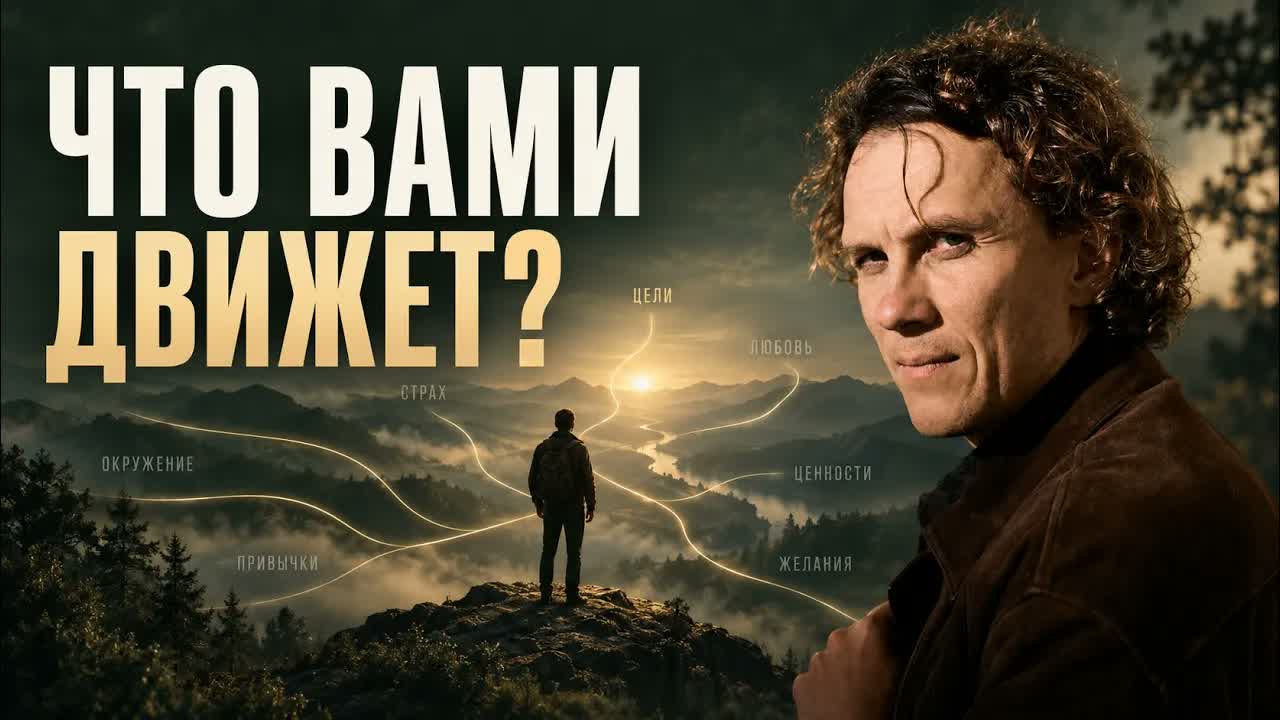
When we talk about dependence, we usually think of alcohol, cigarettes or social media. But do we always notice what controls us in other areas of life? In this video, I look at dependence from the perspective of spiritual development: where habits and impulses come from, what role society plays, and why even what a person considers freedom or their own choice may call for a deeper look.
Can a person consider themselves completely free and at the same time act every day on impulses whose origin they don’t even understand? What does society shape in us, what do we bring with us, and what arises during our lifetime? How do you tell a free impulse from dependence, and why is it important to look not only at the habit itself but also at its source?
Where dependencies and habits come from
There is a very interesting premise in this question: it is believed that the consumption of alcohol and the very existence of alcohol, of supposedly bad habits, social media, reels, the existence of murder on Earth or the hunger for money — all of this was shaped by society. As though it were very important that a human being did this. And not just important: as though it should even evoke a certain pride or a certain excitement — a human being did this.
Is there really a person in the world who created alcohol? Is there really a person who created the technological world? Or a person who started wars, murder, some form of violence against other people? Did some particular person really start doing this? Nobody knows that person. Although notice: people constantly try to pin something on someone and say that this person is the creator of telephones, this one the creator of artificial intelligence, this one the creator of certain economic laws, this one the creator of modern medicine, and this biologist discovered certain things in biology. They try to pin it on some individual. And when they can’t pin it on an individual, they say: basically, it’s society, people did it.
This is very interesting. We will now look at what “people did it” even means, because this topic actually lies at the root of humanity’s current movement, at the root of how all of this is perceived.
Once again: four thousand years ago, a person did not think that if I have a particular habit, then people created that habit in me. Or that if I have a particular habit, then my parents created it in me.
My sister and I were driving — she had come to visit me in the States — and we were discussing an interesting topic: that from time to time help from different people is very important for a person. For example, a person goes to a psychotherapist or an osteopath, works with their body in some other way, or discusses some subject. And sometimes you want to come to a person and keep to one particular topic with them. Actually, this topic deserves a separate video, but I’ll note it here.
For example, if you go to an osteopath, osteopaths often start adding things while doing a certain procedure: “You have tension in this part of your body — that’s your mother. And the tension in this part of your body — that’s a relative, a sister or a brother. And this part — that’s your ancestral line, those who have died.” That is, they make certain connections. And my sister and I talked about how sometimes you want to find people who don’t add anything: a person has come to you, and they work in a very narrow category, on a very narrow task.
And the more we explored this topic, the more we saw that it is present everywhere, not only in osteopathy. If, for example, you turn to nutrition science and start working on your diet, you will be told that a huge part of your body and your test results inside your system functions depending on whether you are nervous or not. And they will start giving recommendations: you are probably very nervous, so you need, for example, to do a meditation.
Or imagine you meet a person who helps you with your outward style, and they start describing what style would suit you in terms of clothing or space. And this person may start adding aspects that are not just about style, saying: “Listen, it’s important that you develop a certain set of qualities in yourself.” That is, they start moving into psychotherapy, adding elements of psychotherapy. And you yourselves know a huge number of trainings where people, while teaching business, move into additional aspects of a person’s life, go broader.
The spiritual world is real
So, four thousand years ago in Egypt, if a person felt a state of anxiety, they would not say their mother was to blame. They knew they had had spiritual past lives — this is four or five thousand years ago, not two and a half or three — and within those past lives there are reasons why I may feel this way. A person knew that the spiritual world is real.
And when there is a spiritual world and you truly perceive it, you understand that the current life is a component of this spiritual world. The world is the spiritual. You don’t even need to use the word “spiritual” there. Physical, material world — please, let’s use those words, but the word “spiritual,” in terms of spiritual life, you can leave aside and simply say that this is life.
And then it is obvious that there are causes for the emergence of particular events or things. Not just why you, for example, decided to drink alcohol, or why a person decided to watch a series every evening, but the very fact of where this phenomenon comes from. Who brought this phenomenon? What energies brought it? Why is this phenomenon on Earth at all?
From the point of view of describing human development, illnesses are necessary for a person so that the spiritual system can heal. Just as death is necessary for the spiritual system to heal. If there were no illness and no death, a human being as a spiritual being would be utterly destroyed, would disappear. Perhaps not even disappear, but undergo some transformation. This, by the way, is a very interesting aspect to observe: you and I can observe it in meditative states.
And is the dark spiritual world — if we could divide it that way, the side where Ahriman and Lucifer are — are the demons on that side interested in all people becoming demons, becoming the demonic world and serving the demonic world? Because then what would Ahriman and Lucifer be seeking to the very end? What do they want to find at the endpoint, what are they seeking at all, what do they want to obtain? After all, they have plenty of legions of dark hierarchies of spiritual beings and people, including those absorbed by that world, and they have very serious power over all these beings and people. Maybe that would be enough for them? Or do they need the world of light? Or not? We won’t go now in the direction of it being needed for enslavement or for labor. That would be strange to analyze.
Spiritual treatises say that Ahriman is waiting to destroy the Earth. They even describe the movement of meteorites: directing a meteorite to destroy the Earth or the system where people live. So fundamentally this process is deeper in terms of everything that is happening, if you look at such an extreme.
Is difficult experience always necessary for development?
But still, if we say that illness and death allow a person to heal, then how should we relate to different habits or phenomena in a person’s life at all? And what is the source of what? Illness is not the cause and, on the one hand, not what the dark world carries within it — the world that keeps a person from developing or restricts them on the path of development, those systems, beings, realms, that time, energies; you can call it whatever you like. Although illness and death did appear because of the presence of these energies, because otherwise a person would have started to become infected and to sink in all the realms.
And people often use this construct to justify themselves — it’s like a karmic justification. A person says that if they are doing something bad, it is experience that will allow them to gain something later: “I’m probably not getting this experience for nothing, but so that I can gain something later.” You have heard this phrase countless times.
Although you could tell that person: “Listen, you are suffering now not in order to gain experience, but because you did very bad things. And if you hadn’t done very bad things, these events wouldn’t have happened, and you wouldn’t have needed this experience.”
There really is a process of a person living through different states that brings benefit in terms of their development. And there is a process that is merely a chain of cause and effect.
We understand, after all, that not all incarnated people have ever killed anyone. Not all. This is clear even from the number of people living on planet Earth now, at this moment. If you add up the number of people who lived before — precisely in terms of numbers, to the extent that science can add it up — the formula will in no way add up.
The different forms through which dependence shows itself
So when we approach things such as dependencies — alcohol or social media — or say that the technological world is a plus or a minus, or discuss current political systems in terms of the state of power, or the division of people by nation, way of life, country at all… The very fact of dividing people is, after all, also a crazy dependence.
What is a person more dependent on? On their perception of other nations, of people with a different skin color, with different physical bodies? Or on alcohol? What are they really more dependent on in terms of the information being transmitted to them?
I was recently in Europe with my friends, and when they referred to people from other countries, they used words that you can’t use in America. Not because they have a bad attitude toward people, but because that’s how they were taught to speak. What’s more, those who live in the US were also taught to speak the way they do, because that’s the trend now. It is a trend. A hundred years ago people spoke completely differently. Open films from a hundred years ago — American, European or Asian — and you will see different approaches, a different culture, different circumstances, different details altogether.
When we talk about dependencies, it’s always a very interesting question. For example, why, if you come to America or Europe, will there be far more fashionably dressed Asians? People from China arrive much more fashionably dressed. You can’t say they are all fashionably dressed, but there are many fashionably dressed people among them.
I remember this effect from Guangzhou. I was there for the first time, I think, in 2011 — fifteen years ago. And I remember my impression of the shopping — brand shopping, expensive brand shopping: how the Chinese themselves behave inside these stores and how it looks from the outside. It looked very massive. Not exclusive, but truly massive. And it’s not because there are so many of them. Someone might say: “There are so many of them.” But we understand that stores are limited by space overall. And in these countries, in China, there are very many stores, and fifteen years ago there were many stores too. So what energy is in these people? Why do they have this energy?
Or my nephew is visiting me now, and every day he dresses as though he is going on show, really on show. This is already fashion, really strong fashion. It’s not stylish and not fashionable — it’s fashion. You could call it roughly that, because fashionable is one category, stylish is another, and this is a whole mix. Serious fashion. Although people in fashion may say that it isn’t so. Or for someone it will be tacky, wrong, a misunderstanding of styles. But clearly the person lives in his own world of perceiving outer space and image: what he’s wearing, how he looks, what he carries, how he expresses it, how he shows it.
Freedom or another dependence
This, by the way, is a very interesting aspect. Can this be shown through other aspects of life, in particular through spiritual ones? Can it be expressed? Because society has taught people to separate: you draw, you program, you sing, you wear clothes. Everyone has been separated.
But few people have been told that this energy exists and can be directed in different directions. You can direct this energy simultaneously into physics, into studying physics or scientific research, and simultaneously into fashion, and simultaneously into some musical art — exactly the same energy — and express it there.
So is this dependence or independence? Or is a person’s dependence the fact that he doesn’t hear the world and wears leggings every day? Is that dependence or, on the contrary, independence? Look at how modern society describes it: as the absence of dependence. Right now there is a very strong trend saying that, on the contrary, this is a person’s freedom, that the person isn’t tied to this.
So is he not tied to it? Or is he, on the contrary, very strongly tied to it, unable to live any other way, not understanding what something else is, not feeling these energies, not hearing them, simply not having them? He is limited in terms of his actions, his possibilities. So what is it?
Energy that creates itself
When we discuss dependencies and say that this is a social process, it is very important to understand that these things have root-cause energies. These energies need to be sorted out and examined: was this energy pure originally, has it become distorted now, have certain worlds captured it?
I want to tell you that an enormous amount of energy in the world has been captured and transformed. For example, the way the energy of metaverses or artificial intelligence is transmitted now. It is a transformed demonic structure, but it is transformed energy. There is a very serious pure impulse in these energies. Can it be used for something other than good? It can. There are countless films about that.
I was just flying on a plane and watched some new, modern film about artificial intelligence. In one case, a man wanted to create an army of artificial intelligence: to take everything from games, from the virtual world, and print it in the real world. And another company brought equipment from the virtual world for healing people, various systems to help with agriculture, with nutrition. So some bring a negative aspect, and others a positive one.
There’s a good film — what is it called? You’ll find it. A huge ship arrives — I also like that actress — and they pass on a technology so that people will help them a certain number of years later. Can this technology be used negatively? Of course, such volumes of knowledge can be used negatively. And they can be used very positively.
I want to say this: since today’s artificial world, today’s technological world talks too much about the negative aspects of using technology, they of course also carry a negative impulse. And today’s artificial intelligence is, after all, a self-governing, very serious energy. And precisely in terms of dependence, Olya, it’s important to understand that this energy is not created by society.
That doesn’t mean it shouldn’t be studied. On my other channel I actually made a long video on this topic — specifically from the point of view of personal development: what to do about studying artificial intelligence technologies. And I have a separate channel about artificial intelligence and technology themselves.
I keep saying that these energies need to be studied, but you and I must know absolutely clearly that this is energy that creates itself.
If it can be called energy at all. Because these are energies, worlds, realms, beings, sources, causes, time, not-time — all at once. The universe is an extremely complex set of everything that could possibly exist. An extremely complex, very specific set of everything that could exist.
Imagine a person has become dependent on this. Let’s say society is dependent, or a person is dependent. But does a person really have the possibility of stepping back from it? That’s exactly what your question was about: what is this person to do? This is what we are coming to. What, then, should a person do?
Can death be avoided?
Why did the circumstance of this dependence arise? Why did a person fall into it? And are there things a person can avoid falling into? For example, people today all die. People have been dying for several thousand years. That’s right, they die. This is very important. They get sick. Absolutely everyone dies. There is no one on Earth who has lived fifteen hundred years — at least, you and I don’t know of such a person. But we could allow for it: from the point of view of spiritual science, of studying the spiritual world, one can always allow for it. I calmly allow for it, but basically everyone dies.
This means that everyone is in this dependence on the world. Just as everyone is dependent on causes and effects and karmic influence. Each to their own degree.
Can death be avoided? At the moment — no. Basically no, given the current structures of bodies and everything else. What’s more: if you could avoid it, would you want to live? That’s a big question. In general, this line of reasoning is very interesting, very. One could also make separate episodes and separate meditations on this topic.
Would you want to live once you received boundless possibility from the point of view of the spiritual world — or what is considered boundless for the material world? Would you want to live here, in the material world? Would you even have such a thought — to want to live?
Because basically, from the point of view of the spiritual system, your spiritual being has a tremendous attachment after death: it wants to return to the physical body, but there is no physical body. Due to certain energetic dependencies. But if you look further, the reincarnation of a spiritual being is a process that, on the one hand, seems to be the spiritual being’s desire to return to one and the same realm. And on the other hand, it is merely a consequence — so that a person develops, moves forward. And basically what wins there is independence from the person’s wish to live and to incarnate.
Find even one spiritual system that would describe a thirst for life. Find one. Some clubs, perhaps, some religious orders, I don’t know, will say that you need to live a long time. But it is modern society that says you need to live a long time.
And here is the question, Olya: where does this energy come from, the one that has developed, for example, the concept of biohacking? What is biohacking? A person already wants to hack both biology and the physical world. The brain is already saying it is so smart that it is about to hack everything. Hack itself. It wants to hack itself. The ego system and the personality want to hack themselves. The dark forces laugh at this. They smile. What else is left for them to do? The forces of light, by the way, may also smile at this — at this lack of development, at this boring idea.
How to look at your habits and states more broadly
This chain of reasoning allows you — in terms of your specific dependencies, your specific states, specific social phenomena, your specific life — to come to a sober state, a state of expanded perception, and to observe your children in a completely different way. Because that’s much easier. It’s very hard for a person to grasp their own life in terms of the movement of time. Very hard. But redirecting your material gaze outward, to your children, and watching how different causes and effects play out for them — that’s very interesting.
Here’s a story that just happened. A few days ago we were coming back, driving along our street. There are five to seven houses here, but the street is long, maybe a kilometer. We’re driving along it and see my older son, who is ten, coming out of one of the neighbors’ houses. We roll down the window: “Igoresh, hi! What are you doing here?” He says: “I’ll tell you later.” And walks on, looking very pleased. We drove off. And in the evening it turns out that he had gone to the neighbor’s house next door — to an old lady who is eighty-something — and said: “Would you buy a drawing from me, for however much you like? Buy any drawing from me.” And he sold her that drawing.
He comes back, I hear this story, and that evening I happen to be talking with my sister, Anya, and I say to her: “Anya, can you imagine how one could even make sense of this, evaluate it? What do people think about it?”
- Someone might say: “Why did you go and bother the old lady?”
- Someone might say to themselves: “Good for him, he has an entrepreneurial streak.” That’s the current trend.
- Someone might suggest to him: “Go to the other neighbors.”
- Someone might say: “You should have given it away for free.”
- Someone might start worrying that he is anxious about money.
- Someone might start rejoicing that he is anxious about money.
Can you imagine how many different states and emotions can be seen here?
The best thing to do here is not to let your brain debate this topic at all, not to discuss it at all. It’s pointless, it’s simply pointless.
You won’t be able to grasp at all the set of energies that lives in such an action. What’s more, it is merely an action.
I tell everyone that a person can fulfill their karma both working as a server in a café and working as the director of a company — in one direction or the other. Everyone thinks that if a person is the director of a company or has some kind of business, they are probably fulfilling some serious karma. Who told you that? Who came up with that at all? A person can live through the very same states. Whether they live in a big city or somewhere on a remote farm in the countryside and hardly see anyone — in terms of living through certain states, they can live through, and fully live, what they need to live through.
And such actions can, after all, be seen only as dependence — you’ll agree, from society’s point of view, for example, as dependence on money. Or they can be seen as open energy for freedom of communication and of a person’s life, as a huge open impulse that is, on the whole, quite healthy. A person came and said: “Wouldn’t you like to take my picture?” And on the other side there was the old lady, who could have said: “I don’t want your pictures.” Or: “I’ll take it for free.” She could have said: “Listen, here are two dollars, but I don’t need the picture.”
Can you imagine what causes and effects this could have turned into for the person next? She might not have been home. He might have tried once and stopped doing it. Or she might have been in a certain state and passed this state on to the child — after all, she could have passed on to him her perception of this event. We don’t even know how that person perceived this event.
There’s your social phenomenon.
A person is first and foremost dependent on defining such events wrongly and acting wrongly in relation to them. That is what a person is often far more dependent on than on the habit of drinking coffee, smoking cigarettes or something much worse — drinking alcohol.
After all, what matters is the impulse with which a person does this. Is it an impulse of freedom — and he knew that such an action can be done only through an impulse of freedom? Or a desire for support, for help from the surrounding space? Or is it energies that came to test something in him? Or is he himself testing certain realms?
It’s a great test, after all: go and sell, then sell for a high price, then not sell at all but give it away, then not do anything at all. We would all call these great tests.
But people aren’t interested in tests. People want a result. People want not a simple life, but a particular result, a particular life, particular circumstances.
And at that moment darkness penetrates and captures the person, captures their consciousness — the consciousness of a soul unprepared for particular causes and effects, for particular dependencies.
🎥 Video for this article
Original video · Russian audio