
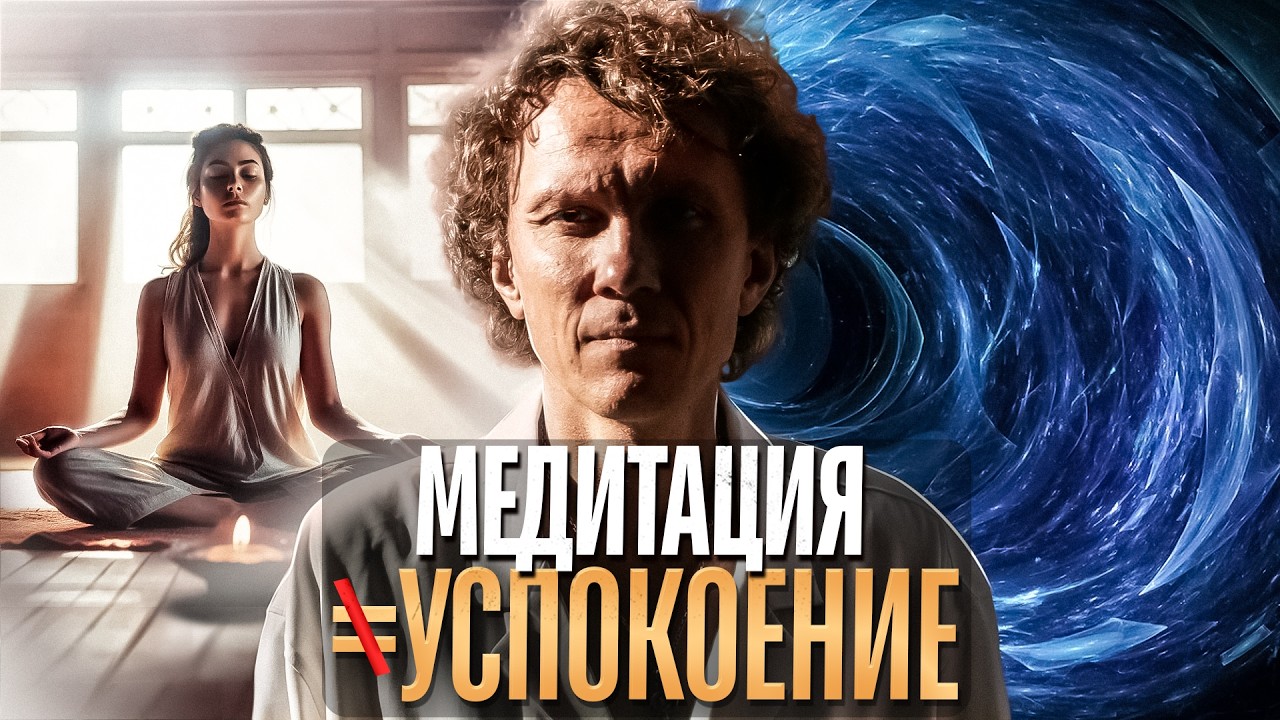
In this conversation with Galya, I answer her question about how my meditations differ from others. To answer it, I first look at what a person actually means by meditation, and why entering a state of calm and moving into a state of expanded perception are different, incomparable things.
We talk about why there is nothing worse than coming to meditation for a result, what it means to begin knowing the truth about your life, why immersion takes impulse and energy, what is actually worth comparing when you choose a meditation and the person who leads it — and why the very act of comparing begins to destroy.
What a person means by meditation
– How are your meditations different from others? When I tell someone that I watch meditations, or invite them to one, I can’t find the words to explain why they absolutely have to come to yours. People are used to meditations being for calm or something like that. And when they ask, “So what happens there?” the word that always comes to me is: “There is truth there.” It’s an explanation of sorts, but it’s impossible to explain what I mean. What would you say to that question: how are your meditations different from others?
– First, it’s worth saying what a person means by meditation. I talk about this a lot on the channel, and I want to explain once more: there is a big difference in how people perceive the word “meditation.” When you describe meditation to people, you mean one thing, and the other person understands something completely different. That is why they ask how meditations differ or what is special about these meditations.
If you ask this question from the standard understanding of meditation — and if we read what meditation is, it will say that it is some activity that brings a person to a calm state, some kind of “spiritual connection with yourself” — then you get some abstractions, aimed mainly at exercises. It’s like what happened to yoga: yoga ended up becoming physical exercise. And meditation, if you look at it, is an exercise for calming down.
Just yesterday, I think, I was recording a video for the channel — probably this one, maybe the second one — and I said that on a band such as WHOOP, meditation falls under recovery. In other words, a person is essentially supposed to calm down, to enter a calm mode.
That is how society defines it. And if we classify meditation only as recovery of the physical body, then what does a person want to compare? What are they comparing at all? The music they like, or the person they listen to, or the fact that there are no people there or there are some images, or that for this meditation you need to put on headphones, go to the ocean or sit in a certain position. They compare external characteristics and want to find the differences by them.
What is the person basing this on? When you talk with them, it’s as if you were from different planets. They ask about external factors that you never intended to explain. You don’t say that the meditation is led by someone with a particular image or appearance, that there’s a dog of a certain color in the background or children running around, that the person has a family or doesn’t. You say that none of this matters: they can lead it in a basement, outdoors, or by the ocean.
What difference does it make? It doesn’t matter at all. It’s simply an additional aspect — let’s call it that — which, by the way, can even get in the way. I’m sitting here with a very beautiful view and the sounds of nature. And those sounds of nature can even get in the way of general recovery.
Meditation is a state, not an action
If you approach meditation from the other side, meditation is a state. A state, not an action: a person is in expanded perception.
Or you can call it an action — when a person strives toward that expanded perception. Although “strives” is a very relative word.
There is nothing worse than coming to meditation in order to get a result.
Yesterday I was leading a meditation in our group, and during the meditation I said that certain states were happening. Not everyone was connected with that state. And one person sent me a private message: “I felt that it was me.” That is what’s called wanting to attain a certain state. If there’s a desire to attain a certain state — that’s it, dead end. If, because you felt you didn’t connect or you don’t see what is being described, you start having some kind of problem, that is exactly a crazy block.
If we see meditation as a certain state, then the meditative state should essentially be present in your life all the time. It’s not some separate special moment that happens together with another person or when you’re alone, when you must be sitting, standing, lying down or crawling, when you’re in a quiet space or a noisy one, at work or at home, in a park, simply in town, in a coffee shop. Meditation isn’t tied to these circumstances: a meditative state can switch on at absolutely any moment of life, including when you’re watching television.
I remember that in one of his reels Sadhguru talked about the meditative state — I think he gave samadhi as the example. Samadhi isn’t simply a meditative state; it is one of the states of a person’s rather strong, deep immersion, of connection with their spiritual structure or with various structures. I don’t want to go into a precise description now — it would turn out theoretical. But he said that you can enter samadhi while watching television, simply a movie. That is, you have entered a certain state of silence and calm. The question is whether a person knows how to notice it.
Or a person notices such states only when they’ve been sat down on a chair, and they say: “Yes, I’m feeling something now. I’ve relaxed.” But obviously, if you’ve been somewhere with lots of snakes and flies, and then you’re simply put in a dark room and given tea, you will relax too. Can you call that meditation? Or you’ve worked fourteen- to sixteen-hour days for two years, then someone takes you away, sits you in a particular space and puts on music that balances the physical body in any case — obviously you will relax. Is that meditation? Again: that is what modern society has named meditation. I certainly don’t call it that.
So, the first difference. Although “difference” already implies some kind of comparison, and I don’t think comparison makes sense here: comparing the notion of expanded consciousness is meaningless altogether. But here is the difference: here we are talking about oranges, and there about ants. These are completely different, incomparable phenomena. They can’t be compared in their very essence, because entering a state of calm and moving into a state of expanded perception are different things.
You begin to know the truth
Now let’s move on to the next, most important aspect. After all, we’re not talking about simply moving into a certain state of perception, but about beginning to perceive your life. When a person begins to perceive their life, the very flow of life and the presence of energy in it change. It’s not that life itself changes — everyone wants to change everything all the time, and for the better, too. But the sense of this life, the knowledge and understanding of it, change. You begin to know the truth. That is very important.
In material terms, knowing the truth means knowing that this person thinks you’re bad, that one stole something from you, and this one thanks you every day, but you don’t hear it. This person has hated you all your life, and that one set you up. This one carries kindness toward you in their heart, comes to you out of kindness and brings you gifts out of kindness, not out of ego. This one wants to manipulate, wants to take advantage, that one was unfaithful, and this one will die sooner than you can even imagine, and you will suffer because of it. Here you will lose, there you will gain.
Expanded perception is not knowledge of the future; it is knowledge of the present moment, of what is happening at this point in time.
Of course, to some extent this also includes knowledge of the past and knowledge of the future. But the most important thing is understanding the truth here and now, a real understanding of now. For example, that I feel bad right now not because the sun isn’t shining, but for other reasons. Understanding the real aspects of life, causes and effects. And most importantly — confronting the reality of your own personality: knowing what I actually feel, what I want, what kind of person I really am and how I relate to other people.
There is a whole range of perception here. If a person truly understands what they carry and what they do, understands it genuinely, and understands it out of love besides, they will not feel very good. From the point of view of material life, as it is usually described, they will not feel very good. That’s an important aspect. From the point of view of development and knowing the truth, it’s a great miracle. But from the point of view of basic life, people don’t want to experience such states or enter them.
So it turns out that we’re now talking not simply about expanded perception, but about knowing the truth — about the fact that truth is happening now. This is the fundamental layer we can talk about at all. And then, when we compare, we can ask ourselves: am I right that I can enter meditative states in my life at different times — including while sitting in some professor’s math class, watching television, planting a flower in the garden, talking with my manager, or simply contemplating, looking ahead at a wall?
Yes, you can arrive at these aspects of expanded consciousness. The question is whether you do arrive at them, and how far you can direct this expanded consciousness and drop further, into the next layers.
Developing spiritual organs of perception
There’s a very important range here. A person simultaneously perceives a huge number of different layers: some are active, some are not. You’re sitting here now, and you’re hardly feeling your esophagus or larynx at this moment. But if I shift your attention, you’ll say: “Oh, there are some sensations there, or I ate something that didn’t agree with me” — and you’ll begin to observe it.
We shift our consciousness and develop spiritual sight, entering expanded consciousness, expanded perception — and expanded perception is fundamentally possible through developing spiritual organs of perception. These are not the organs of perception with which we simply see with our eyes, smell, touch. You begin to see, hear and know things that are not subject to material explanation from the point of view of the physical body.
And expanded perception is, of course, the development of these organs of perception. This is a very important aspect to understand. What for? That is the whole point of expanded perception — for you to begin seeing areas that are fundamentally out of reach for your ordinary gaze. Out of reach.
Compared with ordinary sight, expanded perception is as if you had been given binoculars. But here you are given a new organ of sight or a new organ of knowing, which is no less important. After all, you can learn something because you watched this video, or you can learn it simply from different worlds — I won’t go into exact details now — from different ranges of worlds, of time, of timelessness, from different areas of perception. You simply know it. Somehow you know it. Just as you sometimes know that a person will die tomorrow, that someone will fall ill, or that you’re about to see a red or a blue car. You know — and don’t understand where this knowledge came to you from.
Here you begin to see it more, perceive it more, understand it more, and you encounter other ranges of perception. But these are only echoes of the true things that happen from the point of view of expanded consciousness.
The basic, fundamental task of a person in expanded consciousness is to know what is actually happening, and thereby to perceive themselves as a whole.
I’m not even going further — into developing this wholeness in a certain way or along a certain path: connection with solar energy, building certain spiritual bodies and everything else. But basically, if you have expanded your perception, you have the opportunity to move toward this movement more consciously. That’s the important aspect — more consciously. For the most part, you will move toward it anyway. You’ll go through forests, roads, pits, certain worlds, deaths, new births. So there’ll be ten extra deaths — what difference does it make? You’ll simply move toward it along some path of your own.
And there is no concept of “higher.” If you look at certain areas, in the radiance of your spiritual being there is no concept of “right” or “wrong” at all. It’s so relative — incredibly relative.
When you move into the zone of expansion, of forming the organs of perception, of sensing your wholeness, you move into the phase of forming your spiritual bodies. There are some things that can only be done by perceiving. Then you move into a layer where your spiritual system, your spiritual being, begins to develop not only on the plane of material incarnation, incarnation in a physical body — it develops as a spiritual being in its own right.
Does a person have a foundation in the spiritual world?
And here is the paradox, Galya. The people you talk to, the ones who will be asking — the modern person who asks about meditation is not interested in two factors at all. First: they live in the material world and do not rely on the spiritual world being primary. They don’t. However much they think they rely on it, however much they believe themselves, however much people talk about how they meditate, in most cases what matters to a person is the physical world. It matters.
You can ask simple and difficult questions. Are you ready, for the sake of truth, for your child to die right now? You can also ask about dying yourself right now, but there are even more wrenching questions. It’s a stupid question. But through this stupid question, if it is asked from truth, you can look at yourself truly and say: “Listen, for now I’d like to wait. For now I don’t understand what is meant. For another person to die — I’m ready. My own child — no.”
So the question is whether a person has a foundation in terms of the spiritual world. I’m not saying this so that anyone should die, but so that you understand at all where you really are and what you live for. This doesn’t mean you can’t live for your child, for your wife or husband, for a tree in the street, for a flower, simply for ordinary work. There’s no question about that at all. It’s a true, normal, natural intention. If you also add your attitude toward other people — looking at how you treat them out of purity, out of love, out of compassion, from the heart, forgetting about your personal interests — that is more than enough.
But here we’re talking about a slightly different layer. Number one, paradoxically: a person doesn’t rely on the spiritual world but on the physical one, and believes that there is the physical world, while the spiritual one is some possible illusion off to the side. For them there’s no such clarity in it as in the fact that I have two eyes. Then discussing reality with this person is pointless. It’s the same as discussing the variety of color ranges with someone who can’t see and arguing with them about whether this tree is green, orange or gold.
It’s simply pointless. Why start such a discussion at all? A person who doesn’t perceive colors, who has no eyes, will try to prove to you: “I hear a sound, I see that there are ten cars ahead.” And you tell them: “Those aren’t cars, that’s the wind blowing.” It’s an absolutely meaningless discussion. You’re relying on different points of perception.
The second important area is people who at least partly rely on the spiritual world or live in the perception of the spiritual world. Here the question is what matters more to you: your spiritual life as a whole, or your current living of thirty, forty, fifty, a hundred years — your current incarnation. Can you rely on the wholeness of your spiritual life and perceive your true path, in which your current life is fleeting? That doesn’t mean it isn’t important. At this moment, in this video, it has full, one-hundred-percent meaning — for recording this video and for our conversation. But for your personal path, the path of your spiritual being — or mine — it is some part of the path. Not that it is meaningless or useless — of course not. It’s simply a part.
How can you compare meditations at all?
If a person doesn’t carry this construct within them, how can they compare? How can you compare meditations at all, then? In many meditations — I have series of numbered meditations — I often say that this develops your spiritual system and your spiritual being. But why does a person need to develop their spiritual being? Why develop the spiritual system? Why develop many things that have nothing to do with their life?
I’ve traveled a lot in my life on various spiritual trips — they’re called by the word “retreat,” or loosely some kind of retreat. On some of these trips there was a purposeful acquisition of certain spiritual knowledge. And in that setting, the teacher or the person organizing the trip says, quite cautiously: “Well, the main group, of course, won’t experience anything. They need it for their next lives.”
In general, it’s a big question whether there’s any point in comparing anything. What is a certain energy for this life or for the next one? What is it? After all, “for the next lives” is still a kind of embellishment of the fact that someone received something for their current life. I’m not picking on anyone, but on the whole it’s a kind of embellishment.
So I received some energy here and now — so what? It’s as if another tree had been planted on my property. Well, it was planted. It makes no difference to me either way. Just another tree. What difference does it make, what has changed? Or as if I had one more car. Fine, I could drive a different car on some extra day. Does that have any influence, bring any change? A very abstract one. On the one hand, it seemingly could make a substantial one — if you crash in that car. On the other hand, it may simply be another tree in the garden.
This is also about why people keep practicing certain methods or meditations intensively or, on the contrary, give them up. It’s like your ability to perceive different trees in the same way every day — to see life in it every time. Because it’s simply the movement of life, and you contemplate it, including from the point of view of the spiritual world. That’s why comparison here is very relative.
What would I compare, Galya? I would ask the people who lead meditations: “Why do you do this?” And that’s it. Or the person who goes there: “Why do you go there?” And when the person says why they go, I would ask further: and what does the one who does it say about this? Why do they do it? What do you receive? And then I would compare: I have told you what I receive, and another person — what they receive.
Comparing is very relative, especially meditative practices — when we say that consciousness can expand while watching a movie. Not that it does, but that it can. Or while talking with different people.
But still, if you’re comparing and choosing something for yourself, compare what the person wants to bring you. Hear them: try to hear them a little more, don’t limit yourself.
And when you hear a little more, you’ll immediately see what matters to that other person. Why are they doing it? I’ll point out, by the way: people can do this simply for money — organizing a space. Yesterday we recorded a video about retreats, about the word “retreat” itself, and I read what a retreat is. It’s an internationally accepted name for an organized event — aimed mainly at a spiritual trip, at searching for yourself, at a gathering. It is an organized event. That means absolutely anyone can organize such an event, and they won’t be deceiving anyone. The question is what the person then exaggerates, what they carry behind it, what they try to show through it, which aspects and meanings.
Immersion takes impulse and energy
If you really want to compare — imagine, Galya, a person who can’t see. You tell them: “We need to go into the green room.” And someone else says: “We need to go into the blue room” — or the yellow one. How can a person who can’t see make a comparison? They need to go there, and go more than once. How else can they compare, how can they truly come to it, realize it?
The fact that a person went once, sat there and felt light and great says nothing at all.
Most people in the world, if you simply send them to sit on a chair for thirty minutes with a straight back and their eyes closed, will calm down. By the way, retreats were mostly associated — that’s what was written there — with forests, fields, some natural spaces. Obviously, if you leave the city, the noise and everything else for nature, you’ll feel a little better. But the question is how you’ll feel, what energy you’ll get into, what kind of energy it will be.
And then people start inventing further and saying: “That’s being a hermit, you shouldn’t do that. A person loses energy. If they don’t do this, they need to stay in the energies. It’s better not to lose the energy of business, and if you’ve lost it — that’s it.” Meaningless cause-and-effect conclusions of absolute illusoriness.
It’s the same with a person’s ability to become a hermit. Someone thinks they’ve made that decision. Really? Then make it. I often give this example: there are people who can give up their job and not work. And there are people who can’t do that. They can’t, and that’s it. A person can talk about it as much as they like, but they can’t do it. Just as there are people who can’t start working: they have no energy, simply no energy.
It’s like when a person says they simply don’t like playing the piano, so they’ve never learned it in their life. Or they don’t like swimming, running, playing sports, performing. But for the most part you simply lack the energy for it. It’s simply not there — there’s no such impulse and no such energy.
No energy to feel calm with your children. You sit for four hours and feel calm: they’re running wild, wrecking things, and you’re simply calm. And someone else watches for thirty seconds — and can no longer stay there. Someone can go out and calmly lead a meeting for four hours, cool as a cucumber. And someone else goes out, stays two minutes — and that’s it, they’re done for. It has eaten away at them for life; they have a psychological trauma.
So when we talk about immersion in a certain state, we need to understand that it takes, among other things, impulse and energy.
The very act of comparing begins to destroy
Galya, you are in my meditations for reasons unknown to you — partly known. Even though you’ve spent hundreds, and by now probably thousands, of hours exploring why you’re there. And still these reasons are unknown to you. Known only in part.
And you know yourself that the impulse, the very inner desire to take certain actions — to read certain books, travel to certain places, spend time with certain people — these are arising impulses that automatically draw a person to that place. It’s not that a person sat down, compared parameters in ChatGPT with their brain — who’s better at what, who’s worse — and went there.
So run a comparison of meditations in ChatGPT, suggest it to people — let them compare in ChatGPT. But then, as of today, you would need to tell ChatGPT:
- Compare these meditations across fifty parameters. Derive those parameters from the very meanings people convey in these meditations.
- Study all these people’s materials on these meditations, study the meditations themselves. Compare what these people talk about.
- Base it not on the generally accepted Wikipedia notion of meditation, nor on how it is described in some city or country.
- Expand your consciousness with the ancient treatises of India, Egypt, Greece and any other religious traditions. Expand it with new movements — future ones, old ones.
- Compare all possible teachers — from modern ones, Steiner and Krishnamurti, to ancient yogis and initiates, from the Bible and various mysteries to absolutely any books.
- Establish at least fifty parameters of comparison, based not only on these people but on other things as well.
- Compare the meditations of forty people with one another. Add this person, add the one you watch, and compare all the others too.
Then, Galya, perhaps ChatGPT would produce a certain result — without being biased. There’s your prompt. A comparison prompt.
And what do people want to compare? What do they want to hear from you? “This person spent fifty-six years sitting in a cave. The Dalai Lama received him personally, and the Pope, and everyone received him. And all the presidents received him too.” Everyone likes that. “And he also talked with trillionaires” — and so on. What do people like? People can say as much as they want that they simply like spiritual leaders. But give billionaires — or future trillionaires: there are no trillionaires now, but there will be — a few more spiritual attributes, say they’ve been meditating for fifty years each and traveling everywhere — and that’s it!
Every now and then I see people running events and saying: this person was in the group that traveled with Steve Jobs to India, and they meditated there together. What does Steve Jobs have to do with it? What does his being there with them have to do with it? What kind of comparison is that? Do you see? What even is that? These are bad energies. They immediately begin destroying everything — every space, every consciousness.
The very act of comparing begins to destroy.
🎥 Video for this article
Original video · Russian audio