Today millions of people are searching for themselves, their own work, their true self, their mission and their purpose. And often there is a feeling inside that somewhere one right goal is hidden away, one great mission, one phrase you need to find — and then life will finally begin. But what if that is a trap? What if purpose is not a profession, not a dream, not a single task and not an event to which you have to reduce your whole life?
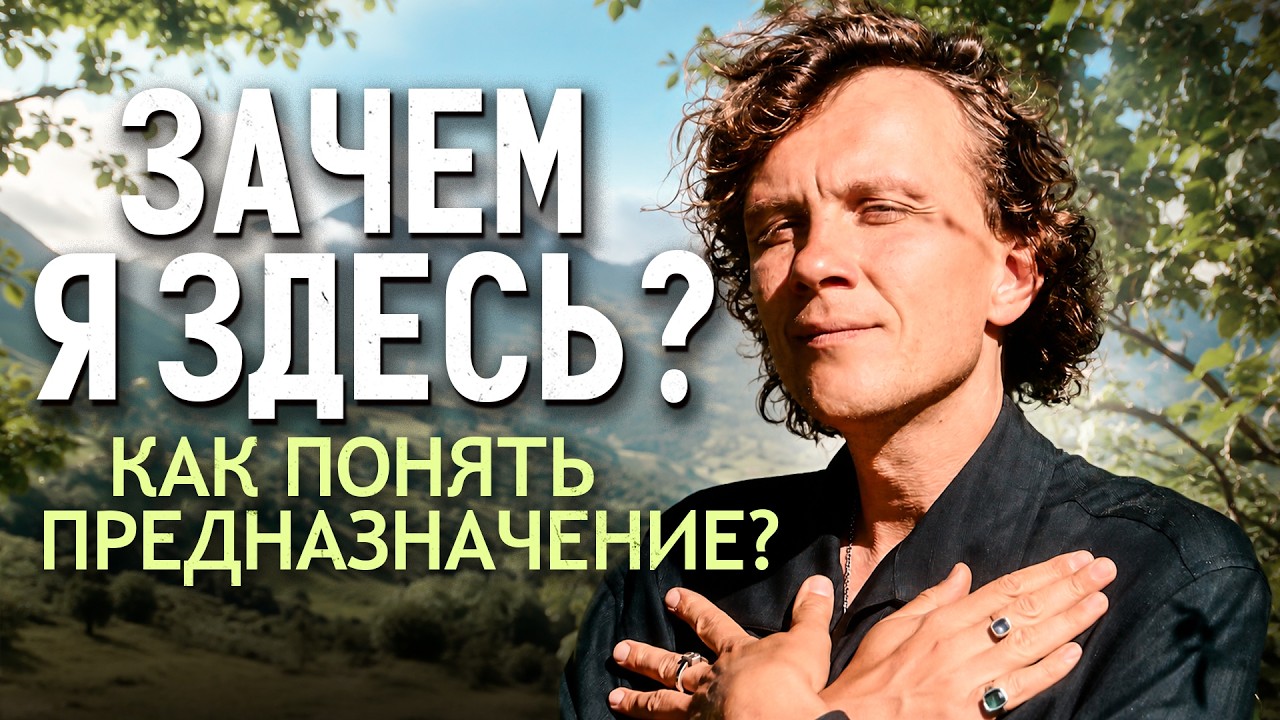
How do you find your purpose and understand what you should really do with your life? In this conversation with Tatyana Tsvetkova, I look at what purpose means in a spiritual sense, what the main mistake in searching for it is, and why this search can become a way of not living. What happens when a person looks not for truth but for an appealing construct for their personality? Does each person have their own individual purpose, or do all people share one? And above all — how to truly move closer to understanding your path without turning purpose into a beautiful idea, an illusion for the sake of which life itself is put on hold.
The illusion in how we perceive purpose
– People search for their work, their true self. The classic version is searching for your purpose: “Until I find my purpose, I won’t do anything else.” And that purpose absolutely has to be something great. In this construct there is a feeling that a ready-made self is hidden somewhere and you just need to find it. Does it work that way? What do you need to do to move closer to your true self? And does it even exist?
– Look, let’s examine the terminology. Purpose, in the form in which people search for it in the world, is a construct that lets a person do something other than what has come to them through causes and effects: people want to find a purpose that will be in harmony with them and their personality. And that is a big difference from the fact that purpose does exist — what is destined for you by fate. For example, a person is destined to die at twenty — but they found their purpose: their main karmic task was to live to twenty, and they died.
You know, there are lots of jokes about this. “Can you tell me my purpose?” — “Yes, I’ll tell you right now. Remember when you were twelve, in sixth grade at school?” — “I remember.” — “And remember a boy came along, you had an argument with him, and because of it he moved to another school?” — “Yes, I remember, that happened.” — “Well, that’s what you were born for — to perform that action, because it turned the boy toward a different life.” And that’s it. You ask: “What else?” — “That’s all, it has already happened.”
– That ties in with the grand idea — inventing a cure for cancer or HIV.
– Yes. People take as their purpose whatever they will like. In today’s social world — on Instagram, YouTube, TikTok — some see it as something grand, something great. That’s exactly why at those trainings people walk on hot coals, for example — to encounter something beyond their limits. I’m not against telling people that extremes exist, extreme possibilities, showing them there is a little more — like with walking on coals: you can do it. A person thinks: “Oh, it turns out I can do that too.” Fine, go ahead. But basically people are shown great things, and the emphasis is put on them.
Purpose as a profession, a dream, or daily work
On the other hand, there are people who search for their purpose and say: “This is my purpose: I always wanted to become a teacher.” And the person becomes a teacher. Here is the question. Yesterday I was at a concert at Iolanta’s school — it was their final concert of the year, and a teacher was retiring. He had led the choir for forty years. It is a very well-known school in the US, in California, in Silicon Valley — Gunn High School. The teacher was retiring after forty years, and the choir is simply incredible; it really amazes me. I am simply amazed by the schools here in the Valley, the quality of the music, the musical development available to children in all the schools from first grade.
And he says: “I always dreamed of being a teacher.” This state of dreaming of being a teacher — does he experience it as life or as a tunnel? If he experiences it as life, that is, there is actually no dream there at all, it is simply his daily work, and he lives in the joy of that work and the joy of what he brings to all the people around him — that’s wonderful. But if he believes he has fulfilled the dream he set himself, that is a big problem, because you are a slave to that tunnel — to the teaching you did inside the school.
The main mistake in searching for your purpose
If you look at purpose as a goal, as a construct for achieving a particular goal or for getting some effect for yourself — for example, so that everyone around says how great you are, puts you on the honor board, singles you out somehow — then you will never in your life solve this task.
What purpose is
But if you approach purpose from a broad position of understanding — what is purpose?
Purpose is understanding why I, as a spiritual being, am here at all. And for that you need to understand that you are not a physical body.
By the way, have you noticed that people talk about purpose and immediately say they will rely on science? But what purpose for your life can there be in science? If we rely on science, then you have no purpose — supposedly you have complete freedom to choose with your brain, and you can do whatever you like. What purpose do you have, then? Such a purpose does not exist.
But if you rely on purpose, then you are saying there are premises of the spiritual world. If there are premises of the spiritual world, then the spiritual world comes first. And if the spiritual world comes first, you need to study how it works. You need to study what exists:
- heredity;
- the psychophysics accumulated over a lifetime;
- karmic causes and effects;
- the energy of your spiritual being;
- the karma of the country and people you live among;
- the current energy of the social space;
- the influence of the spiritual world flowing outside you;
- the influence of spiritual beings;
- the influence of different worlds and energies around you;
- interaction with different spiritual people.
So what is purpose, then? It turns out that purpose in this case is understanding all these patterns simultaneously and always. There is no purpose that can be described in one phrase, because at the very least we have a long span of time with a broad range of things happening to me simultaneously.
I am giving you an interview, and at the same time blood is flowing through my body. At the same time I have a child — and a second, a third, a fourth child; there is a dog, a mother, a wife, a business and work, some meters, bills, stocks, followers, people. At the same time some people are certainly watching my videos right now. Considering that thousands or tens of thousands of people take in what I put out — can you imagine what a simultaneous touching of everything that is? At the same time I hear the road, cars, birds, planes. I have a very wide range of things happening at once, and on top of that it is long, and I exist within this whole system.
They will tell me: “That’s all some kind of nonsense. You need to single out some task and do it.” But which task? If I single out a task, it turns out I make it more significant than the fact that you and I have met right now. Or I could say that our meeting here was the purpose. But that’s somehow strange: surely we have other purposes in life too. All right, the purpose was to have children — then our meeting has no significance at all.
And which children exactly? How many? To raise them or not to raise them? Only to give birth — or to raise them and observe different states with them, including when you are yelling at them or they are yelling at you, when your child says they hate you, or when they love you? Which specific things interest you? Are you interested in when you and your wife are in great joy or in great unhappiness? Which moment interests you — when you bury her, when you are together, or when she buries you? Or when you simply divorce? What exactly interests you in this purpose, in this event you want to behold?
As soon as there is some specific event, you have burned your whole life down to that event. And that is not life. Life cannot consist of just one event: there is an enormous number of things happening both now and over time.
The spiritual being and the human path
Another interesting point — as an addition to what I am saying now. A person who listens to me just wrote: “You know, I understand for myself that purpose is not about looking for something special for yourself. There is a true purpose for all people, and you need to be within this true purpose of all people. The true purpose of all people is to live for the sake of other people, to live from the standpoint of understanding truth, of studying the world, the Universe and everything that happens. But what should I do now if I don’t understand what I myself need to do for such true living in relation to the spiritual world?”
When I received this question, at first I was somewhat puzzled: what does this reveal? What it reveals is that the person has not understood what real, true purpose is. Don’t rush to understand it. It is very important not to rush to understand it. Your task is not to understand it, tick a box and say: “So I know everything.”
An incredible number of people say: “I know there is a spiritual world.” But in every situation of their lives they act on the basis that there is the material world. And in the hardest situations of their lives they rely entirely on the material world alone. Here you must by no means rush — you need to keep observing it and keep being in this search. Becoming aware of this is not the most important task in this life.
This is very important, because living by the laws of the Universe means living by those laws, not being one hundred percent in a state of understanding everything that is happening.
I talk a great deal here on the channel about the laws and about what to do. But a huge number of people find it is not enough. You tell a person: it is enough for you to see how another person feels and to keep track of that state. And they say: “No, I want something more. I want to come to know something else.”
What’s more, there is also your spiritual being and your spiritual system. It actually does not live entirely in the physical world alone: it has the spiritual world and a spiritual dimension of living. Your spiritual being has a certain plan agreed with the spiritual hierarchies, including a plan for its development in the spiritual world. And that plan comes first, not your life here.
When you think about purpose, you think of it as the most important thing that is happening. But your spiritual being is shouting to you: “No, no! There is me!” If it could shout at all, it would say: “God, how tiresome this ant is! What is it doing or not doing here again? Another new ant, another new day for it, more new events.” But there is the spiritual world, which lives through all of this.
How purpose relates to sleep
At night you go to sleep — and your spiritual life is working incredibly intensively. You are not conscious at all of what is happening. For at least a third of your life you are not conscious at all. What are you even talking about? You are not even conscious in the spiritual world. And that, by the way, is the most important part of your life, in which your purpose actually takes place. That is exactly where it happens.
Of course: you lie down, and your “I” and astral body detach from your physical and etheric bodies and go off to live through and process what you have lived through here — in order to embody it in the spiritual world. That is what living through is. It is like a real thought.
Why should memory be poor? Because when you have forgotten something, it means you learned it, lived through it and let it go — even felt hurt that you let it go. Lived through it — because the thought entered your system, was stored and lived in your etheric body. Then it left it, entered the spiritual world and was processed there: that energy was processed, and new energy came. If you keep it here, it is simply stored in you as a phantom. In the same way, if you took pills, say, antibiotics, another, phantom body was created in you, and it lives together with you. There are trillions of such phantom bodies inside. They need to be processed and released so that the spiritual world can live them through.
The point is that it is the spiritual world that should be living through this, not you going: “Now I’ll write a formula and understand.” What can you understand? You are endlessly understanding a whole heap of states of joy and suffering at once. What do you understand? Every day I see people who tell me: “I’ve finally become aware.” And two weeks later they come: “I’m feeling bad somehow.” But you had only just become aware that you feel bad! The same thing. And they keep pulling this winch around in circles endlessly — endlessly the same thing.
You need to rise higher and understand that there is a higher system that is aware, and above that system there is an even higher system that is aware. Your spiritual being, too, is in slavery. It has been damaged by an enormous amount of dark energies. When you incarnate, you are enslaved by Ahrimanic or Luciferic systems and cannot get out of them at all. That is why you have karma, that is why there is death, that is why there are illnesses. All of this exists because you cannot get out of it.
If a person could live for thousands of years, they would simply sink into endless filth. They simply need to die. A person lives, say, six hundred years — they would spend all six hundred years living through heredity and psychophysics and would never even get to karma. “Let’s kill him already, so that it can start living through its own.” And then you still have to make up for those six hundred years in terms of living through karma — to make up for that living.
So, of course, this leads to a completely different understanding of the question you are asking. You look at it and see that purpose and goals are just some kind of micro-manifestations here. And anyone can see this very easily.
For example, right now you are concerned about your relationship with your husband and about how you will build a worldwide design organization. And it has to be not just worldwide but cosmic — and not merely cosmic: it has to take in the galaxies of the past, future and present, all the seasons of existence in general, preferably angels, archangels and absolutely everyone. And you will still not be satisfied.
You care about your children, your relationship with the children’s nanny, with the garden, with the dogs, with the cat, with your friends, with the mountain standing across from you. For some reason it is hot today; the water that broke down; the air conditioner; the coffee — tasty or not. All these relationships concern you. But if you, Tanya, were moved thirty years back, nothing I have just listed concerned you at all. I would ask what concerns you, and you would say: “Sasha, damn it, I’ve got something important! I know what concerns me.” Why twenty years — move you back seven or eight years: none of this was there. When you came and we discussed things, completely different things concerned you. Absolutely different things.
Even now your psychophysics is reacting to this automatically. It is as if it has been turned inside out, you know, stripped bare. You have become like bare energy, because I seem to have turned it inside out — and the system immediately starts to block. Look at that.
What matters when searching for your purpose
Look, Tanya, what a very important pattern. Imagine the situation: you were dealing with completely different tasks, absolutely different ones. And in ten years you will be dealing with completely different tasks. Can the very same mountain concern you? In theory it can, but in life it is very important to see this. Yes, there are some aspects that persist — for example, your relationship with your mother. It interested you then and it interests you now; what’s more, some things, you could say, have stayed exactly as they were. Or with your brother: you’re like — nothing has changed, it’s just as it was. That is, there are aspects that have stayed with you, and there are things that turn out to be completely different.
So what purpose are we talking about? Right now we are talking about a purpose that we like at this particular moment and that we exalt.
There is one defeat built into purpose and into thinking in terms of purpose that all people should know about: when you think in terms of purpose, you are placing a bet with your life, as in a casino.
Because whatever event you envisage for yourself — even if it were written down by the spiritual world, and you had studied it, read it and knew it had to be done — you must understand that you may not achieve it.
That is why people now say: the goal is not what matters, the path is — the movement toward that goal. But they still keep the goal. Look at what they are saying: they have taken the emphasis off the goal, because a goal sometimes becomes unattainable. People also say you absolutely must set a goal beyond your own life. Set something beyond your own life — and everyone says: you need to build a company that will live on beyond your life. But it will die later too — everything will die, everyone will certainly die. Or a person says: “Then I will raise my own family, which will later create something incredible.” There are people who say that.
Look: there are goals that are unattainable, but you like them right now. And when a person talks about the path, they essentially keep the same goals and simply say: they may not be achieved, so there will be the path. But the point is not the goal and not the path at all. The point is to set yourself a huge number of different constructs and allow that right now this matters to you. And in exactly thirty minutes it may not matter.
I keep talking about this. I know that for one of my employees, perhaps, this business matters right now. But tomorrow he may come to work — and he has fallen in love with someone new, decided to move to Australia for the rest of his life, and he doesn’t care at all about anything that is happening. And he has every right to do so. As soon as you allow that another person, that other people, have every right to this, you also allow that everything in your own life may happen in completely different ways.
The only thing you can do with different goals, even if you set them, is simply to say to yourself: let this goal stand, it has such-and-such principles, such-and-such criteria of fulfillment. Some goals absolutely need to be allowed. But the global things we call purpose may not be fulfilled. And they may not be fulfilled because you may decide not to fulfill them.
Many people say: you need to have a dream, go toward it purposefully and fight. That is a distorted psyche — that belongs in a hospital, in psychiatry. You should be absolutely independent of everything. You depend on normal things — for example, on the gravity that exists on planet Earth. You depend on the spiritual hierarchies, which you are not aware of — and please don’t be — but you are absolutely dependent on them.
If the archangels switched off right now, you would die at that very moment. That cannot happen, but if it theoretically did — you would die. A certain movement of your internal, physical organs would go out: it would simply switch off instantly. Or you would float up as if in space and explode. That, perhaps, is what would be worth taking an interest in.
A person’s only purpose
So what can a person’s only purpose be?
The universal purpose is to come to the light, to follow the true course of human development, the endless development of one’s spiritual being. And the human task is to come to know this, to study this, without ever knowing it fully, because no brain can digest it.
And besides, everything in the world has developed, is developing and will develop — tirelessly. And if everything in the world develops, then you will endlessly be coming to know yourself, endlessly be in a state of studying yourself. And if everything in the world develops, then besides you, what is around you develops too. Can you imagine, Tanya, all of that also has to be studied completely. Constantly.
Today you are sitting here like this. Yet I know it is the same spiritual being I saw back then — I see it immediately. It tells me: “Ha, I’m exactly the same.” Figuratively speaking, but in the spiritual world I just look — it is all the same, Tanya. All this is just a flash, a flash that has flown past. And there, there is an endless field of knowing.
But even here, you and I don’t know what will happen in our lives. We don’t know at all. Simple things: whether you and I will open gardens, or shops, or some business, or centers; whether we will teach people together or work and serve together under someone; whether we will be partners or enemies; whether we will put each other in prison or be cellmates; whether we will move to another country or to different countries; die in the same year or in different years; be present at each other’s deaths or not; attend our children’s weddings together or not — or whether children will come along.
Relationships with others as part of your purpose
When I meet people, when I get to know them, I tell everyone: imagine if you had known from the very beginning what our shared life would be like? Imagine if back then you had truly known, with the full experience of everything, how, for example, your relationship with me would unfold in life? You would have done some things differently.
– In terms of attention.
– Exactly. What I mean is that, in terms of tuning in to a person, you might at the right moment have looked at me a little more as a human being, and I would have looked at you a little more as a human being. As a human being — not at the specific events that are happening, not at a first and last name, not at what needs to be obtained at that moment, but a little more broadly — at the essence of what is happening. I would have looked and thought: “Oh, how interesting! Aha, how interesting.” And I would not have shut myself off because of it.
That does not mean I would have rescued you better somewhere or done something better or worse for you. It is not about that at all. It is about — damn, I wonder what it’s like? I wonder how to look at it. After all, we may never meet again in this life, but meet in other lives. Or what if we have already lived together for hundreds of years?
That is interesting, isn’t it? Imagine: you meet some person, you find them unpleasant, they find you unpleasant, you are outright enemies. And then you are given twelve volumes — an enormous “War and Peace” of sorts — describing how you lived together. You begin to read — and you fully understand why you find each other unpleasant. That isn’t there at all: just a description of where you were and what you did. You put it on like a movie, like a series, and you know it is true.
Imagine they put on such a series for you. Tanya, I guarantee you: you would start watching this series with this person. You would be told: “Watch it for six months.” You would meet up, buy popcorn, drink tea and watch this series. You would laugh, rejoice, discuss, roar with laughter, feel embarrassed, love and hate at the same time. And at some point you would look at this person and say: “I think I already love this person more than my husband. I think I love them more than my mother.” Can you imagine? You live through all of it — and you have your mother there, and your father, and your children, anyone at all.
If consciousness could be expanded like that… In reality, when it comes to people’s karmic lives, it isn’t that all people have had a large number of incarnations — most have not had very many. But if it were so — imagine, you would look, and it would be a completely different kind of attention.
In exactly the same way: here you are, living with your neighbors on the other side of the bay near San Francisco. Imagine you had to get into a bunker with ten neighbors, with ten families — not for a week, but for a year. You would treat each other differently. You would form a completely different consciousness, a different attitude to each other. Even a wife and husband — put them in a bunker for a year, lock the two of them in together. You would come to know yourselves differently.
My wife recently sent me something — perhaps it was a hint — saying that a husband and wife absolutely must vacation together. I take this very lightly in general. I believe you need to vacation both together and separately, and with different wives and husbands, and so on. Not in that sense. What I mean is that you need variety in your perception: you need both many businesses and few, both a lot of work and little — a lot of one thing and little of it. And to be able to rest alone, and with one child, and with two, and with three, and in all the pairings selectively, and with your wife. And to go away calmly with a male friend, and calmly with a female friend. These are simply different types of rest.
In that piece they explained: when you and your wife or husband go off together on some trip, you find yourselves in unfamiliar circumstances of life. You have to solve certain tasks — in a new city, for example. I laughed at this: what tasks, if I plan, buy and do everything? That is, some people have to solve things and some don’t. But on the whole, that is the point: if you put me in a bunker with one of my daughters for four weeks, we will change our relationship for life. Tanya, for life.
If you put me in a bunker with her, we will spend most of our time meditating — I guarantee you. And even if there is no complete isolation, we will come to it. For me it would be an incredibly powerful achievement, because I have limits in interacting with my children when it comes to explaining certain things. Obviously, it would be a different reality. Can you imagine, it is a miracle — a completely different miracle of interacting with a child, a different life altogether.
We remember our parents here and think: we are already forty-two, and something like that has never happened and will not happen. That unique knowing will not happen. The year before last my mother came to stay with me for a month and a half. By the time she was leaving, everyone was already unhappy with everything: my mother was unhappy, my wife was unhappy, I was unhappy — everyone was unhappy with everything. And my sister says: “We probably spent too much time together.” And I say: “But you could approach it from another side. We spent forty-five days together, twelve hours a day. When did I ever spend that much time with her?” That’s a miracle, can you imagine? An incredible miracle that we did it at all.
Or last time Vitalik came to see me and stayed with me for three weeks, twenty-one days. We talked for fifteen hours every day. He and I spent more time together than I have spent with any of my friends in Moscow. Do you know how much time that is? It is like meeting up for three or four years — every weekend, say, for two hours. And every time it is the same thing all over again. And you also often watch a movie — and it is the same thing, just going around in circles.
Rather than sitting down and giving this person your attention, and them giving you theirs, and the two of you locking together and living your whole lives for real, sincerely — fully living it, insatiably. I know one thing: if you and I were put, say, in one space for five hundred hours, we would simply spend five hundred hours examining and discussing things, examining and discussing. My desire to discuss myself and you would not run out, and your desire to discuss yourself would most likely not run out either. We would find something to discuss. That is what I want to say.
So why don’t we do this in our lives with the people around us? And we don’t. With our husbands and wives, with our children and our parents, we live exactly the way we meet friends at weekends. These are simply one-sided, repetitive actions, not a real entering-in, when you take each other in with your whole consciousness, with your whole sensitivity.
And that, Tanya, takes time; you need to set it aside. Remember, today we discussed that we could make a video about why I would like my mother to come to me for a discussion? That needs time set aside: hours of conversation, hours of discussion, of telling, examining this topic from different sides, with different people. You could write a research paper, a dissertation about it; you could devote a life to it. Do you see what I mean? Someone will say: “Oh, what have you dreamed up here?”
But this is what the real life of people is — coming to know each other, truly, genuinely coming to know each other, and not limiting it to certain things.
Sometimes I meet with someone. You come wanting to get to know the person, but you sit drinking coffee and realize that today it will just be coffee. And ping-pong. You sit, you talk — and you realize it’s the same thing again. The conversation isn’t flowing, something is completely off. Well then, let’s play our familiar social games again. That is, you are not with the person in a state of real understanding of what is happening — of giving attention to this person and this life.
By the way, there’s this story. Recently I was sitting with my wife, we were discussing something, and for the first time in my life I had a certain feeling — for the first time in my life, Tanya, I experienced this feeling. First, during the conversation with her, I gathered all the space and all the energy to truly hear her, to give her love — so that she would have the strength for this conversation at all, and I would have the strength for this discussion. And for the first time I came up against this theme: an energy arose in me that I had to live through — was I ready to sacrifice myself for her? Now. At this very moment.
It is not an empty sacrifice — you know, there is the notion of an empty sacrifice: “I give my life for her.” It is not that. At that moment it is not for myself, not for something, not for her — it is a sacrifice for the sake of spiritual truth. That is what real knowing of another person is: when you truly live in a conversation, in communication with another person.
A real conversation, a life with another person, is when you sacrifice your whole self to that person absolutely, completely. Not a single limitation remains, nothing holds you back: not your blood, not your children, not your relatives, not your loved ones.
For some reason, at that moment you are entirely in this sacrifice. And it is not a question of love, not a question of husband and wife. It is a question of true human sacrifice for another person. It is a completely different way of experiencing reality.
🎥 Video for this article
Original video · Russian audio