
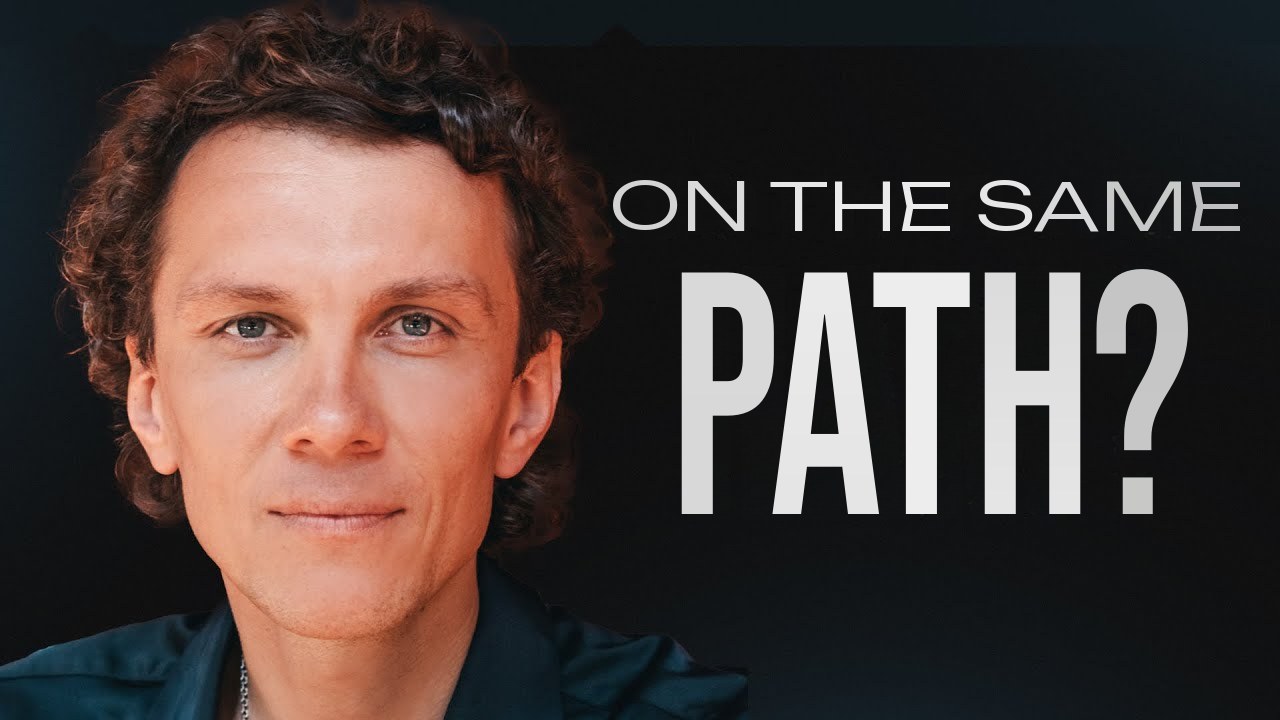
In this video, I discuss the important question of choosing a business partner. I share my personal experiences, successes, and difficulties with partnerships, and explain how they have influenced my professional development and growth.
I look at different aspects of business partnerships, from choosing a partner to shared goals. I pay particular attention to honesty and openness, and to how differences in partners’ goals, expectations, and financial circumstances affect a partnership’s long-term stability. I share stories of successful and unsuccessful partnerships.
How to Find and Choose a Business Partner
How do you find and choose a business partner? It is an important, interesting, deep, complex, and far-reaching topic, a question that will, in reality, accompany a person throughout their life.
I have had many partnerships in my life, hundreds of them. Some have been especially important and deep for me: the partnership when I launched my first programming company, the partnership at Business Molodost, the partnership with Andrey Rogachev at Agro24, and the partnership at GeekBrains. Many living partnerships in which I experienced pain, suffering, luck, success, and joy.
The pain that arose was, of course, partly rooted in how I chose a particular partner or partners. Why did I make that choice? What was at work inside me at that moment? What was the inner source of my choice of partner?
Have you had partners in your life? Were all those partnerships great, with an easy choice of partner? Have you ever made a mistake in choosing a partner—the very mistake that often leads to suffering afterward, but ultimately contributes to your growth as a person?
I have had a great many partnerships. I did not say “hundreds” for no reason; there really were hundreds. Partnerships exist in different projects: within teams, in different businesses, large and small, with equal shares, or with me as a minority shareholder, or as the most important person.
I also have a partnership with my wife that has lasted a very long time. We met in 1987. I just thought about 1987; it seems like such a strange and distant time. A long, enduring, real, living partnership, with entirely different circumstances and, most importantly, with different versions of me.
Why Are You Entering This Partnership?
The most important thing when choosing a partner is to understand that any partnership, of course, comes about by chance. We are talking about circumstances in which you face the question: are you and this person headed in the same direction? Or you sense an impulse, a possibility that something could emerge with this person. They may offer you something, or a team or group may offer something, or you may be thinking of making them an offer.
The most important thing in a partnership is to establish its purpose clearly for yourself. Why are you entering this partnership together?
In the previous video on my channel, I talked about business goals and how important it is to know the real purpose of a business. Knowing the purpose of a partnership is incredibly important too. Why are you forming this partnership? Is it to build a business with a particular goal, with that business at the foundation of everything?
For example, you want to start an education business and build a company worth ten million dollars. Or you want to build a chain of beauty salons and sell the company for forty million dollars. Or open a coffee shop that brings you a thousand dollars a month. Is the business the essence and purpose of your partnership?
Or is the foundation of your partnership that you fundamentally want to be with this person: simply to be together, live through things together, share experience, joy, different businesses, events, and circumstances; share tragedy, pain, trauma, business closures, failure, bankruptcy—anything at all? The most important thing is that you want to experience it together with this person. Business partnerships like that exist. And perhaps that kind of partnership closely resembles a deep, real, truthful partnership in a family.
So there are two important possibilities:
- Your partnership is based on a central business goal.
- Your partnership is based on wanting to be together.
Your Partner Is a Different Person
When choosing a partner, it is important to begin with two understandings:
- First, you have your own sense of what this partnership will be.
- The other side, incredibly important for success and for moving in the right direction, is understanding that your partner may have completely different goals, tasks, actions, foundations, principles, and a different strategy for working together.
Your partner is a different person. With that understanding, you can reach a real, honest, sincere agreement together.
An agreement based not on your unspoken expectations, guesses, or fears, but on entering a partnership together in which things are generally clear and understood. You are in a state of open dialogue, steadiness, confidence in the relationship, honesty, truth, and authenticity. You know that there are no lies in your partnership and that you have told each other the truth.
Partners Do Not Have to Be on the Same Level
There is an interesting foundation here, a unique point: there is no such thing as partners’ “levels” when it comes to a partnership. Some people think that a person with a billion dollars must form partnerships with others who have roughly a billion or more. Or that someone with a hundred thousand dollars, or nothing at all, cannot partner with someone who has ten billion dollars. That is not so, because everyone has their own inner purpose and their own way of experiencing partnership.
Someone with a billion dollars may want to partner with you—a person with no money who has done certain things in certain circumstances—simply to spend time with you, for example. Perhaps he feels calm around you and wants your company, your creativity, your professionalism, your perspective, your ability to make decisions, or your precision. And perhaps all you want from him is money.
Imagine that situation. The partnership will fail if you do not tell him. You could come and say honestly, “Listen, my inner goal is to make money. What is your real goal?” Try to see that his goal is not to make money with you. There is no guarantee that together you will earn an amount that interests him. Ten million dollars may interest you and not interest him. Perhaps he simply enjoys being with you.
He tells you that, and you tell him that you need money. Openly and honestly. Most likely, there will be some discussion of your inner states, some analysis, but at least each of you will know firmly that you have spoken the truth. On that basis, you can try to come together and understand whether such an arrangement is possible.
Every Partnership Ends
If you do not tell each other the truth, this partnership will end, and it will end unsuccessfully. Of course, it is important to remember that every partnership in life ends. Absolutely every one. At the very least, one of the people will die, but every partnership ends in any case.
The question is what happened during that partnership. Was it real life, a real and truthful partnership, a blazing fire of partnership and creativity? Did it develop you and everything around you? Or was it stagnation, decline, negativity, lost money, an enormous amount of lost time, and one disappointment after another?
There was a time in my life when I partnered with someone whose financial circumstances were completely different from mine. It was at Agro24. My partner was Andrey Rogachev, the founder of Pyaterochka and one of the first people in Russia to earn a billion dollars in cash. A very experienced, very wealthy person. And there I was, with my own experience, such as it was. We were making an agreement. Why do I say “such as it was”? Because that is an inner feeling: in this case, you measure things in money. We were inseparable and spent a great deal of time looking for business projects together.
We agreed to do a project together. This is where it matters. We agreed, and wrote down, for example, that distributing profits in the business was important to us. But did he need that profit? Did he need a million dollars in profit? No. Why would he? He did not need a million dollars. Just as, in general, I would not have needed that business if I had begun earning one or two thousand dollars from it.
I was strongly focused on the money. He was strongly focused on being with me. He felt something different, a different energy. I eventually told him, after several years of partnership, when the partnership was already shaky. I admitted it honestly.
How good it is to have the ability and opportunity to discuss this from the start without fear. Why are people afraid to tell a prospective partner their own motives from the beginning? Because they are afraid the partnership will not happen. And most likely, they already have expectations.
In that business, I expected us to earn more than a billion dollars, because the main goal was to earn more than a billion and build a company worth more than a billion. I was afraid to tell the truth because doing so might have broken off the partnership. He could have said, “You know, if you’re only in it for the money, I won’t do this business at all,” and shut it down.
Because people do not want someone to be with them only for their money. They want someone to be with them because of who they are as a person. In reality, no one wants someone to be with them only for their money.
Of course, I was not with him only for the money. I was also there because of the person he was. Perhaps I was one of the few people around him who felt that way. But that impulse, that source and motive—money—was still there in me.
Two Thousand Lies
So if, while choosing a partner and reflecting on whether to be with this person, you leave things unsaid, you create a false expectation for yourself. Most importantly, you create false expectations for the other person. That person may also be in a state of fear, not explaining things, or lying, and may layer his own lie on top of yours. This becomes not two lies, but two thousand lies.
What is more, that lie then carries over to customers, employees, and senior management. Everyone starts to feel it somewhere. It carries over to your families. It can carry over anywhere.
A foundation of truth, honesty, and the greatest possible authenticity in a partnership allows you to move toward the result as quickly as possible.
Sometimes the impulse behind a partnership is so strong that there is little need to negotiate: everything is already honest, and you simply move forward. Other partnerships require you to think through the business circumstances in extraordinary detail, because there is no other way. Partnerships like that, which require an enormous number of parameters to be written down, will most likely be difficult for you to bring about.
Almost a year ago, I was discussing the details of a potential partnership with two people. I set out a whole list of conditions and details under which I was prepared to work together. Someone told me that you cannot do that, that it is wrong. The partnership did not happen.
But why did I set out that list? I knew that if I did not communicate a great many details, I would not stay with these people. I could see that some of our principles were headed in different directions: principles about life, personal freedom, managing companies, or business in general. I understood that it made sense to discuss certain things in advance, write them down, and establish them firmly.
Perhaps I lost a business because I told too much truth and tried to anticipate too many circumstances from the beginning. But I know that at the time I was certain: this was exactly what I needed to do with these people. And I am still certain I did the right thing.
At other times, I form a partnership instantly. You see someone, spend a little time with them, and immediately say, “Listen, let’s form a partnership.” You feel the authenticity, the truth, the reality of it. You feel that this business will be alive.
But if you do not write down and discuss certain details, or explore some of the other person’s circumstances in much depth, you must allow for the possibility that the things you have not discussed may be illusions, may not be real, and may not match.
Living Your Life in Freedom
This also matters for you personally: for living, developing in the right direction, developing in accordance with the laws of truth, and moving forward. It will allow you to do more than form a good partnership, build a great business on it, make a lot of money, become well known, make a lot of money again, keep making money, build good teams, and benefit customers. It will actually allow you, as a person, to live your life as fully, honestly, truthfully, and authentically as possible.
After all, we do not build a business and a partnership to become a unit or a tool of that business and let it control our lives. We form partnerships and build businesses so that, within our lives, we can live in freedom, with inner abundance, inner harmony, and a sense of taking the right step.
The most important thing is how to take your next step well. Your next step leads to growth in who you are as a person, and the scope of who you are determines the scope of everything else.
🎥 Video for this article
Original video · Russian audio