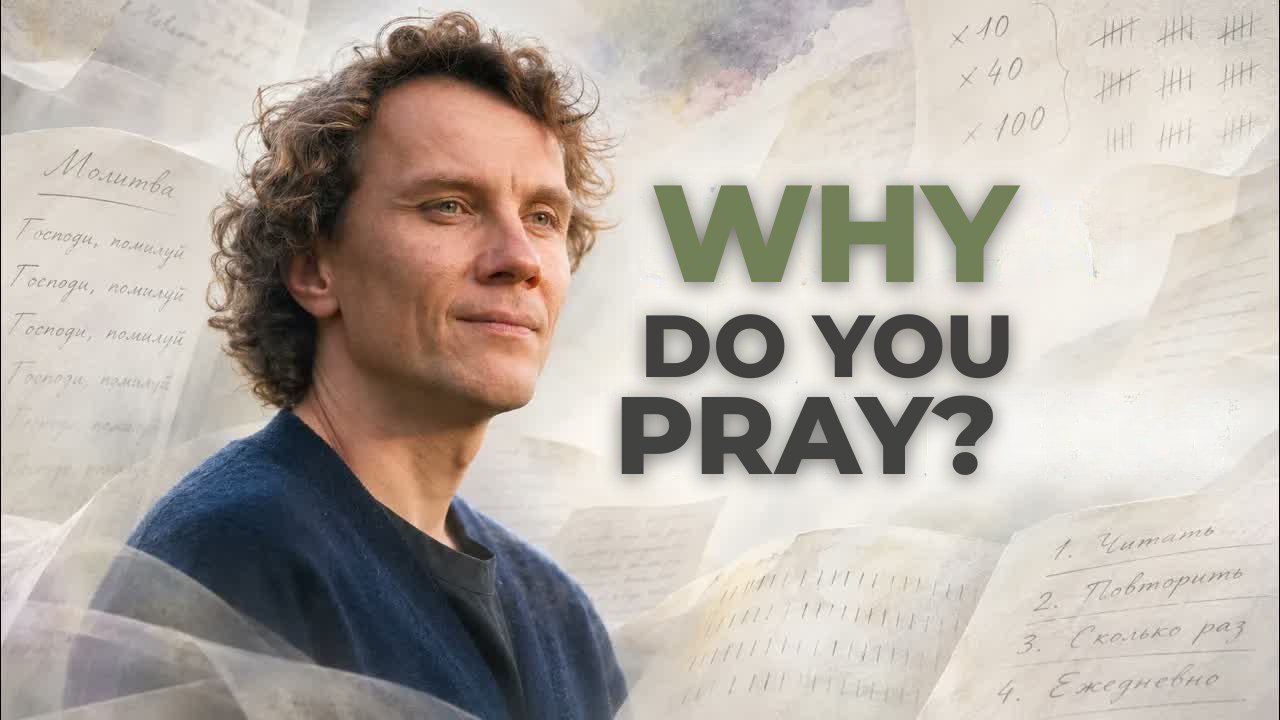
What is prayer from a spiritual point of view, and who can create its texts? In this episode I look at what stands behind the words of a prayer and behind the external rules for reading it.
Who has the right to compose spiritual texts? Why does the same practice or the same melody evoke different responses in people? What task does a person set for themselves when they turn to prayer?
Prayer from a spiritual point of view
What is it, really? What kind of energy is it? Where did it come from, and what does it carry within it? Prayer from a spiritual point of view — what is it, and what is it for? What is it that today is called prayer?
Imagine how wonderful it would be if we were told about the notion of prayer the way a person encounters it over the course of their life, from the very beginning, from birth. If we were told truthfully what it actually is.
What is prayer, and who has the right to pray, and how one has the right to pray, and where one has the right to pray? And who has the right to read the texts, who has the right to compose prayers? What actually counts as prayer?
Ours is a meditation channel, so today we will stay in meditative spaces as we take up this subject and work through it.
Who has the right to create prayers
I once had a discussion with my wife. I referred to one of the people close to me, who had given me a great deal of advice on health, and said that this person was a doctor. And Polina said to me: “He's not a doctor.” She was in a state of resistance, in which she wanted to tell me that to become a doctor, this person had to graduate from a medical school and work in hospitals.
And there was another very important aspect: this person has to convey certain ideas that are accepted in medical circles. Because even if you studied somewhere and got a medical degree, but you convey something different, people won't accept it. They will still consider you not a doctor.
And there was a person very close to me who often told everyone around her: “And I'm a doctor too, I have a medical degree.” That always bothered me, because I understood that it made no difference to me at all what education she had in this field. And the people for whom her education matters often won't listen to what a person says about the spiritual worlds, because they want to hear from a doctor what a doctor is allowed to say, what a doctor is used to saying.
And in prayer this distortion is incredibly strong.
In particular, in who is the source of this or that text, and who has the right to grant initiation into this or that text. There are people who say: “To read this text, you have to receive a certain initiation. To read this text, you have to pay a certain sum of money, or do a certain job, or give some help, or reach a certain level in the spiritual hierarchy, be ordained into some rank, receive a certain belt — in order to read this text, in order to come into contact with it.”
Or someone says: “This person couldn't have written that text.” Why couldn't he? He just couldn't.
Everyone refers a lot to prayers written somewhere in antiquity. But if someone writes a modern text, people say: “Oh, that's some nonsense, that's not a prayer. What right did he have to write that?”
And do you know the source of that earlier text? Which particular person wrote it, and what state were they in? What were they doing when they wrote it? Who did they consider themselves to be? What education did they have? What was their approach to this text in general? What did they really convey in it? And does this text actually carry something for a person, and if it does, then what?
Prayer, by the way, can be expressed as a text, and it can be expressed as bringing you into a certain state. Or prayer can be expressed as a certain gathering of people — that can also count as prayer, as a certain group process. Or you can come to a place where a prayer is taking place and be a participant in it without understanding how it works.
First of all, of course, you need to figure out what it actually is. What kind of energy is it, where did it come from, and what does it carry within it?
And there the text matters, the words matter, your state matters.
Prayer and external rules
In my life this was an interesting subject. There was a time when I devoted myself a great deal to reading prayers from Jyotish, from physical astrology, and prayers to various spiritual systems.
Because when you say “planet,” that is a kind of spiritual system. For me it was a spiritual system right away. Probably by those years I no longer saw it as just some physical planet. I didn't fully understand what kind of spiritual system it was, but at least I felt from within that it was so.
And at the start, when you are taught to read a text to a certain spiritual system or planet, you are told that this reading has to be done for a certain number of hours, a certain number of times, at a certain time, in a certain state, and so on. You have to sit, be dressed in a certain way, turn your head in a certain way, sit on cloth of a certain color or a certain kind, and so on. A great many such precise, explicit restrictions.
And I remember a moment when I had already merged with it and was doing it not in the mode of “this has to be done,” but simply doing it. It was a part of life. Not a dependence, simply a part of life.
I remember coming to the person who gave me all these details as a teacher of this tradition. I say to him: “And do I need prayer beads too?” — I see special ones. Of a special material, a special color. He says: “Of course.” With each bead of a special weight. He says: “Of course.” I say: “So I'm breaking the rules here, then? Why didn't you tell me about this right away?” He says: “If I also start talking about prayer beads, then who's going to do it?”
If you and I carefully trace this whole structure, we will see that all these restrictions were created by the circumstances of how a person perceived their own life.
And how they perceived the way everything is arranged and how it all happens. And at some point in time it really was important for a person to receive instructions about the color, the attention, the direction, the prayer beads, the number of times and everything else.
The same rules for different people
I always asked myself this question in this matter: “Can you explain to me why I have to read it ten thousand times and another person has to read it ten thousand times too?” After all, in principle, maybe someone needs to read it five times, and someone else needs to read it ten million times. Why is it the same for everyone?
Yes, different planets, some different scales, details, but basically the same. Why the same? Why do millions of people on Earth sit down and read a prayer to Saturn the same way? With some variations, but the same in terms of reaching the final result.
Which on the whole is strange, because all people are very different in terms of their spiritual state and the spiritual development of their system, if you can even put it that way.
And it stands to reason that someone doesn't need to read at all, while for someone else, whatever they read, nothing will change, nothing will move even a gram. Then that person should know that they are reading simply for the sake of reading — so that maybe somewhere in the future something might move.
And here we immediately understand that specific prayers were given at a certain time to certain people.
Because if they had been given not to certain people and not at a certain time, everything would have been different. It would have sounded different. It would have been conveyed differently.
Practice or external form
Does a person need understanding when they perform certain actions — understanding of what is happening in reality? He simply learns to perform certain actions, like physical exercise.
And that, by the way, notice, is where the basic yoga tradition ended up. Basic yoga has nothing to do, absolutely nothing to do, with this sport, with the physical exercise that is promoted all around. Usually yoga is yoga with a mat. There has to be a mat that you sit on comfortably — I mean this mat, yoga with a mat. So basically the mat became more important. The mat, the clothes. Buying clothes of the right brand in the right store. Walking in with the right words, or buying physical exercise from the right trainer. It turned into physical exercise.
And prayer disappeared.
And in yoga these days a great deal really is said about how, in some of its schools, there are those who keep promoting it as spiritual yoga while doing exactly the same physical exercise and having nothing at all to do with the perception of the spiritual worlds. And often harming people through such exercise.
And elsewhere people say clearly that this is simply a kind of exercise, a type of exercise that we do. Someone has reduced it to unloading one's psycho-mental state.
Why a person chooses a practice
Dima, why has it always been so hard for me to discuss it when you talk, for example, about tai chi? It's just hard for me to discuss. Then we need to learn to agree on the parameters of the causes, consequences, goals and tasks of this word, or this teaching, or this physical exercise, or this spiritual practice, or this process. And to understand what it is done for, what task we have then.
And in prayer an incredibly important aspect is: what task do you have? What are you doing?
- You start the process of transforming your spiritual system.
- You learn to be grateful to the church.
- You develop your fear because you can't not do it, since otherwise things will be bad.
- You look for light outside, for God outside — or are you looking for peace within yourself? And within yourself — where is that?
- You do it to earn money.
- You do it to improve your social standing.
- You do it simply to pass your time.
- You do it to find friends and acquaintances.
Why are you doing it? What exactly are you interacting with? At least this needs to be understood.
To figure out what is contained in this or that text, what energy is conveyed there, whether it is still conveyed, whether there has been some interpretation, and what really happens in the worlds when you read this or that text — that is a big question.
Why the same music is perceived differently
And you could ask me: “Sasha, do texts exist that degrade people, that degrade their state as spiritual beings?” Of course they exist.
Remember how we were driving yesterday, and music started playing in the car, and I said: “I really love this music by Rachmaninoff.” And Polina said: “That's for a horror movie.” By the way, she says that every time about this particular melody.
That is, it makes no difference to her why I like it, it makes no difference to her what I see in it, it makes no difference to her what it carries. But I meant it with a different message. A bit later I say: “It's interesting how this sound could be laid over a person's day, over a person's life. And what you are living through at that moment, how much you feel a person's experience, a person's state. Is there horror in a person's life, a constant horror movie? Is there constant joy in a person's life?”
How differently one can hear the same thing, how differently one can see the same thing.
And does a person want to hear it — or do they want to block the perception of energy through resistance? When you yourself can't come into contact with it and can't understand this energy — to block it, cut it out or alter it.
That is why people socially create a hell in the social world, saying that the world is completely scientific and material, and after that they come to religious and church holidays, come to church, gather in huge numbers of people and glorify something. They like the smells, certain words, the way someone does something at a certain pace.
A trip to Vietnam and the perception of prayers
I remember, in 2012 we went to Vietnam. At that time I was with a group of people who studied certain esoteric teachings. And there was a person there whom I partly regarded as a teacher, among others, and I listened to him very attentively.
And when we arrived, he regarded all the people in monastic robes as spiritually developed, as if they could see. I remember how we were sitting in a restaurant, and one such person came up to us and left. And this teacher says: “He saw that we have strong auras.”
This is the quintessence, the collected sum of all the deception and devilry that is possible at all. Of an untruthful, unreal, untrue understanding of reality.
How prayer is connected with the perception of reality
And a person's task, of course, is — through prayers, through such spiritual texts — to bring into their life a healthy perception of space, a healthy perception of human life, a healthy perception of reality. To look from the truth at how you perceive it, what you actually see, what you know about it. How you approach it, why you put forward this or that person.
After all, how is the spiritual world divided today? You are into the spiritual, and I am into the spiritual. …And I'm interested in esoterics too. And have you read this author? In the mental layer, everyone perceives that everyone is the same. They make everyone equal.
And at the same time the ego machine drives a person to rise above everyone. A person wants to rise above others, wants to be stronger than everyone, cooler than everyone, more worthy than everyone. To read a prayer correctly, with the right intonation, with the right voice. To film the video correctly. To choose the right text, the right author, the right translator, in the right posture, in the right clothes, on a mat of the right color, within the right walls, in the right space, in the right place. That a prayer must not be read in a bar or at home. And that a proper prayer can only be read by a specially initiated person.
And how much each text, each sound carries completely different energies, ones that concern people directly or do not affect them at all. And a person, glad that they sat for fifteen minutes and calmed down, simply concentrated on one thing, runs off to tell everyone how exactly this author of this text worked, how inspiringly it helped them — while carrying on doing all sorts of nasty things in life.
And viewers of the channel could be invited to see whether a video can be a prayer for you. A video in which something is simply being told, like this one. It is a very interesting observation to make for yourself.
🎥 Video for this article
Original video · Russian audio