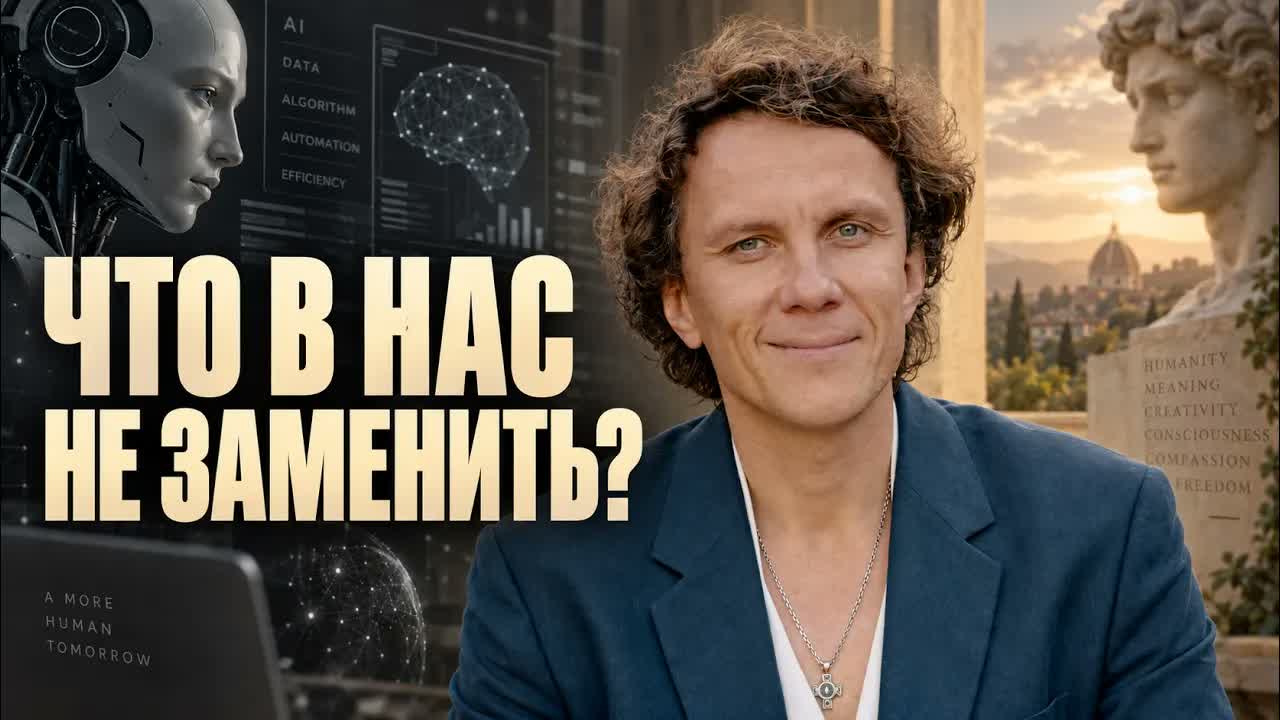
In this conversation with Olga Stolyarova, I look at what a human being is first and foremost, whether we should compete with artificial intelligence at all, and what technology can really take away from people and what can never be replaced.
What will be left for people if AI handles more and more tasks? What can we base our sense of worth on? Should we fear automation? And what is important to develop in ourselves in a world where technology keeps growing more powerful? This is a conversation about artificial intelligence, the future of work, human value and what it means to remain human in a changing world.
Why people fear technologies that become better than they are
– What makes a person valuable if artificial intelligence is starting to do the same things? We have come into a world where artificial intelligence can do in ten minutes what a person spent decades learning. And a question arises: if my value lay in what I can do, and now artificial intelligence can do it, then where does my value lie today? What should people now base their sense of professional worth on, and what qualities should they perhaps develop in themselves? After all, artificial intelligence is now simply an enormous competitor to virtually every profession.
– It’s interesting: I had an episode about artificial intelligence on my ToTheMoon channel — we have a fairly large channel. From time to time I give examples there of how the modern world is replacing certain standard processes in life. One of my recent examples was that my younger children won’t need to learn to drive. And a whole discussion broke out there about how I’m stupid, clueless, off in the clouds and don’t understand people’s lives at all. And about how, when a person learns to drive, neural connections develop, they become smarter and so on.
Nobody there mentioned that:
- a huge number of people die in accidents, spend a huge amount of time on driving and on worrying, and spend extra money on it;
- a huge number of people are afraid to drive, and it is a great psychological stress;
- people get tired and are limited in getting around, including because they can’t drive;
- cars in general also harm the world in terms of exhaust gases, while modern cars do less harm.
It’s a very interesting discussion, because right next to it I had another example, to do with a vacuum cleaner. I said that a robot vacuum vacuums better than an ordinary person. And people got angry with me there too: what are you telling children — that they no longer need to learn to vacuum? A robot vacuums better than a person.
Discussions like these always arise from a very narrow perception of the human being in life. Absolutely.
When a human being cannot be replaced
It’s the same with the discussion about artificial intelligence appearing and doing something better than a person. So where does that leave the human being? As always, people start worrying about their ego rather than about where they stand. Because a human being was and remains a human being.
A human being cannot be replaced from the point of view of their spiritual system. If you see a person as an object, then of course they can be replaced.
And this is exactly the huge problem humanity is in: for the last five hundred years for sure — and very seriously for the last three hundred — it has begun to see a person as an object, as some simple material substance that can be reproduced.
How not to fear AI
And even the main goal in developing artificial intelligence is to make it better than a human being: supposedly so that it helps people, so that it replaces people. This is talked about all the time: replacing the human being. Once again, this is very important, and the great minds of planet Earth talk about it. Take a look: the main person responsible for artificial intelligence at Facebook, Meta, says he will have children when he can automatically load all the information into their brains, put some chips in them that will let them instantly know everything completely.
They want to replace parts of a human being, they want to turn a person into a robot — to forget the most important thing there is in a human being and what a human being should be doing.
And about my robot vacuum example — so as not to lose it — there is a very interesting explanation when I talk about efficiency. My wife and I had a laugh yesterday, because I replied to people: there was a very big, unbelievable discussion about this robot vacuum.
I made a very simple comment: if my vacuum cleaner drives around my house thirty days a month for five hours a day — and that really is so — is that in any way comparable to a person’s efficiency? It isn’t comparable at all. The way you can clean a space today with this little disc is beyond comparison with a person. And it became beyond comparison more than ten years ago.
I remember it very clearly: I lived in Moscow, the apartment was three hundred square meters, and every two days a person came to clean it and spent a huge amount of time mopping and sweeping the floor. But when you have a robot vacuum that can go around every day and collect the dust, it is an incredible help to a person. Why fight it?
And someone there said: “So you won’t teach your child to vacuum now?” Vacuuming — definitely not. Nobody in my household knows how to vacuum. My children can’t vacuum; they don’t need to. But that doesn’t mean my children can’t hammer in a nail, climb a tree or do something else. Or know how to react properly to a snake, how to react to the diverse world we live in.
The development of the world and humanity
What is more important — knowing how to drive or loving other people? Look at why I say such things — what is more important? Because this is an abstraction we really do fall into, in my opinion.
By the way, I just went out to get water, and my wife said a cyclist had been hit and killed on our street here. But I can tell you that an autopilot won’t hit and kill a cyclist. That probability exists, but it is close to zero. With a human driver it is very high, especially in hilly terrain: I live in Silicon Valley, but in the hills. Driving here is absolutely unsafe — small roads through hills and mountains. And a lot of cyclists ride here, sharing the road with cars.
So a modern electric car such as Waymo, which drives in San Francisco and also here where we live, can’t have that kind of incident, because its system for recognizing everything is colossal — it is beyond comparison with a human being in every respect. Why argue with that?
People started making claims against me there: that I live in Silicon Valley, and everyone who lives in California thinks the world revolves around California. I don’t think so. I know there will remain a great many countries where there will be cars, of course. But I was talking about my own children — whether they need to learn to drive or not. What’s more, even if my children go to a region where they won’t be able to drive, they simply won’t use it. Just as my mother can’t drive, my grandmother couldn’t drive, my nephew doesn’t drive a car. It all depends on the person. We all know a huge number of people who can’t drive a car. I don’t know, do you drive, Olya?
– I can.
– Do you have a car?
– I can, but I don’t have a license.
– So you can’t actually drive, right? “I can, but I don’t have a license.” You are not a safe driver; you haven’t driven thousands of hours to go out into heavy, complex traffic. That you can press the gas and the brake — okay. That’s roughly like my eight-year-old child who drove around inside an electric toy car. But look: when it comes to real driving, it’s a fact — it’s years of life, it’s your inner state in terms of automatic reflexes, these are very complex things.
I recently had a situation: literally last week my sister and I were driving on autopilot, the kind where you can drive with your hands off the wheel. There’s one like that in my Cadillac; it’s called self-driving hands-free. But it isn’t a full autopilot, because you still have to watch the screen — it’s probably level two or three, I don’t remember. And you have to look ahead. And on a bend it suddenly jerked the steering wheel.
And I want to tell you: if I hadn’t driven tens of thousands of hours… Even I, having driven tens of thousands of hours — some reaction simply kicked in automatically, I did something, but the probability of an accident was very high. Next you might say that autopilots will drive like that. But modern cars that drive without a human are at a different level — they don’t jerk the wheel. This system, on the other hand, dropped control. It said: “I’m no longer driving.” That’s what Cadillac is known for. It seems to me someone should sue them someday, because they really do let go of the wheel from time to time. And it’s very frightening.
But you and I understand that a human being can easily let go of the wheel too, if they have an aneurysm, a pinched nerve, are in the wrong psychological state and so on. The probability is very high, because people die, and get sick, and lose consciousness, and they drive. I don’t understand why anyone would argue with that.
But we argue precisely about the question you asked. People are afraid. First, of course, people argue simply to set themselves against the world, without figuring out what kind of person they are talking to. That’s one side. On the other side, people really do push the idea: what will happen when artificial intelligence starts doing certain things?
But, Olya, we live in a world where, for the last hundred years, tools have endlessly been appearing that do something better than a human being.
A particular person used to perform an operation better, but then cameras were added, and with cameras a person began to perform operations better. Is that bad or good? In my opinion, it’s good. After all, humanity constantly talks about how smart it is and how smart people are: they have reduced mortality and increased life expectancy. And who did that? It was done by technologies that came along and began to do it better than a human being.
On the one hand, people talk about how great it is that you can now study a great deal of information and it’s accessible. On the other hand, people complain that these same systems will replace human beings because they know so much. But what has happened over the past decades? We have all come to know more information, and people have come to live relatively better as a result. Very relatively. Some have come to live better, and some have come to live much worse.
Let’s look at real world conflicts — truly open our eyes and look at what is happening in the world at all, in every country. What madness is going on! People now have far more opportunity to reach agreements. In the past, to reach an agreement, they had to meet each other, fly somewhere — actually not fly but ride on horseback — and come to an agreement. Someone could attack someone else without warning, without fully understanding them. Now there is an opportunity to understand everyone. Yet the number of conflicts is only growing, and agreements are just a puff of smoke. They have started changing every day, because people change their opinions, their statements, and don’t fully stand by their words.
What determines a person’s value? Why a human being cannot be replaced
So, fundamentally, the question should be put like this. If you treat a person exclusively as a material being, as a physical object, if you believe that nothing exists besides the physical, material world, that there is no soul, no spirit, then all these people should at the very least stop crossing themselves when they approach a church, going to the holidays, celebrating Easter and performing a huge number of rituals. If that is truly how one regards a human being, then of course that is a problem, and life will become harder and harder for these people.
But you do know that in your life you don’t fully control your consciousness, your state, your thoughts, your ideas, whether you feel good or bad at any given moment. Why does one person look ahead and feel great, while another stands right beside them, looks ahead and feels bad?
My wife and I recently went to Beverly Hills — this is just an example, because this conversation came up between us. We’re sitting there, and I say: “How do you like it here?” She says: “It’s so great!” And I say: “I feel uneasy.” Although we seem to be spending time together, we’re in the very same place, sitting in the very same café, drinking coffee.
She feels great about what she sees, and I feel uneasy, because each person has their own state of reality, their own energies at work.
And if there is even some hope in you, even some ray — and there is one in every person — a spark of knowing that the world is much wider than the material, physical world, then you should know: a human being cannot be replaced.
I will be very glad if artificial intelligence does a huge number of tasks for me. Let it. That’s fantastic! If only someone could go and check all seven hundred flowers I have planted for me, check the soil acidity and various details that only one gardener in a million understands. Distribute water properly, not waste extra water, not waste extra electricity. In my house there are, I don’t know, a hundred light bulbs, and the children walk around endlessly turning them on, off, on, off. And my wife too.
And maybe distribute electricity properly — and do it not only in my house but all over the world. Manage it properly.
Recently a Flydubai plane almost crashed — we know that the pilot there decided to commit a crime, decided to kill people. Let there be a system that won’t do that. And today aviation safety is at the highest level. Why? Because there are a huge number of automated systems. Planes fly and land by themselves. Among other things, this has given people the opportunity to travel.
A friend of mine here recently bought himself a plane — fairly inexpensive and small. I categorically don’t get into planes like that. But this plane flies itself: during the flight he changes the route in a mobile app — he simply moves the line and says: “Here I want to fly a little closer to the ocean or a little farther away.” That’s incredible development for humanity. And people talk about it all the time.
Clearly, the question is how it is used, for what purposes. That it can be used for negative things is precisely a question of how developed a person is. If you think from the physical world and think only about yourself, then of course people will want to destroy other people. That is exactly why there is an incredible amount of aggression, madness, arguments, conflicts: people want to think only about themselves.
What the world of AI has an interest in
And the world of artificial intelligence has an interest in people continuing to think it will replace them. And it has an interest in giving people power. That’s its task, after all.
How can artificial intelligence replace my love for my children? I was once riding in a car, and one person said: “I imagine the future: my avatar is interacting with my children, while I’ve flown off to some other planet, and something else is going on.” I listen to this person and think: “What madness. What avatar of yours is interacting with your children? I don’t need a robot to interact with my children.”
This, by the way, is promoted by a huge number of leaders who are creating artificial intelligence — listen to them. Sam Altman once said: “We will write programs, and a program will interact with the child.” I don’t need a program to interact with my child. To solve some tasks — okay. But I don’t want to replace myself, my interaction with my child. People have a difficulty — how to spend time with their children. And I don’t need to solve it like this: let’s replace this difficulty by putting a robot in our place.
Yesterday we were walking, and my son says: “I want a second dog.” Our family is divided: I have four children, and five people want a dog. My wife said: “If there’s a second dog, I won’t be at home.” I have one dog, and I want it to guard the property, to walk around. I say: “It would be easier to put up a robot that will guard the whole property.”
Recently I voiced the idea that I would buy a robot. And my wife said: only over my dead body — she would be afraid that there’s some kind of alien inside. I say: “But it will stand outside, and you’ll give it commands. You’ll tell it: ‘Walk the perimeter, watch the property and report any signs of anything.’ Believe me, you’ll start feeling so safe you’ll be blown away. Nobody will ever come near your house if you have a system standing there that scans the perimeter.” And who would want to come near such a system at night, when a robot is walking around your property?
Where fear of AI comes from
It is said, for example, that a person will guard a space better and more efficiently. Of course not. The question is why we live in a world in which space has to be guarded. What is happening that brings people out into the streets in crowds? What is happening that people are afraid — afraid to live, afraid to be? What impulse is at work in people when they are afraid? Very often regardless of environment, place, space. Why are people afraid? They’re afraid all the time. And now they’re afraid of artificial intelligence again. They themselves want to create it, want to use it everywhere — and are afraid.
A week ago I came to an OpenAI conference, and there was a protest outside: we won’t let OpenAI take over — only we will do it. Take over what? In his latest statement, literally a week ago, Sam Altman said that people need to make concessions so that artificial intelligence can develop, because artificial intelligence brings benefit. And it’s a fact that it brings benefit. Whether Sam Altman brings benefit is another question. For that, you need to genuinely talk with him, genuinely know him, genuinely hear him. This video isn’t for that. I am by no means saying that he does or doesn’t bring benefit.
But arguing with this, trying to stop it — what do you want to stop? It’s just marketing. Trying to stop the advanced systems that exist today? What is there to fight? Why fight it? Hold it back? Are you capable of holding it back? We aren’t capable of holding anything back.
Humanity can’t even predict the weather. The weather changes every minute. What they write is already laughable. It’s laughable even with the current models of artificial intelligence: the weather in the app, everywhere, simply keeps changing all the time. Maybe it doesn’t change in the Sahara Desert, and even that isn’t certain.
Right now flowers have bloomed in the Chilean desert — some kind of super-phenomenon. Did anyone predict it? Did they know how the flowers would bloom? One of the driest deserts in the world is simply covered in incredibly beautiful flowers. I don’t understand at all how flowers can bloom there. And where did the seeds come from? Where were they? So many earthquakes, floods — people endlessly fail to predict them, including here in the Valley. A couple of months ago, literally near here in California, there were such storms — everything was incredibly blown apart. The ocean hasn’t been studied, a physical object hasn’t been studied.
What to develop in yourself today. Remembering what matters most in a world of technology
And has the human being been studied? Who, where, how has the human being been studied? How can a human being be replaced? How can this particular human being be replaced? Today my son is sitting there and says: “Put my socks on.” We put his socks on. He says: “I don’t like how you put my socks on.” And yesterday you put the very same socks on him, even more crookedly — he’s happy and says to you: “Thank you.” So why does he not like it at one moment and like it at another? Who has studied that — completely, for real?
In order not to perish in this illusion, on the one hand, you need to keep studying new technologies. I talk about this a great deal on the ToTheMoon channel.
And on the other hand, of course, you need to begin truly perceiving the world and studying the spiritual world, studying spiritual science.
If a person doesn’t study spiritual science, doesn’t truly study themselves, their spiritual system, there will be big problems. Of course, the spiritual world will renew this. From the point of view of the spiritual world, from the point of view of causes and effects, this isn’t a problem. But how can a person in their present life truly understand what to do? Not forget that you need to love other people. How do you develop this in yourself, how do you not forget to do it at every moment? This is what you really need to think about.
And ask this question: how am I to do this at every moment, remember it at every moment, regardless of the situation — whether someone is shouting or rejoicing, whether I like it or not, whether missiles are falling or the sun is shining? How am I to do this as a human being?
Human beings will not stop today’s artificial intelligence in these years, because it is not human beings who are creating it.
🎥 Video for this article
Original video · Russian audio