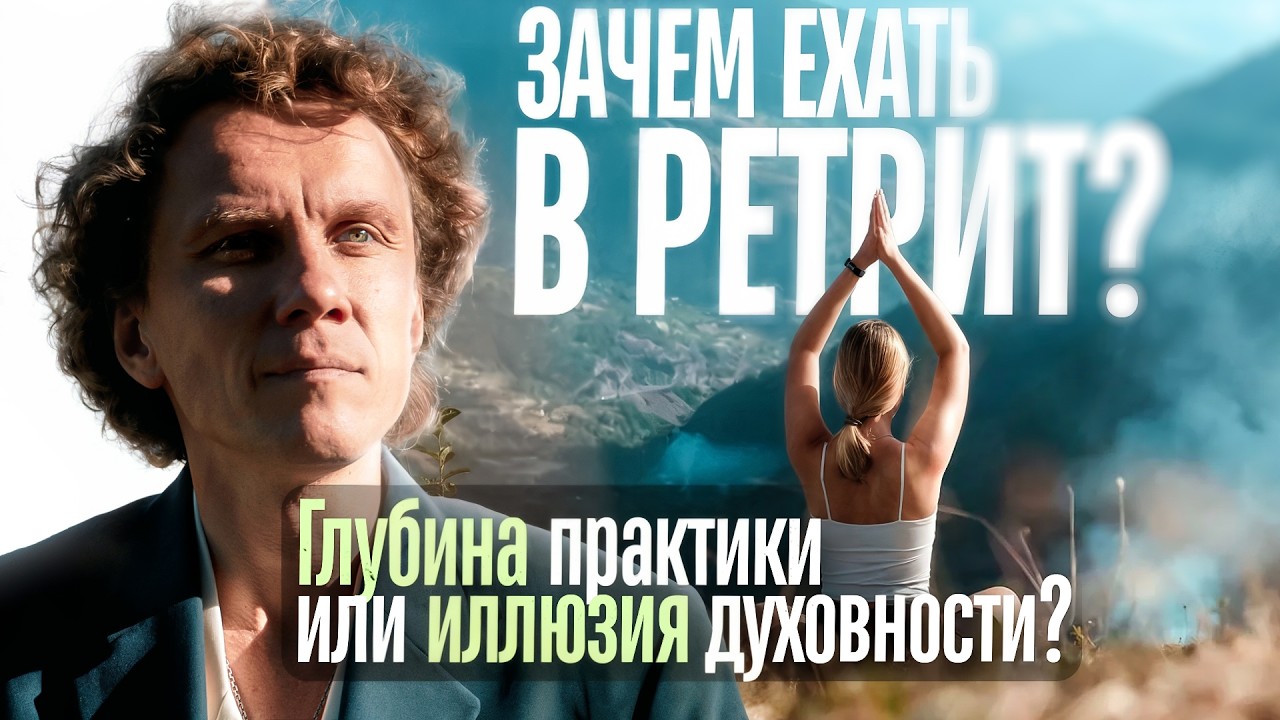
In this video, I look at why going on a retreat for spiritual development can be an illusion: a retreat may turn out to be recovery, it may become a strain for years to come, or it may be nothing at all.
I also look at what is actually called a retreat, how expanding perception differs from a little recovery, why it matters to understand where you are going and to whom, and what you can do for your own recovery right now — starting with sleep.
A retreat can be a strain rather than recovery
You need to understand that going on a retreat for spiritual development is an illusion in itself. That doesn’t mean you shouldn’t do it. If I ask you: is going out into your garden and planting things a retreat or not? Is spending time with your children a retreat or not?
There is the WHOOP band, and there are a huge number of other bands. They are built in a very particular way inside: people made them according to their own understanding of what counts as recovery for a person and what counts as strain. For example, in the WHOOP band, meditation is recovery. And every time I meditate and then analyze it in ChatGPT, it tells me: “You clearly weren’t meditating.” Why? Because for it, meditation is what people generally take it to be today: a state of calm in the physical system. Which is very strange.
Take playing with children, for example — it has that item. The items are selective, not everything in life is there, but playing with children is. That is also a state of calm. Playing music, on the other hand, is strain. Parents who have children know that playing with children is only relatively a state of calm and relaxation. Can it be relaxing? In theory, it can. But I know few people who experience it that way.
I take it calmly. I can’t say I have some colossal experience, but I have four children, and for me it is sometimes calm and recovery — WHOOP has a recovery measure — and sometimes the most intense strain. This is a very good example for you.
Retreats are generally perceived as recovery, wouldn’t you agree? But a retreat can obviously also be an enormous strain.
It can be a strain on your system for years to come rather than recovery. Or it can be recovery. Or it can be nothing at all — just some words: someone told someone something, and at that moment someone liked something.
I’m sitting here; it’s morning, eight forty. If you look at what I’m seeing right now, it’s simply a super-retreat, simply bliss. Paradise itself. What I see in front of me right now is obviously paradise itself. An ultra-paradise. Does that mean I must necessarily be in a state of recovery? If so, I don’t need any retreat: I can simply stay here and never go out or go anywhere at all.
It’s true that if a person lives in a city, in a forty-story building, with the buildings standing close together — as in Hong Kong, in Cairo or in any other big city — then a trip into nature creates a certain state. But it only creates a certain state, changes it. I’ve said many times: visit the Pacific Ocean. It’s a very particular, different state. Of course a person will recover more in nature. That is logical and natural for a human being. Obviously, you should do it.
And, obviously, a person from a big city goes on a retreat into nature. Where are retreats usually held? Usually in nature. Why are they held in nature? Can a retreat be held in some building? It can. Can a retreat be held in Las Vegas, in a casino building? Clearly it can. It depends on what we mean by it.
The word “retreat” itself
Let’s look at the word “retreat” itself — I often refer to this. “An organized event involving a temporary break from everyday routine for the sake of spiritual, mental or physical recovery. It is not simply rest but a deep immersion in oneself, whether through meditation, yoga or living in harmony with nature.” Then some more words — they’ve neatly worked yoga in. In the same way you could attach eight hundred and sixty-seven other practices, techniques or words.
But what matters is that it says: “or physical recovery.” Okay, if it’s physical recovery, it can be simply rest. A strange phrase that contradicts itself: it can be physical recovery, but not simply rest. “An organized event involving a temporary break from everyday routine.” So what matters to a person is that it is an organized event — which is a complete abstraction. Can you be on a retreat all the time? Look, it’s like the word “meditation.”
“A temporary break from everyday routine” — because the world perceives life as routine, not as life. Not the world, but the modern person. Modern science perceives life as routine, so you need a break from it. There is routine, and there is some little diversion.
A person lives their life and perceives it as routine. They go somewhere else, they are given a different view, a different state, and they are told: “This isn’t routine.” They’ll say: “Great, I’ve rested. And not just rested, but also — what does it say there? — recovered mentally or recovered spiritually.”
Spiritual recovery is a funny story altogether. They left their routine to recover spiritually. But you can recover spiritually precisely in your daily work and in perceiving your life not as routine.
As soon as you say, “My life is routine, I want to recover spiritually,” you are degrading spiritually, not recovering. The opposite happens.
“A deep immersion in oneself or living in harmony with nature.” Notice that something else gets added after that: “an international term for time devoted to spiritual practice.” Then — there are solitary and group retreats, group retreats often include instruction in meditation practice, some retreats are held in silence — a great many things. “Retreats are often held in the countryside, in the mountains or in other places far from civilization.” And off it goes: the dark retreat, all kinds of different retreats, prayers. “Retreats play an extremely important role” — and then it goes on into religion, Buddhism and so on.
Expanding perception — for the sake of knowing
But that is exactly the point. A person is in a space like this — what do you think? This is a little piece of Silicon Valley, a good neighborhood of it — not that there are very many neighborhoods like this here, but still. There are homes here belonging to prominent owners and executives of the best-known companies in the world — we won’t name anything. But what’s the point? Are these people in a state of permanent retreat, or are they never in it? What does it arise from? How does it arise?
And this is a very interesting aspect. From the point of view of meditation — as you say: “When I listen to your meditations, I have very different states.” But you remain in the same place where you are, you don’t travel anywhere. That is the essence of expanding perception.
The impulse “how can I maintain this state all the time” is not a bad impulse, if your foundation is that you maintain expanded perception in order to bring benefit to the world, simply to figure all this out. And you increasingly form this core in yourself: I need this for the sake of knowing. Period.
For the sake of knowing. Simply to perceive what is really happening. Believe me, that is enough.
Someone will say: “Knowing — what for? To become clever?” But this isn’t about the mind, it isn’t about the mind at all. It has nothing to do with the mind. For the sake of knowing.
It matters where and to whom you go
Of course, a person does this through various practices. I am not diminishing or dismissing the importance of retreats, good states, meeting interesting people and living through all that. Especially since a person mostly lives in the absolute prison of their own personality and their own mind and can’t look themselves in the eye: what is really happening now, what is happening around me? What illusions am I in right now — in what billions, trillions of illusions? For them this is an opportunity. It really is an opportunity for a person.
I myself organize various trips and meetings, hold sessions, do a great many open meditations, lead groups, answer a huge number of questions, because this is an opportunity for a person, a big opportunity. But here it is very important to look at where you have come and to whom you have come.
Because when there is such an international term — “time devoted to spiritual practice” — then, in essence, anyone who says, “Look, we’ll be doing spiritual practice,” may not even be deceiving anyone. Anyone has the opportunity to organize a retreat. Just as my youngest son — he’s five, no, six, it’s hard with ages — has the opportunity to teach you math.
He can, can’t he? I’m at home now, I was walking through the house, and he’s watching The Fixies. Their cartoons may explain something about math — I think it’s a very old brand, I’ve seen it with different children. And he’ll come out and start telling you about math. Will he be telling you about math? Yes. Should you learn math from him? I don’t think so. That doesn’t mean you shouldn’t listen to him or talk with him — but you shouldn’t learn from him.
When you go on a retreat, you need to understand perfectly well where you are going and with whom.
But since people live in complete ignorance, complete lack of knowledge and understanding of what the spiritual world is, then of course it’s enough simply to hang up a sign — and a person runs there. Just as people run toward signs saying “Healthy food,” “Environmentally clean products,” “Good-quality clothing.” A person simply runs toward the advertising without working out what it actually is.
How a person perceives the word “organic”
I mean food here. A couple of days ago we went to a local market. Markets are held here often — on weekends, sometimes on weekdays too. I live in California. California is the biggest agricultural producer among the US states, producing all kinds of food. And, if you look at the world, it is a fairly big global supplier, in very serious volumes. There is everything: from olives, almonds and pistachios to oranges and any kind of fruit, meat, rice — whatever you want.
At the markets there are often small producers, small farmers — and there are a huge number of farms here — and a person reacts to the notion of a farm. Just a couple of days ago I drove into Nevada, and there are a lot of signs there: some milk brand, and it says: “We source our milk from family farms.” Family farms: the business and the farm belong to families. Since it belongs to a family, it gets imprinted on people that it’s great. Although whether it’s great or not is a big question. Great for what — for the development of business and entrepreneurship, or in terms of quality?
How does a person perceive this, what does it press on in them? Will they buy this milk as healthy, or in support of local entrepreneurship — for example, so that corporations, as all over the world, don’t take over this whole environment? The same thing happens at the markets. You walk around the market, and everywhere it says: a farm owned by a family, family owned. And the perception is automatic: these products are high quality.
But if you look carefully at the signs, not all of them say the word organic. For a Russian person, the word “organic” says nothing: someone wrote “organic” — write “green” on red, “red” on green, what’s the difference? Write whatever you want. There are some laws, but they are not that complicated when it comes to organics. Here, though, the criterion for organics is very strict.
We were recently studying bees. A close friend of mine opened a large apiary in Sochi — with incredible inspiration, with an understanding of what organic honey is: with an approach where we take no more than twenty percent of the honey from the bees, because the bees themselves need to feed on the honey, it has to stay with them, mature and so on. There is a huge amount involved. And you realize that to put the word “organic” on honey here, you have to meet a simply incredible, catastrophic number of criteria — as if it were impossible. At least, I have seen these lists — they are very complicated.
And the food doesn’t say “organic,” but there is the very fact of the market. People grab everything there, because they perceive these products as better than in the store. But that is a big question. It’s like farm-fresh milk or local homemade honey — a big question. And next door there are fields treated with chemicals, or neighbors’ plots, neighbors’ flowers treated with chemicals — so what’s the difference?
I have a big garden, hundreds of flowers and plants that I planted myself. An incredible number of wild bees come to me. There are a great many of them, and somehow they don’t sting me. I think they don’t sting anyone — except maybe my dog: he comes up, stands there and keeps trying to eat them in the flowers. But I have some plants treated with growth products — many of these products may even be organic.
But these are external products, and some organic compounds do more harm than chemical ones — than what is called chemicals. I’m no great expert in this and won’t go into it — I may use some incorrect word — but I know that some organic compounds create a far more serious problem for people, not to mention animals, insects and all living things.
How a person perceives meditation
The way a person perceives a word, the way a person perceives anything — that is how they perceive a retreat too. And that is how a person perceives meditation too, Olya. Look, how a person perceives meditation is very important. If you and I type “meditations” into YouTube, most of the meditations that come up will be calming meditations: some pleasant music that affects a person’s consciousness in a reasonably good way. Obviously, a person listening to this music will recover a little. And that is normal. Their perception has been closed off: they put on headphones and were given only music to listen to. From this music they entered a certain state of consciousness.
But there is a big difference between what expands perception and a little recovery.
So, does sleep expand perception?
The most important recovery is sleep
Then the most important recovery for a person, and the expansion of perception, is sleep. Not some retreat, simply sleep. So learn to sleep properly. But if a person sleeps five hours, goes to bed at one in the morning, having drunk wine before that, eaten meat and generally overeaten, or shouted at someone, argued, or watched a TV series, and then got up abruptly at some odd hour, and the air there isn’t fresh — that’s it! What recovery can there be? Then don’t bother with any retreats or any states at all. Simply work on restoring your system.
Let me point out: sleep is the recovery not only of the physical system, it is the recovery of a person’s entire spiritual system. This is very important, incredibly important. It is the recovery of all their bodies.
And a huge, essential spiritual work in a person’s life is when their astral body and their “I” come together to live a life independent of the physical and etheric bodies. They detach and leave the physical and etheric bodies for that time. This is an incredible necessity for the spiritual system. This is the greatest spiritual recovery in a person’s life. The greatest, Olya, and the most constant.
Because, at the very least, even if you sleep three or four hours, that is four hours of sleep. But people don’t understand what sleep is. I look at a huge number of people. They tell me: “Oh, I need very little sleep, everything’s fine with me.” Now it’s fashionable to wear bands — and it isn’t even a question of fashion: they have made decent software for the bands and new, modern sensors. And a person has the opportunity to see whether they actually slept or only think they rested.
I know many people who say they feel good. You open their app and their sensors — and it turns out things aren’t so good. And the person goes: “Whoa!” And then the question is whether they have enough awareness to realize that things aren’t so good.
A friend came to stay with me, and we had a time difference. I say: “How did you sleep?” He says: “I slept wonderfully.” I say: “Let me see your app.” He opens the app, and I tell him: “Look: you were in bed for four and a half hours, and you slept for two hours and twenty minutes. For an hour and forty-five minutes you didn’t sleep at all.” He goes: “Oh, listen, that’s when I lay down and then decided to look at my phone. Oh, right, I made two calls in the evening. And here — yes, right, I woke up.” I say: “So you didn’t have any sleep at all.” And he says: “Interesting, at first my consciousness perceived that everything was fine.”
At some point I realized a very interesting thing. I told a great many people that I had problems with sleep. But when I started wearing various devices, it turned out that by ordinary standards I not only had no problems — I had super sleep, mostly ninety to a hundred percent. Super! But for me it wasn’t super, and it still isn’t.
The question is what you pay attention to, what you register, what you see, what you truly want to live through and work through.
And most importantly — to see the real actions you can take right now, without paying tens of thousands of dollars for it and without setting aside some astronomical amount of time especially for it. What can you do right now to recover spiritually, physically and morally?
🎥 Video for this article
Original video · Russian audio