
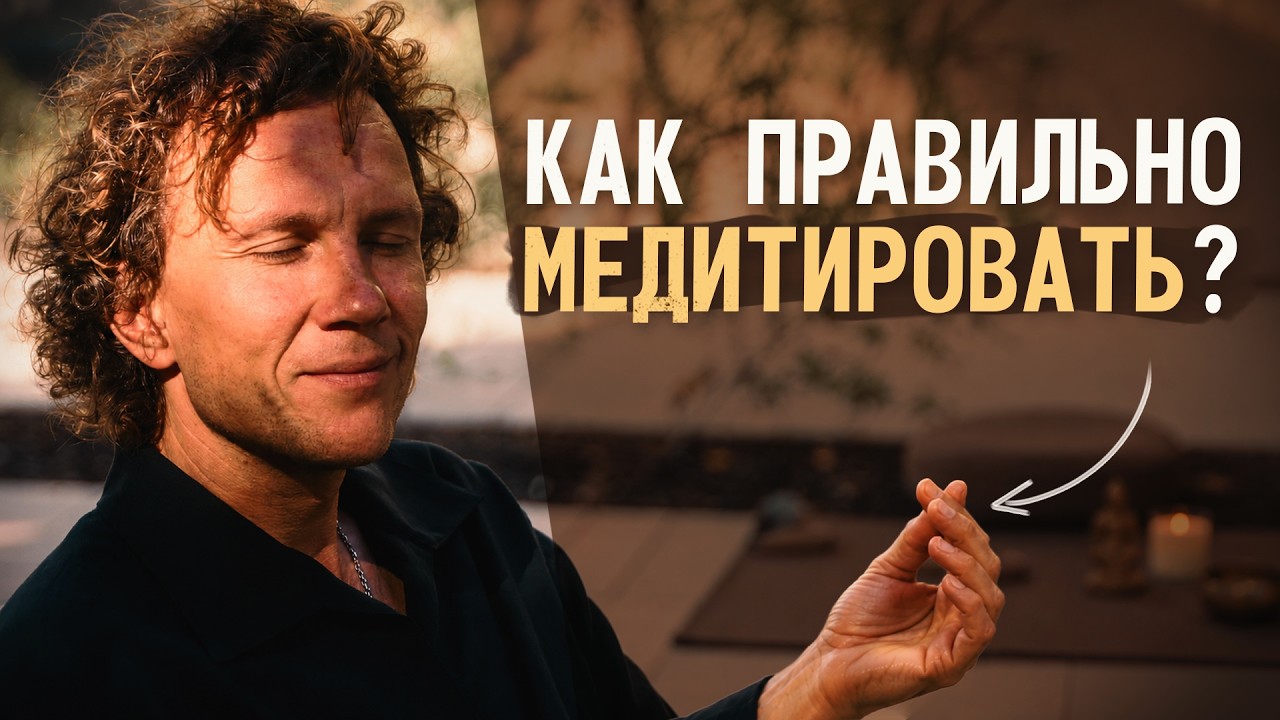
How many hours to meditate; sitting, standing or lying down; with your eyes open or closed; with headphones or without; at home or outdoors — people ask about this all the time. In this conversation with Olya, I look at which of these things really make a difference and why the first question to ask yourself is why you are doing it.
We talk about why music narrows perception rather than expanding it, what really lies behind tears during meditation, whether posture is connected to the flow of energy, and why any moment of the day can turn out to be more effective than thirty minutes of meditation.
Why you are doing it
People ask a lot of questions about how meditation works. Someone left a comment under a Telegram post: “How many hours on average do you spend in meditation?” And when someone asks how many hours you meditate and whether to meditate sitting, standing or lying down, people are treating it as an exercise.
There is a very good description of this from the point of view of yoga. The yoga everyone talks about everywhere nowadays is simple, basic exercises for people — a kind of sport. And there is a very good conclusion: however much you practice that yoga, it will have no effect whatsoever on your spiritual state and spiritual development.
The same can be said about meditation. If you treat any type of meditation as an exercise, as something you have to do for a certain number of hours, as something that leads to some state — it’s not even clear which one, say calming the mind or making your body feel pleasant — then you will simply be doing some exercises. And here a person should ask themselves: why are they doing it?
Why do it at all? What for? What do you want to get out of it? There are people who talk a great deal about how you need to do triathlons, or climb mountains, or run, or go to the gym.
The most important thing in all these matters is always to answer for yourself why you are doing it and what your goal is.
Do you want to prove something to someone? Or do you want your physical body to change visibly? Or to become healthier? Or simply to be doing something? Or to find some friends? Or do you want to call it a hobby, a certain way of spending your time? Why are you doing it?
It’s the same with meditation. Why are you doing it — standing in meditation or sitting, keeping your eyes open or closed? We will go into that topic. But the first question you need to ask yourself is: why are you doing it? Why do you need it at all? What, fundamentally, is the point of it?
Because if you don’t pay attention to why you are doing it, there will be no movement at all. None whatsoever. If a person is in a meditative state every day — supposedly in a meditative state — sitting down for thirty minutes in some meditation, in some particular posture, closing their eyes and reciting some particular text inwardly, do they become more spiritual from this? Do they bring spirit into their system, begin to understand more, see more, live more vividly? What is happening? Or is nothing actually happening at all?
Or what is more important and more effective? There is always the notion of effectiveness — the whole world is driven by effectiveness now. So perhaps it would be more effective not to sit down to meditate for thirty minutes a day, but to spread those thirty minutes across the day, observing your state?
I am recording a video right now. I can record it consciously — at least with the awareness and observation that people are required to have in a meditative state. Or I can simply speak about something or, for example, be in a state of serious, intense distress and stay in that distress the whole time I’m recording this video. Can you be in meditation and at the same time remain in a state of serious distress? That can happen too: a person seems to be doing a meditative practice, but in reality is in a state of serious, intense distress the whole time. So the most important thing is always why you want to do it and why you want to practice it.
Why sometimes with your eyes open and sometimes with them closed
I talk about this a lot here on the channel, in meditations, in assignments — everywhere. And still, my meditations and this channel have a particular meaning. Mine specifically has a particular meaning. Of course, you can find knowledge in all sorts of places, in different videos, from different people.
And you ask: what happens to a person, why in my videos — in mine specifically — do you sometimes need to sit with your eyes open and sometimes with them closed? It’s actually a very good question: you can get some very interesting, fundamental information out of it. And in general — where does a person in a meditative state or in meditation need to have their eyes open, and where closed? Where at home, and where outdoors? Where with headphones, and where without? Where it’s noisy, and where it’s quiet? When a person is driving or on the subway, when they are walking or sitting?
What is this, and what is needed where? It gives you the chance to understand even more clearly why you need meditative states at all, why you need any of this, why you would be in a state of learning and in a state of expanded perception. Why be in that state at all?
We have a cycle of numbered meditations. There are also meditations without numbers, but the numbered cycle is ongoing — at least when this video comes out, it is still being created. In these meditations I really do sometimes say that this meditation is better watched with your eyes closed, and that one with them open.
The thing is, a person has different organs for perceiving information — organs of both the physical body and the spiritual systems. Different structures of yours perceive knowledge and information. And understanding how all of this is perceived isn’t easy — it’s an overlapping story. We perceive and process a great many things at the same time.
Can we say that we are able to perceive something through sight alone? That’s hard to say. On the one hand, we seem to perceive only through sight; on the other, our activity, our thoughts, our knowledge and our experience are influencing us at the same time. And at the same time our physical body is sensing something, perceiving it right away. The question here isn’t what comes first: what is happening is a complex of perception. A complex.
It is essentially impossible to understand what spiritual perception is if you don’t perceive through it.
I have always said, and still say: if a person is blind, you can explain the difference between red and green to them as much as you like, but it will only be suppositions and guesses. One can truly understand what the red and green you are talking about are only if one is not blind, or if at some point one has regained one’s sight.
That is why any discussions of spiritual vision are illusory for most people: they are not in points of awareness. A person doesn’t consciously understand at all what is being discussed and what is meant.
In the same way, a person doesn’t understand what is meant when they are told to be in a state of observation. What does it mean to be in a state of observation — for example, when you are recording a video like this? What does it mean to observe something? People are told: observe the sensation in your abdomen, or the sensation in your right or left hand. Even such observations are very abstract. What are you observing in your abdomen? Your circulatory system? Which impulses? Which specific sensations? What are you even capable of sensing, what are you capable of recognizing?
Are you really capable of recognizing each of your organs — simply in order to be able to recognize your physical body? At a minimum, that requires understanding your physical body: knowing absolutely all of its structures, every centimeter or millimeter of your body, everything that happens inside, and constantly tuning in to it and directing yourself at it. Not just knowing abstractly from some diagram that the heart is somewhere around here, but truly understanding how it functions, how it works.
And how many people in the world truly know their physical body? I’m talking now only about perceiving the physical body. So what does it mean to perceive the whole world spiritually at the same time? Or what does it mean to perceive this room I am in? What is happening in this room? What energies are present in it at the same time? Only mine — or yours, as you ask me this question, or those of all the viewers who will watch this video? Or the energies of the street outside, or of the country I am in? Or has someone imprinted and left some energies here? Or are the energies of these vases or paintings at work? What energies are present in this room at the same time, here and now?
And this brings us to a very interesting point. If you perceive something with your eyes and the picture changes, it clearly affects you. If you are sitting looking at the ocean and suddenly a shark appears, or a bear starts coming out of the water toward you, it will have a certain effect on you. It will be a psychophysical effect — at the level of your body and at the level of your personality, your personality’s reaction. But it will definitely, without fail, have an effect. Even though at that moment you may be in a meditative state or an immersion that doesn’t depend on these circumstances, and, in essence, they shouldn’t affect you. They shouldn’t affect you at all.
Imagine you are watching some horror movie, and someone suddenly jumps out and scares you. People get frightened, even though it has no actual impact on them. Accordingly, when you perceive a space with your whole system — with both your spiritual and your physical senses — things can happen around you that will affect you and interfere with your immersion.
Music and tears during meditation
Sometimes, in a particular space, it’s easier for you to put on noise-canceling headphones or turn on some music to isolate yourself from the noise around you. Say you are sitting in a cafe, everyone around is talking, you’ve put on headphones, music is playing — and you are sort of with your own music.
A person is sitting and working — programming, doing marketing, writing a book or doing something else. They take off their headphones and say: “It’s impossible to be here.” What have they done? They entered a certain circuit of perceiving that music and, within that music, isolated themselves from the rest of the space — although they were in that space and remained in it. This is very important.
And here there would be a very interesting conclusion: can you be in exactly the same space in exactly the same way without music? Of course you can. Absolutely. If you can isolate yourself with music, you can be there that way without it as well.
By the way, you have heard this and you know it: many people turn on music during meditation. What do they turn it on for? To isolate themselves from themselves and from a lot of other things.
They narrow their perception rather than expanding it.
Through music they narrow their perception — this is very important. They really do narrow their perception to a particular area, and within that area they are able to tune in to something. It makes sense that if powerful music of a certain type is playing, you can concentrate and tune in to something. Especially if the music contains repetitions of some text or mantra, an attunement to something.
Imagine music in which a phrase is constantly repeated: “Observe the sun, observe the sun, observe the sun. More light, more light, more light.” Psychophysically, you will tune in to it and try as hard as you can to get into it, grasp it, observe, look. Various noises may appear for you.
But if the music is more or less relaxing, with the right structure, dynamics and the right impulses, then at some point you will relax psychophysically and direct yourself toward something. In essence, you will narrow your perception and, having narrowed it, get a certain effect that, for example, this meditation requires — say, a certain relaxation. You simply get a certain effect. But how this has affected your spiritual development, your spiritual state, is a big question.
If we look at another interesting point: people often cry during meditation. We see huge numbers of people in huge spaces listening to music and crying. And these tears are considered a sign that the meditation went great. But let’s look at the structure of tears. What are tears?
Tears are formed exclusively by the ego of your structure, by the underdevelopment of your spiritual system. Tears form as a consequence of your “I” absorbing your astral system, of your astral system narrowing.
So what is the positive effect of crying? There are certain positive effects on the psychophysical state, when a person, as it were, transforms the physical body through tears. But these are simply certain aspects of a certain experience. Because, in essence, in serious, proper transformation, in serious, proper development, there are no tears. They simply don’t exist. They are not a sign of anything good, anything positive.
You can say as much as you like: but what about tears of love, tears of happiness? There are no tears of love there, and no tears of happiness. These are socially invented aspects of perception. Come on, what tears?
Tears can come, and do come, only from the suffering of the astral body, from the narrowing of the astral body, not from its expansion.
But if you have laughter, if you have joy, that is an expansion of the astral body, an expansion of your whole system. Wonderful: a smile, joy — simply your own joy, the joy of life. This can happen in certain aspects. It is an important system.
Why limit perception
Why does someone tell you to do something — to isolate your visual or auditory perception, to isolate yourself in a particular room, or to enter a particular space that certain, let’s call them, waves or energies cannot reach? Spaces like that do exist in some form, of course.
For example, you can isolate yourself. There is a technique like this — burial: a person is lowered into the ground and covered with earth, and they are left with a tube to breathe through. There are practices like that, which people conduct. Why do this? A person is cut off from a certain freedom of the physical body so that they live through certain states.
And there are practices in which a person’s perception is expanded: they are placed in a particular space so that their perception expands. And then they are told the opposite: you need to get into a space in the city, for example. Or: you need to move, go somewhere, do something else. That is, a person’s perception is expanded. But mostly, if we look at the meditations people talk about, a person is urged to limit their perception. And why limit perception, what do you think, Olya?
– So that the person goes through a certain state there and connects it, probably, with their spiritual growth, some kind of awakening, an insight. You gave the example of someone being buried — I just pictured it, and the first thought that came to me was: this is a stressful situation. And it’s as if, on the contrary, it’s an opportunity to learn to feel calm inside a stressful situation. And that is the very spiritual growth people sell. Perhaps that’s why they narrow perception.
– There you have it — you’ve named a specific thing: so that the person gets a certain effect that is being sold.
And it’s very important for all of us not to sell to ourselves. Even when nobody else is selling, it happens that a person wants to sell something to themselves. In order not to sell to yourself, you need to understand: why am I really doing this, how does it affect me, what is actually happening?
I am by no means saying that you can’t meditate with headphones, or lying down, or standing, or sitting. But you need to understand the difference in what is happening. You need to understand what is actually happening and why it is needed. What is the point of meditating in the lotus position, which a huge number of people talk about? Is it a physical exercise — or does a person actually gain access to something? And if access to something, then to what, and why? Most important of all: to what, and why.
Posture and the flow of energy
– About posture. When I was studying this topic, they explained why the right posture matters: your feet or knees should touch the floor or the ground, your back should be straight, and the crown of your head — I forget what that point is called — should stretch upward. All so that during meditation the energy inside a person flows in the right way: a person’s physical position affects how energy flows in them. That is exactly why a particular posture matters in meditation. And here it’s interesting too: how true is that?
– Let’s suppose it’s true. This will be a good addition to the answer to the question of why I sometimes tell people during meditation to close or open their eyes, or to sit in a room where there are no other people. Let’s suppose what you just said is true: a person needs to get a particular flow of energy. But why do they need it? Why do I need this flow of energy? What exactly will happen thanks to this flow of energy?
Because if we look at the relationships in the world, the set of events in the life of a person who can sit with a straight back and of one who can’t doesn’t correlate. There is no relationship, none at all. Find me anything, any description at all. If there were any description in this area, there would already be scientific papers on the subject — scientists would have been quick to pick it up, and with pleasure. Find me any description, any genuinely real correlation of these events. How much does it affect how many children you have, how much money — which is what people usually do all this for — what state or mood you are in? What does it affect? Look at these things.
By the way, pay attention to what the bodies of various yogis looked like. I’m talking about real yogis now. The physical body — was it a beautiful body or just some body? Again, the question is why you are doing it.
People mostly do sports and physical exercise. They go to yoga, sit, do breathing, and then eat a bun. That’s the whole point: afterward they calmly, easily eat a bun or drink a glass of champagne on Friday — whether or not they understand the connections.
The question here is this: does a person understand what happens to their astral body when they consume any amount of alcohol, and for how long it is affected? How long is very important here. And do they understand what specifically happens if you have sat in a certain state, and what effect it has?
We keep talking about the effect here. I’m saying: when you cry, your “I” compresses the astral body, and a whole cycle of various kinds of damage and deterioration of your spiritual system is launched right away. It is entering a state of damage, of underdevelopment of the spiritual bodies, of underdevelopment of your spiritual system.
The most important question is why this is done, why it happens. To be aware of it. And being aware of it is possible when you are able to observe a large number of events at the same time.
Pay attention to a person’s speech. There are people who talk with you or give presentations on television. You can see the difference in their speech: the tone they speak in, the speed at which they speak, how they look physically, whether they move a lot or a little.
Any moment of the day
Why does it happen this way? Why does a person do this? Why do they sometimes speak very fast? I have videos or channels where I can talk very fast, and others where I speak slowly. Look, first, at why I myself am in a state that leads me to speak fast or slowly, or why I sometimes just went and half-closed my eyes. And what happens to the people on the other side who are watching this information? If I speak fast or slowly, what happens to them at that moment, what do these people feel, what state are they in?
Or there are meditations in which you simply stay silent. What happens at that moment? Or is it necessary to speak, necessary to explain something? And can simply a video like this be a meditation of much higher quality than forty minutes of beating a gong and sitting at some retreat? Imagine we were sitting here now in a particular state. Can this video be more powerful than sitting somewhere else in a particular state? It’s important to understand: of course it can. That’s the first thing.
Any moment of your day can have a far more serious influence on the development of your whole system, on your consciousness, perception, on causes and effects, on freedom, than any other event taking place.
Any moment of the day, no matter where you are: buying coffee, working at the computer, sitting down for a moment to rest, watching a series, talking with your child, stretching on a pull-up bar, or sitting down in a so-called state of meditation. This is very important — the so-called state of meditation. Any moment of the day can be far more effective.
And when any moment of the day can be far more effective, we understand: effective for what? Then we at least begin to understand what we are talking about at all in terms of effectiveness. For example, about influencing your state: affecting your state, changing it, switching on a particular state of yours.
You can spend an hour every day in meditative states and at the same time be fading in terms of the spiritual world.
Can that happen? Of course. It all depends on what you mean by this meditative state. What is being done at that moment? You simply sat down to rest — and you are resting. That’s how all people rest. All people sleep at night — a huge number of people, most people sleep at night, and most of them also sleep a fairly large number of hours.
And even if you simply lie down in bed and lie there for an hour without sleeping, you are also at a certain stage of a meditative state. Consider it a meditative state, and not simply that you are lying there. What is the difference?
It is impossible to perceive everything at once
So, once we understand that there are different organs of perception, it’s worth asking: is it possible to be present with all the organs of perception at once and perceive everything at the same time? And here it is very important: you can’t always perceive everything at once. It’s impossible. A human being is not made to perceive everything at the same time. What’s more, a human being cannot perceive everything.
Their task is to develop in terms of perception and understanding of everything that is happening. Their task is to expand their perception, their knowledge of themselves, in particular of their whole spiritual system. That is why it is an endless process of learning. It has a certain limitation, but I talk about that in other videos.
When the process of knowing yourself is endless, and when, because of this endlessness, we understand that perceiving everything at once is impossible, then at some moments, in order to focus on a particular experience of living through something, you need to concentrate on it and focus even more. For example, you are unlikely to learn to play the piano while drawing, talking with, say, four children and studying mathematics at the same time. That is practically impossible. Or you would need to have an incredibly powerful system of consciousness and perception of everything that is happening — and at the same time also observe your whole physical system, your spiritual system, the influence of different worlds, states and energies on you, the living through of the past and the future, the scanning of the past and the future, and everything that is happening in general.
It’s a rather complex process. Can you be in a large system of learning all at once? You can, but for that you need to be capable of it — of learning a great many things at once. If we look closely, people can’t type messages on their phone and listen to another person at the same time. It’s a very simple action — being able to listen to people and write something at the same time, or deal with something in parallel. Basically, people can’t do that. There are people who individually can, but basically people can’t.
People can’t even simply listen to another person. They get distracted, they forget that they’re supposed to be listening to this person, trying to figure out what they are actually saying. Sitting in a lecture at university, a person starts drifting off in their thoughts. They can’t do even one thing — simply listen to the lecturer who is explaining something and try to grasp what is being said.
And if they have thoughts — to grasp what is being said and observe their thoughts at the same time. And if their physical body hurts or changes — to observe the physical body at the same time as well. And then an intuition comes flying in that tomorrow something will hurt or that they will fall ill — to perceive that too at the same time, to be in that learning. And then — whoosh — a bird flies into the room. You need to perceive the bird at the same time too. And classmates are sitting nearby, and you need to perceive these people’s state too, because each of them has their own state, and these states can also influence you.
Sometimes people have an obvious influence: if someone, say, walks into the room naked, that usually influences everyone. Or shouts, for example, or lunges at you. And sometimes a person has an influence that isn’t obvious — through energies. You need to be able to be present in all of this at once. That is why, in certain practices, it is quite normal to sometimes limit your own perception.
Closing or opening your eyes is just a help
And that is why in some places I say: “Be sure to sit with your eyes open.” Why? So that a person, while their spiritual being lives through various spiritual states, has their whole psychophysical system engaged in this learning. So that their whole system and all their spiritual bodies connect, their whole structure is constantly connected, and the flow of energy exchange runs properly.
And there are places where you need to close off visual perception in order to engage a little more deeply in living through what is happening. People see a great many spiritual worlds, after all — they just don’t understand that these are spiritual worlds. They don’t know what it is. The world has told them all that these are hallucinations. Everyone sees them all the time; it’s just that if they start talking about them, they’ll be told it’s time to go to a psychiatric hospital.
And actually, when a person closes their eyes, they very often can’t calm the stream that runs visually before their eyes or in their thoughts. If you are a healthy person, go ahead and calm down, make it so that you have zero thoughts. Zero. After all, everyone says they are healthy. So let’s show at any moment how healthy a person is. We meet at any moment, and you go: “I have zero thoughts right now.” Or: “I am calm right now.” If you manage your thoughts and manage your psychophysical system.
And what is zero thoughts in space and time anyway? What is it? Here I am recording a video right now. Can I enter a state of zero thoughts? I can. Just now, while I was speaking, I was entering it and even transmitting that state. But as soon as I have entered a state of no thoughts, I have to come back at the same time, because I am talking about it. Or don’t I have to come back? I have to come back from it at some point — or should I never come back at all?
If we look at a person’s whole life, on the one hand it is only a flash. On the other hand, it is quite a large amount of time and events that cannot be recaptured or described. You will never tell the whole story of your life — you won’t have enough time. The story of your life is always longer than the life itself. How could you tell about all your states, describe everything you see, everything you perceive? A person can’t even describe everything they perceive.
If I start describing just what is in my room, I will be describing it for hundreds or thousands of hours. And I still won’t describe every speck of dust, every grain of sand, every element, every visual detail, every micro-feeling of mine. I will never in my life describe them all.
That is why in my meditations I say at what moment a person needs to limit their perception and at what moment they don’t need to limit it and should let themselves perceive more broadly. And often in a meditation I narrate, tell, explain and say: “Observe. What stream of thoughts do you have right now — is there one or not? Have thoughts appeared or stopped? If they have appeared, what are they about? Why have they appeared? Observe this.”
Is there a technique for a person to, say, stop their thoughts? On the one hand, yes. On the other hand, no. Because part of your system will enter a certain experience of absence — there are such spaces of silence. And another part of your system will generate spaces in which certain information will come to you, and you will be living through that information. Can you intensify one state or another? You can. The question is why.
It’s always a question of why. And the next question is: does fear arise in you about this? Because most of the people I have seen who got into a state of silence actually didn’t much want to go further into that silence. More precisely, while they were in the silence, they of course enjoyed being there. But when such states begin to arise spontaneously, a person’s personality structure — what is very close to the notion of ego, if one puts it that way — begins to resist it very strongly. Because it doesn’t need this. The ego doesn’t need this. Why would the ego need a state of silence and the possibility for a person to enter a state of control over their life, of true understanding of the whole system?
Control over your life is not freedom. Control over your life is understanding — a correct understanding of causes and effects. But it is not freedom — not social freedom. In terms of social freedom, a person thinks like this: “I want to control my life. I have decided to be rich or poor. I have decided to live in the USA or in Belarus. I have decided to have fifteen children or none. I have decided that my eyes should be wide or narrow, my skin this color or another, that I should have wrinkles or not.” That is what a person means by control over their life.
Control over life from the point of view of the spiritual world is when you understand causes and effects and don’t compete with them.
You simply don’t compete with it — just as an ordinary person doesn’t compete with the sun coming out. Of course, there are scientific worlds and scientific systems that try to compete with this, to change something, alter it, make use of it. But basically a person doesn’t compete with the sun appearing. And there are people who try to compete, for example, with the fact that you have to sleep — they try to change their system a little. Or they compete with their sex. There are people who try to compete with this, try to fight it, rather than simply live and observe what is happening. But freedom is in living and observing what is happening, not in competing.
What is closing your eyes or opening them? In fact, it is a help for a person to focus as fully as possible on certain states while living through them. It is just a help.
To walk forward or to drive a car forward, you need to put it in forward gear, not reverse. It is just a certain help for a person to move forward, to live through something, to feel something for themselves, to see certain states for themselves.
You just always need to understand why you are doing it. And I want to say: if someone tells you to close your eyes or open them, in this case you either trust that person or you don’t. You either perceive them as a student would, or you don’t. Then this question won’t arise for you at all. It makes no difference to you. You were told to stand for two hours — you stand for two hours. It makes no difference to you. That is the only possibility that exists.
🎥 Video for this article
Original video · Russian audio