
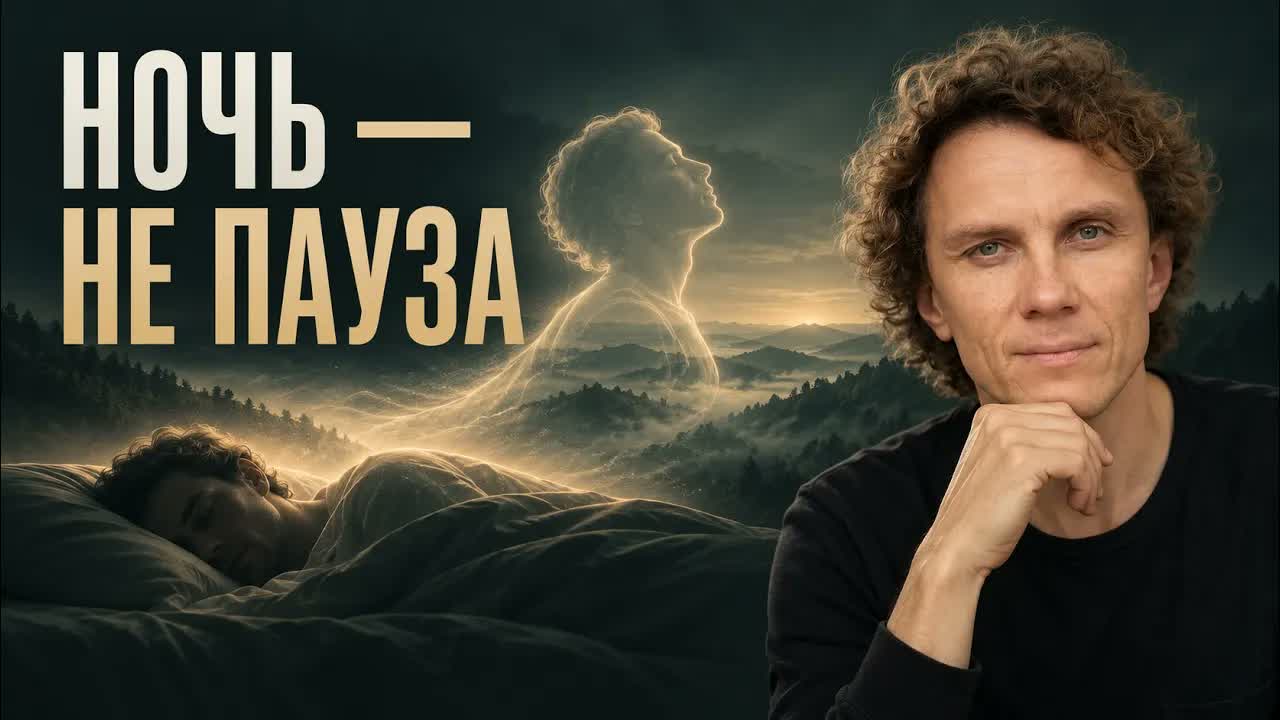
In this episode, answering Olya’s question, I look at what happens to a person during sleep from the point of view of the spiritual system, and where their consciousness is at that moment. And why conversations about dreams turn so easily into fairy tales, even though a person spends most of the night unconscious.
Why, recalling Rudolf Steiner, do I consider dream interpretation an extremely difficult task? And might we be passing off ordinary intuition as a message from a dream? This episode is about how to look at sleep and the night more broadly, without limiting yourself to ready-made interpretations and familiar descriptions.
What happens to a person during sleep
– What happens to a person during sleep in terms of their spiritual system, and where is their consciousness at that moment?
Why conversations about dreams resemble fairy tales
– If we take the subject of dreams, then of course it gives rise to an enormous number of discussions in people’s lives, because for a person it is something unreal on the one hand, exotic. And as a result, it is interesting to discuss: to tell how you flew, traveled, moved around. Or to come and tell someone about a bad dream, or to ask what that dream was supposed to mean.
From the outside, the discussions people usually have create a certain fairy-tale quality, an illusory perception. Why illusory? Because a person is immersed in all these interpretations and discussions purely from a position of a certain childishness, without even fully understanding how a person’s night is arranged — even materialistically, let alone from the spiritual side.
And as soon as you start approaching it from the spiritual side and shedding light on certain aspects and moments for a person, people begin to close themselves off very firmly.
If during the day you tell a person that they are outside awareness, outside the system of perception, and do not truly hear, see, know or understand what is happening — then what can be said about the night, when for most of the night the person was completely unconscious?
By the way, it is interesting that people analyze and interpret the dreams that occur in a certain phase — when a person can remember them. A person certainly doesn’t remember all their dreams. So what happens during the rest of the night? There is a very good exercise.
Exercise: the third of our lives we overlook
If you tell a person, “Look back over your life,” then, looking back, they will begin to remember what happened during the day. And essentially they won’t even direct their attention to a third of their life: they won’t feel it, won’t see it, won’t look at it in any way at all. And you can tell them: it is important for you to concentrate on the fact that when you look back, you went through not only days — you also had nights.
Say I have just spent three weeks traveling around Europe. If someone asked me what happened in Europe, what it was like, I would recall and say: “Listen, on these days I was in these countries, on those days in those, and on these in these.” But I wouldn’t say: “I was in these countries at night, in those countries at night.” Where was I, what was happening at night?
And that is quite a long time, very important for a person, incredibly important.
What to understand about the night before interpreting dreams
And if we approach the study and interpretation of dreams — if a person wants to approach dream interpretation at all — they should at least figure out: what happens at night in terms of the spiritual system? Why does the system fall asleep at night at all? What is that? What happens to the spiritual bodies — to the etheric body, the astral body, the human I? What happens at that moment to the various spiritual processes, and why is it needed at all — not physiologically, but spiritually?
If physiologically, materially we can say that at night the system rests and the body recovers, can we say the same about the spiritual system? Does the spiritual system recover — or are certain processes lived through in the spiritual world from the point of view of your spiritual being?
Once again: if you live with the understanding that the spiritual world is primary and carries the fundamental system, function and states, and that the material world is within this spiritual world, if we understand that a person’s life is not limited to their current incarnation, their current embodiment — then, if that is so, it is in effect all the time, including at night.
So what, then, happens to a person at night from the point of view of the spiritual world? If during the day we can say that we receive various impulses from our spiritual system and act in some way, then what happens at night?
Figuring this out is a big, serious meditative task. But this approach, this knowledge — or rather, this focus of attention — is extremely important for a person: directing your attention that way and looking at what really happens to a person at night.
Can dreams be interpreted? A dream or intuition?
So when people often come to me and say, “We saw a certain dream, and it is interpreted like this; I heard it, or someone said it, or I read it somewhere,” — I always recall Rudolf Steiner, who said that, fundamentally, you cannot interpret any dreams in any way.
It is an extremely, critically difficult task. And the probability that what you are telling has any genuine, real meaning is very low — otherwise these are just some discussions, strange interpretations.
And do you see what the point is? Imagine you dreamed something and say: “This means a guest will come today.” Some interpretation like that, for example. Who told you that you see the guest coming in connection with the dream, rather than simply having seen it through intuition and somehow tied it to the dream?
This story is always very interesting to study: what comes first in terms of genuine seeing or genuine perception? And could it be that when you saw that a guest would come, that guest, on the contrary, will not come? That you, on the contrary, will block or restrict this energy?
So interpreting dreams is a task that is not just unnecessary, useless or leading a person into deception: it also leads a person away from genuinely serious observation of what happens at night.
What happens to the spiritual bodies at night
And at night a process critically important for a person does take place in terms of the spiritual bodies. The astral body and the I of a person separate from their physical and etheric bodies, and essentially the person is unconscious at that moment.
There are completely different states in which some relative connection takes place. Because the notion of connection is very relative. What is a full, one-hundred-percent connection, and what is a one-hundred-percent absence of connection? On the one hand, a connection of a certain kind remains even when the astral body separates. On the other hand, what does it mean for the astral body to be present one hundred percent? To what percentage is it present at all? Can this measure how much a person is in consciousness, in perceiving their connection with the spiritual world? And how ready is the spiritual system at all for a person to be in perception?
The thing is, a person thinks that they will grow and cultivate certain characteristics in order to hear the spiritual world. But within the spiritual world you have a spiritual being that may be completely undeveloped in some part. Although one cannot say “developed” about basic spiritual existence: it is in the process it is in. You can’t even call it some level or measure it with any parameters or percentages. Of course, you can make some imaginary analysis. A person is where they are.
And to say that they will consciously rise up from the physical world and somehow transform all the systems is a big question. Is it possible to do? It is a big subject for your own observation, your own study and for setting certain priorities, certain points of support.
So, in a person the astral body and the I separate. This is an important task, an important aspect for the spiritual world. And this aspect is needed not just so that your physical body can rest. This is how the whole human system works. It is very important that a person’s physical body will not live without the etheric body, and without the astral body and the I it will not actually perceive. That will not happen.
Are you really in control of yourself?
For medicine it is clear: a person has fallen into a coma. How can they explain it? They will describe what happened to the brain or to the system’s parameters. But can people truly observe what is happening at that moment to the soul and spirit in a person? What is happening at that moment to their bodies? Why did the physical system react precisely that way?
If the astral body and the I suddenly left me right now, I would switch off — I wouldn’t be able to hold it all together, I wouldn’t be able to stay seated. So the system holds everything together by itself as a whole. It isn’t as though I walk around controlling it and making decisions about what to do and what not to do.
Am I really in control of it? Am I truly in charge of it? A person should ask themselves this question and say it to themselves.
And of course, for the spiritual world this process is of great significance in terms of processing what happened to you during the day — processing all of it in the spiritual world. Is it possible to understand what is really happening, where the astral body is, where the human I is? And can you imagine what relation dreams have to this? And if they do, what kind?
If you do not hear the world by day, how will you perceive the night?
If during the day a person does not truly feel or hear the world around them, defines the whole world only through visual perception, only through tactile sensations, only within the physical world — how can they perceive what actually happened at night?
That is why the first focus of attention, which I described as a good exercise, is to direct your attention so that, looking back, you know there were nights and understand that you lived through those nights. This is very important.
And right here you can add a serious meditative observation: constantly understanding, throughout your life, in every minute of your life, that you have a spiritual world that is alive at this moment, and you don’t understand what is happening there.
This doesn’t mean at all that something important is happening there in terms of social constructs, the material world or material debate, something extraordinarily interesting that needs to be put on display.
But this world is alive. This is very important: it is not limited to your current consciousness, just as your body is not limited to the physical body. The physical body is limited.
Can the astral body be called a body?
For human beings, people even devised an interpretation: they named the physical body, the etheric body, the astral body. They began inventing, adding that these are bodies too. But are they bodies? What are they really? Can the astral body be called a body? If the etheric body can still somehow be tied to the notion of a body — although that too is a big question — can the astral body be tied to it? I’m not sure. If you go into the terminology of this word, it will be essentially impossible to describe.
Even personality: when someone says “a person’s personality” — how do you describe it? What is it at all? There is an enormous number of descriptions, interpretations, details, but you can go on expanding this term endlessly.
It’s the same as the modern term “artificial intelligence” in technology. Can you describe what it is? What actually stands behind these words? Is it some program, a system, or some kind of spaces? Or move on to the word “power” — how do you describe that?
The task, as it relates to sleep and, in general, to a person’s perception of every moment of the day, is not to limit yourself to false descriptions, false perceptions and false beliefs, but to look at these processes more broadly.
🎥 Video for this article
Original video · Russian audio