
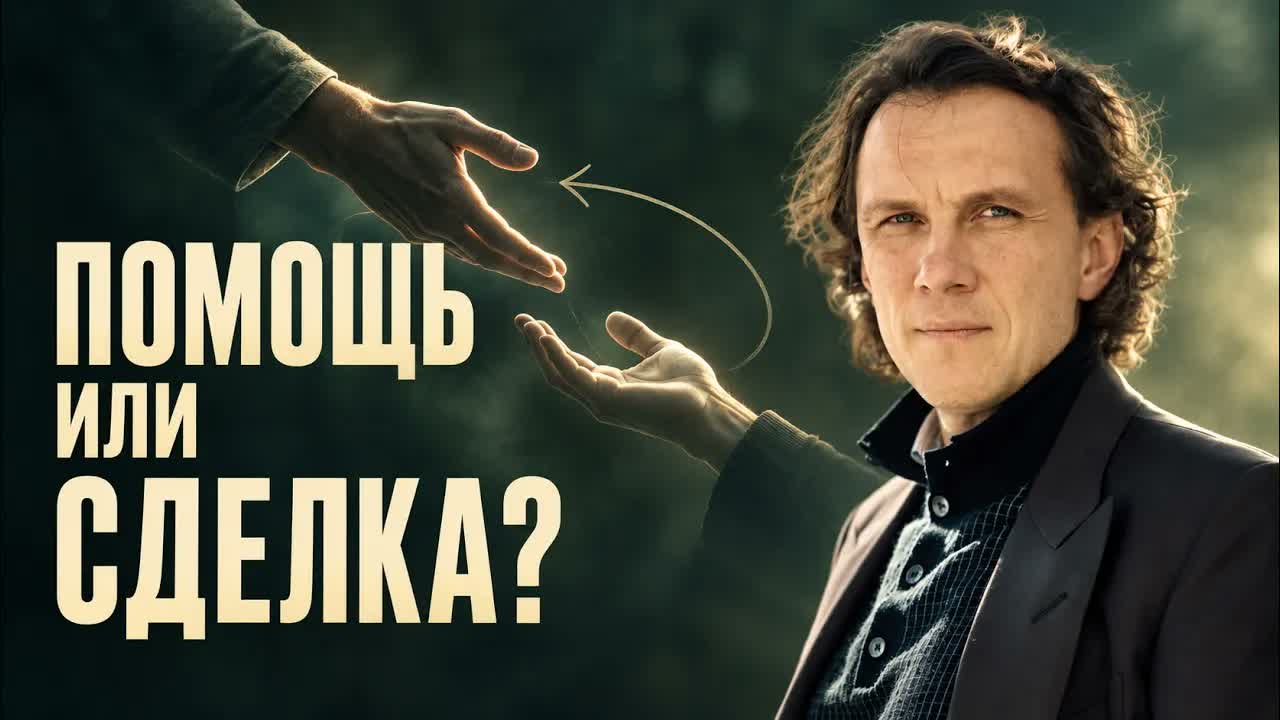
Have you helped someone, invested in them, supported them — and not received even a thank-you in return? That is where the familiar saying comes from: “No good deed goes unpunished.”
In this conversation with Olga Stolyarova, I look at what real goodness is, why expecting gratitude turns help into an exchange, and whether a well-intentioned action can actually harm another person. It will help you notice more precisely when you act out of love and a desire to help, and when you are waiting for recognition, gratitude or a particular response.
What is wrong with “No good deed goes unpunished”?
– There is a fairly popular saying: “No good deed goes unpunished.” It seems to be said by people who did something for another person, helped them, perhaps expected something in return and did not receive any gratitude. Often a person says this outright: “How can that be? I helped, and got nothing in return — not even a thank-you.” I would like to understand what real goodness is, what it should or could be. And should it bring people some benefit?
– When a person says, “No good deed goes unpunished,” it is a total construct of the ego-system — simply a one-hundred-percent, basic ego-system. We will now look in detail at what help is and what goodness really is. But overall — what is the person afraid of in this phrase? In this phrase the person fears evil, or wants there to be no evil. That is on the one hand. On the other hand, besides that, they want a mutual exchange: by doing something, they want to receive something. And there is also a third broken construct: supposedly their good led to evil, and so they won’t do that either.
That is already another story. And there is also the story that they wanted to do good in general in order to receive good. So there is a whole series of false constructs of perceiving human life here.
A true perception of goodness
What would the true construct of perceiving human life be here? What would the construct of truth be? Let’s consider: suppose the person said the following in this case:
“I will do good regardless of what I get in return. I will not do evil — not so that good comes to me, and not so that I don’t receive evil. I will not do evil because this lies at the foundation of my worldview and my values.”
And here is a very interesting story: a person can immediately ask themselves: “Am I ready to think this way or not?” Because most people are not ready to think this way. They are ready to describe it with various characteristics, various concepts, to go into some deep analysis, into various techniques, into details, to look for other causes and effects — social, psychological, whatever. People are ready to do anything at all, except to say right away, regardless of anything, whatever happens: “I do not want to do evil. Whatever happens, I want to bring good — and I want to bring good simply because it is truly right.”
Then someone will say: “And if someone hits you in a certain situation — are you ready to turn the other cheek?” I say: let’s not think that way at all right now. Let’s not compare at all and not look at that right now. Let’s consider, a priori, the construct at the very beginning. Are you ready, in general, to think that you want to bring good into the world? Is this present in your consciousness at all? Let it be five percent, let it be ten. A person will say: “All right, that’s all clear. In general, I’m ready.” But are you really ready, every time you do good, to remember that this good is not done in order to get something? To remember it every time? And when you do some good deed in order to get an exchange, do you understand that it is then a social construct?
For example, I’ll bring you a kilogram of mandarins, and in return you’ll give me ten dollars. That is simply a social construct — then it is not a question of goodness. Then at least you are not deceiving yourself: if you want an exchange, then it is not a question of goodness but a question of exchange, a question of some social understanding of what is good and what is bad. Because many people also pay money for bad actions. That is important. And many people don’t pay money for good actions. Just as many people leave a tip for bad service in a restaurant, while someone else leaves no tip for good service. This is not a question of goodness; it is a question of some social way of thinking.
Are you, as a person, capable of thinking this way? I say to myself: “Am I, as a person, capable of thinking this way?”
If I think this way, I have no problems at all with perceiving what follows. If we have a foundation — and without this foundation it is pointless to look further and listen to arguments — then I look further.
- Can there be situations in which I do good for people and good comes back to me? There can.
- Can there be situations when I do good for people and nobody notices or finds out at all? There can.
- Can there be situations in which I do good for people and evil comes to me? Of course there can.
- Can there be situations in which evil is done to me, but in another place a great deal of good is done that I do not associate with this situation? Of course there can.
When doing good harms another person
Here is the question: what do you live for? What is your true intention? Can there be a situation where you do good, good comes to you for it in another place, and because of this you will suffer very seriously — or someone else will suffer very seriously? Can there be situations in which you do good, evil happens to you in this place, and in another place another person conveys something good to you or receives something good? Can there be a situation where you do good, but for another person this good is not good, and their system does not perceive it as good?
People often say: “This person is ill; they need help.” When you help them — is that good or evil? If you consider the spiritual world and we see that the person wanted it to be this way, then you are doing them evil, because the person needed to be ill.
Imagine: a person opened a company, and problems begin in it. They opened it with a mistake from the start, and they need to close it. And you do good — you help them in this company so that they develop. But in reality, if you look at it globally, you are bringing them not good but evil, because from the start they are in a system that should not be developed. The only thing they need to do is close this company and not develop it further. So are you bringing them good then or not? This story is incredibly fundamental.
Where we go wrong in judging good and evil
What is the story here?
When a person believes they are bringing someone good and wants to get something for it, thinks at all in terms of “but I brought good,” tries to assess it — they are essentially placing themselves on the level of some deity, on the level of an incredible energy.
Because the question arises: what is good? Of course, in the social world people assess good by certain parameters:
- fired someone — bad;
- hired someone — did good;
- offered a job — did good;
- helped carry a bag — did good;
- raised an employee’s salary — did good;
- withheld a bonus — evil.
But in reality, if we look deeper, we will see that good and evil are clearly not assessed by such criteria. If we look at the world more broadly, we will see that there are aspects where the concept of good and evil does not exist. Is there a space where the concept of good and evil does not exist? Of course there is. Even if you look at a particular event that has happened in your life.
In one place you were given a bonus, you set the money aside somewhere, and then, for example, it was stolen. There seems to be neither good nor evil — just some balance taking place. Or, for example, a person was paid their salary and died. What did they need that money for? They never spent it. There is a lot of this too. That is, there is a concept higher up where there is no good and evil — even if you consider, at the very least, a person’s birth and death.
So at least from this point you need to proceed when considering good and evil for a person, the causes and effects they live through, these or those events. At least this is where you need to start — from life as a whole: for life as a whole, is this really good for this person or not?
True goodness: how to avoid harming another person
Another aspect is a smile from the heart to another person, when, seeing someone, you think: “I wish this person well.”
When you expect nothing in return, when you do not try to assess goodness in any way — specifically, to assess it — but simply think from love and from the heart, can this be a negative aspect? It cannot. Not in any way.
How constantly judging “good or evil” prevents a broader view
In essence, the concept of assessment has a very serious influence — whether any evaluative judgment exists. Of course, if an evaluative judgment exists and there is an assessment, then there can be no question of any good and evil.
And we see how seriously the world manipulates this. Good is when the parents beat the child: look how well he turned out. Or good is when the parents paid no attention to the child: look how independent he became. But there is the opposite story too: they paid no attention — the child drowned. There are different factors, different spectra at the same time. And there is also the question of finding causes and effects. Perhaps you did not pay attention because you had no energy or strength for it, and the child became successful at something not because of that but because of completely different energies. And those energies, on the contrary, complicated all his perception, and he was in a very difficult state in terms of his thinking and perception.
Yesterday I read someone’s post on the internet: “We analyzed the richest people on the planet, and here is what they all have in common in their upbringing: their parents did not answer the child when he asked a question, or gave him free time during the day, or did something else — for example, in terms of activities or school.” Some parameters are listed. Absolute nonsense. How did you define success? I will find you a thousand more such people for every case and prove that being allowed to play outside with hamsters and ants in no way led a person to success. And there are people who were not allowed this, who were restricted — and a very healthy person grew up.
Are there basic principles of upbringing? There are. But in order to go into those basic principles, you need at least to take a broad look and decide how we perceive a person from the outside. If you perceive a person as a physical being and only the material world, while I define a person as a spiritual world — how can we then discuss and compare upbringing? That does not mean someone is right or wrong. But it is pointless for us to analyze, because we will have different starting values for assessing a person at all: their joy, happiness, comfort, perception of life, difficulties, the assessment of their life as a whole.
By what criteria will we then measure their life? Otherwise we arrive at notions like these: they seem to feel fine, they seem to have become a decent person, their children seem decent. But does a person become indecent if their child kills someone? Who is to blame for that? The parents, teachers, neighbors? Who exactly? The child became someone bad because they were meant to become someone bad. And even if their parents, for example, behaved somehow inappropriately — did the parents’ actions directly affect the child’s life, or was it the energy this child evoked in the parents, so that they could not behave with the child any other way? What is this? That is what matters.
How powerful events narrow our perception
A few days ago I had a situation: I yelled at the children quite a lot. I may get that angry perhaps once every five or ten years, I don’t know. And interestingly, I was in quite a good state. There was only one thing that happened that day. It is very important to look: did I behave appropriately? Clearly not. Could other solutions have been found? They could have. Was it necessary to find other solutions? I don’t know. But there was one single thing: that day we had gone to a certain place, and my daughter lost consciousness. We called an ambulance.
I seemed to take it all quite calmly, unlike my wife. She took it with strength, but not calmly. I was calmer, but even so it is a story of its own when a child collapses in your arms several times. And there even seemed to be reasons — reasons that seemed to have no consequences. But what happens to the spiritual world at that moment? What happens to your energies? This is the only circumstance that can be seen on the day I yelled at them: because of this circumstance my perception narrowed. That is, I lost a certain amount of energy. Although you can see that I was calm, because that yelling was triggered at a specific moment.
I needed to record a certain piece of material, I sat down to write it, and I was thrown off. But after yelling I came to myself, sat down to write the material and, as always, delivered it as if nothing had happened. That is, you can see that I was in a state of normal, healthy perception. But something was missing for me, something I didn’t see, something went completely wrong. Here you could make things up and tell the children: “Look, I’m yelling at you because you were doing something wrong too.” A strange position. And why are the children yelling? Perhaps that day they too were in such a state because their sister had fainted. Could that be the reason? Could it affect them more strongly than it affected you?
We never like that, after all. We like to say: “Oh, you’re suffering today — go ahead and suffer, you have a problem, we won’t bother you. Oh, you’re taking an exam, of course.” And you have to surround the person with everything. “Oh, you’re getting divorced — of course you have a problem.” And the person says: “Listen, I’m coping with the divorce much more easily than you cope with each of your days.” Or: “I’m coping with this death much more easily than with each of my days.” The question is what energies begin to move.
How to help yourself and others when things are difficult
Speaking of that incident: my daughter was having her ears pierced, they were putting in an earring, and at that moment she kept blacking out. She came to, lies there and says: “I don’t want to die.” Clearly, that’s her reaction.
And I tell her: “Look more widely at the Earth.” That was a very interesting aspect.
There is such a solution when you start feeling bad — by the way, it applies to everything: when you feel emotionally bad, when some unpleasant trigger states switch on. You could even call this state meditative; for some it may help: a person begins to perceive the Earth more widely.
She says: “What does that mean?” I say: “You remember where we live. Draw yourself a map inside, just look more widely, as if from above at everything that is happening.” She says: “I don’t understand what you mean.” I say: “Keep doing it.” Then we came home, and I say: “You know, the most important thing is: when a person says ‘I don’t want to die,’ at that moment to tell yourself: ‘I am ready to die.’”
She says: “Dad, listen, I didn’t want to die in the shopping mall where I was getting my ears pierced.” She is sixteen. I say: “We never know where we will die. But if we are already dying, then at the very least we let it go. And on the other hand, you can ask all the higher powers, all the light, all the sunlight, all the energies to help you cope with this. As soon as you go into fear and it starts eating you, it drains your energy and takes you over completely. It is impossible to be together with it. Fear becomes madness.”
But the influence of such events is obvious. Just last night my wife came to me and said: “Listen, every time I see that day, that photo from the place where the ears were pierced, I feel sick.”
That’s it — this is laid-down energy, a fear that can stay until the end of one’s life. I remember the fear I had. My dad had arrhythmias, and I had a really serious fear that he would die. And this fear lasted to the end, until he died — ten, maybe fifteen years. Every time he had an arrhythmia. Or every time he was in a state of narrowed perception. This, by the way, is very interesting. For example, if he and his friends had a drink somewhere. You’re a child, after all, and you see whether your dad is drunk or sober. It’s not that my dad drank much, but they could easily have a drink. And you see a person with narrowed perception. I talk a lot about expanding perception, after all.
What happens when you see and feel a person with narrowed perception? I’ll tell you right away: when you see a person with narrowed perception, you feel very bad. And when you see your own parent with narrowed perception, you have a specific construct formed: they may have a health problem right now, they may die. And this leaves incredible imprints in your own system.
What, for example, is losing consciousness? It is narrowing perception completely. Within a human being — completely narrowing conscious perception, because there is still a spectrum of unconscious perception there. It doesn’t mean the spiritual system didn’t let you go anywhere. But it narrowed your perception. You see a person with narrowed perception — and an incredible fear arises in you.
Fear for this person or for yourself? That is the question. Of course, for yourself. “What will I do? Where will I be? What will be happening inside?” All of this lies in an incredibly wide spectrum. Somewhere fear for the person can arise too. But what exactly is there to fear for the person if, for example, this is their destiny?
You should at least first ask yourself the question: perhaps this is the natural course of circumstances? And allow that this is how it should happen. At least do that.
Of course, it is not easy to do when something is happening to your own child. You are in the unknown — at this very moment you are in complete uncertainty of perception. That is why, of course, any other person with expanded perception will basically have a calming effect.
In every respect — even if being next to them is hard for you socially, hard morally — overall this person will calm you, because they will carry the most balanced spectrum of energy. They will not project their background onto you, their narrowed background.
For some reason I have now remembered people’s comments again. I see that people often leave comments on YouTube videos — especially on our more mass-audience channel about artificial intelligence — and they leave simply such rubbish, negativity, it’s simply unreal. There may not be much of it, but there is a lot of negativity in it. You read — and there is still negativity.
After all, if a person writes and projects negativity in comments, it is in any case narrowed perception. It is not narrowed perception only in one circumstance — if they were asked: “How do you perceive me right now — positively or negatively? How do you think I look? How do I speak? What do you think my character is like?” But if no one asks about this and the person projects it anyway — it is obviously narrowed perception.
And you can always observe yourself: where you want to judge, to gossip, to add your opinion — that is a signal that you are in narrowed perception. If you want to do it all the time, you are simply always in narrowed perception — relative to yourself.
Look, I am by no means setting some “one hundred” mark of perception for all people, because people cannot be compared in terms of perception. All spiritual systems are fundamentally, incredibly different. But what can certainly be done is to basically diagnose your own presence in your own reality. If you are in a state of perceiving at least the Earth and yourself on this Earth, regardless of any personal characteristic, then the desire to argue, the desire to discuss something or the desire to bring someone some description will basically not work in you — or will work less.
Dividing good from evil
That is why, of course, dividing things into the concepts of good and evil, into parameters of evaluative judgment about another person — who is good and who is bad — and assessing your own actions as good and bad, especially from the standpoint of understanding the development of the spiritual world and spiritual systems, is basically evil. The very assessment, alas, is not good.
Because when you are in a true living of love for people, in a true understanding of goodness toward people, in a true, real understanding of serving people, the very comparison, the very evaluative judgment will not arise in you. It simply will not arise — it will be absent at the very foundation. Then you can analyze for yourself — precisely analyze, investigate, study the harmony of this circumstance.
You can study it, but it should not turn into a mode of endless analysis and comparison: is it good or bad, shameful or not shameful. And what do you get for it?
Fear of receiving evil is fear. This is important: fear of receiving evil is already a negative spectrum of perceiving everything.
🎥 Video for this article
Original video · Russian audio