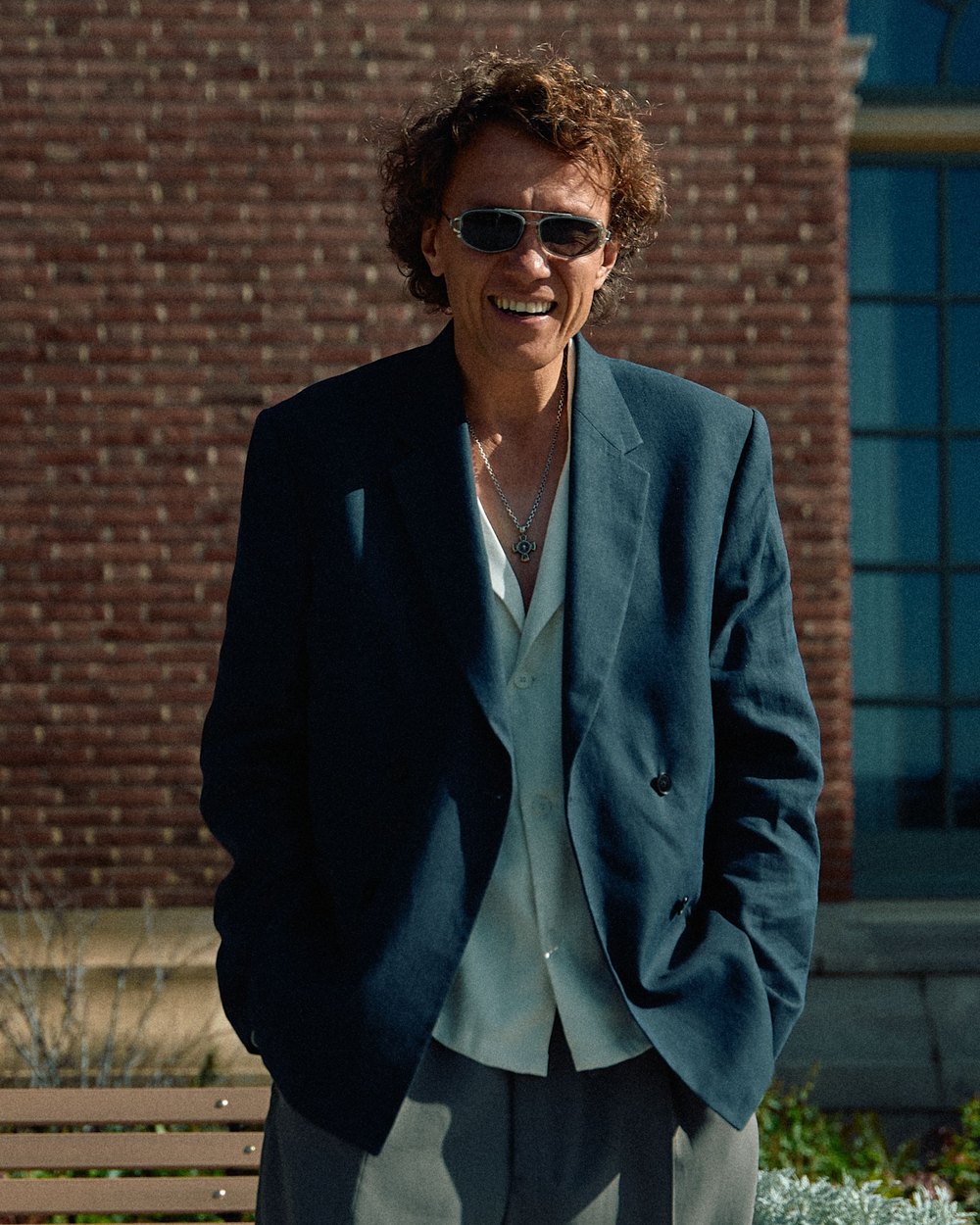

In this conversation with Olga Stolyarova, I look at the nature of suffering, anxiety and inner dissatisfaction: why a person keeps suffering even while pursuing self-development, working on themselves and trying to change their life. How can you work with your state without turning happiness and calm into an end in itself? And why can healthy acceptance of unpleasant states give more freedom than a constant struggle against them?
I also talk about how a space affects anxiety, about the human striving for stability and the wish to know your life in advance. Why can external stability turn into a halt in development? How does inner steadiness differ from dependence on money, housing, relationships and a familiar order of things?
What people call suffering
– Why is it that a person pursues spiritual development, is generally on a path of development, and yet most people still don’t stop suffering? I definitely notice this in myself too. And I want to understand what the nature of suffering is, where it comes from, and what a person needs to see, or how to look at it differently, in order to perhaps change their attitude toward it, to act and think differently.
– Recently I was listening to someone — I think it was the Dalai Lama. Perhaps I didn’t fully grasp the thought, but he was saying that a person needs life in order to be happy and to dwell in happiness. Could that be compared with saying that it is important for a person to live without suffering? That is one side of it.
On the other hand, I see suffering the way I have always spoken about it and still do — which is why you don’t ask how not to suffer.
Not suffering is not a person’s fundamental task. Being happy is not a person’s fundamental task. Neither is living in a joyful state. Because all these words are social.
Can the concept of happiness be considered through a spiritual foundation rather than through the social concept of happiness? It can. Of course, that will be a different term, a different component, but it is not the happiness, the suffering or the joy that people usually talk about. Because when a person talks about suffering, they are of course talking about a state they would like to change, a state they don’t like.
So what is suffering? It is a state a person doesn’t like. And when someone asks: “What should I do at all if I am generally in a state of suffering? Where am I supposed to go then? How am I supposed to live, what state should I be in?” — then of course you always have to start, absolutely always, by calmly, clearly and consciously understanding for yourself that the absence or presence of suffering is in no way part of a person’s task.
And then a person will say to themselves: “Do these human tasks matter to me at all, or is it me myself who matters to me?” If what matters to a person is themselves — as a personality, as an ego-structure, as Ivan Ivanov, as some specific physical individual — then of course they will say: “I am not interested in any tasks at all. What’s more, whatever tasks there are, I set them myself. And I, for example, would like to set myself the task of not being in a state of suffering. For me this is absolutely necessary.” But to look at your life from the concept of the true path of development is a completely different paradigm of thinking.
How to live when you are in a state of suffering
Within this true path of development, it doesn’t matter whether you suffer or not. It doesn’t matter. It can be examined, discussed, studied, analyzed. You can even work on it, work on it seriously — work on not being in a state of suffering. That is natural and normal. But the foundation must be that this is not your necessity, not your important, true task.
And what does that mean? If it is not an important necessity and a true task, then you may suffer or you may not. It is not a primary choice in relation to truth. It is something off to the side — just as it isn’t all that important whether I film this video on this couch or on the other couch here in the room. What would it affect? There would be some local effects, of course. But from the point of view of life, let’s be honest, whether it rains now or not is all very relative. Although if it does rain now, it will spoil our recording. Or I’ll have to move to some other space, maybe the mood will change — but it doesn’t affect life.
So the presence or absence of suffering, from the point of view of your true development, does not affect life. Someone will say: “How can it not affect life? It affects life directly.” That is exactly the paradox.
A few days ago I was in New York. From the very first day I felt very clearly a changed space and how anxiety appeared in that space. Anxiety appeared in me. It wasn’t that anxiety appeared in the space of New York — it has always been there and still is — it appeared in me. It was a very distinct sensation, and it was clear that it was connected with the specific location, with the influence of the place. When such anxiety is there in the background, it brings suffering. Obviously it does. Can it be called suffering? It certainly can.
Does it follow that since suffering is not a necessity, you don’t need to work on it? Of course not.
When anxiety appears in you, it means your perception has narrowed. The external space has taken away part of your own perception.
When we talk about anxiety, this is important: the space has taken away part of your perception. Do you need to work on expanding your perception and getting your normal consciousness back? You need to work on it. Of course you do. But it is not an end in itself. It is very important that this is not an end in itself in life. Can you calmly allow for the possibility that suffering will accompany you all your life?
How to work on suffering
The very understanding that there is no such end in itself gives you, of course, an incredibly powerful opportunity to work on this suffering.
The very understanding that there is no end in itself frees you enormously. You begin to be in a state of healthy acceptance of it, healthy acceptance of what is happening.
After all, once again, there is that abstract phrase: live for today, accept what happens. It is a kind of abstraction. You need to work out this abstraction for yourself — what it actually means. When you are in a state of healthy acceptance that:
- you may have anxiety;
- there may be influences;
- people close to you may die;
- you may fall ill with anything at all;
- the most incredible joy possible may happen to you.
By the way, it seems that people are all ready for joy. But if you actually look, that is not so, because it is exactly the same kind of change. People want stability.
The link between stability and human suffering
Yesterday some acquaintances of ours, adults, came over from Arizona, and we were talking in terms of energy: where is stability felt more — in America or, say, in Russia? I was saying that America is an extremely interesting country in terms of understanding the whole system. A huge number of different processes are going on here, but they are all very measured. And there is stability in that.
This stability is felt very strongly in Silicon Valley. You feel a huge, endless amount of the new, the very newest that is possible or impossible in the world. And at the same time you see very strongly everything that is old — which is why many people don’t like it. It grates on them. A person says: “How can this be? Why has the same café been standing here for fifty years with the same quality, the same service, or the same bench been standing for fifty years?”
Still, there is economic stability. But reasoning on this topic, we moved on to other countries. If you take Russia or Belarus, for example, the stability there is very strong, and people feel it too. There is a changed space there — a certain changed space that arose in the nineties because of the collapse of the Soviet Union. That was a serious change after all. And after that — stability. What does it mean to live, for example, under one leader for thirty years? It is stability. Someone may call it whatever they like — instability, some kind of dysfunction and so on.
But as I told them just yesterday: when it comes to a person’s physical state and a disruption of this stability, it doesn’t matter how you feel about it, good or bad. Just as it doesn’t matter here whether you feel good or bad about anyone. We were discussing the current leaders. I said: what difference does it make, really? Globally, what difference does it make what changes happen? There is the stability of what is happening.
People have an inner need for stability, and it is not a positive one. People generally like to stop.
Everyone has stopped, after all. People stopped developing spiritually in their youth — at twenty-three, twenty-five, twenty-seven, thirty. Now that age is closer to twenty-seven to twenty-nine, but on the whole it’s clear there is a certain range. They stopped developing, they halted in their consciousness, in their development. This is not a positive quality, not a positive story, not a positive state. And stability in this case is not a positive state, because it is a psychophysical stability in the perception of everything that happens.
That is why a person has an endless desire to know their life in advance. Why do they want to know in advance what will happen to them over forty years? That is why they want big capital right away, why they want to buy an apartment right away — so that they have it, set aside, so that it is there. Or they want to stay single for a very long time, or, on the contrary, want to have a family very quickly. Or, on the contrary, they have no children, because that gives stability.
Children, from the point of view of Vedic astrology, are one of the main, most important, significant upayas in a person’s life. They mean a change in a person’s life. But what happens: if a child has appeared, what did they bring? They brought instability into this stable course of human life. People don’t like that. And a huge amount in society is built on stability.
People can’t forecast the weather, you and I know that. It changes all the time. Simply all the time. Some say you can forecast it a day ahead. Recently — you know, I have a friend, Max Grigoriev, we have done several ToTheMoon episodes together — I was just flying out to New York and said to him: “The weather is moving impossibly. Now rain, now no rain, now something else.” He says: “If it already says rain for tomorrow, there will be rain. One day ahead is stable.”
I say: “Listen, yesterday I looked and it said there would be rain today, and now there is no rain.” And you constantly want to take a screenshot to track this absolute lack of adequacy in everything that happens. Just now I went outside to film — there were clouds. I opened my phone and looked: it said the clouds would stay until ten thirty. It is now nine twelve — and there are already zero clouds. While I went to pour myself something to drink and hook up the microphone — you saw: there was no sun, and then the sun suddenly came out. An absence of stability.
People want stability for themselves, they want to believe in stability, they want to know stability. Accordingly, they want not to suffer. They want not to suffer. What suffering?
Wanting to change everything as a rejection of the present
– I want to ask. In one of your videos you said that happiness is when each day doesn’t change. People want all sorts of brightness in life, a string of events, but happiness is in the day not changing. And in essence this also seems to be about some kind of stability. I’d like to clarify: when is stability positive and when is it negative? You have just given examples. Is there some other negative stability? How can you tell the motive behind wanting stability?
– Look, this is a very good point. It is important to be aware of it and understand it, otherwise it will seem like a contradiction: in one video, as you say, one thing is said, and in another, seemingly something completely different. But these are about absolutely different things.
The striving for change, the striving to change and alter something, is dissatisfaction with your current life, a failure to recognize that what is here now is life itself.
And a person’s task is to realize that life is now. I am sitting here and may be doing nothing, but incredible changes are happening in life — like the weather you and I just discussed, or the trees, or the sounds, or all kinds of processes in general. Look: however I sit here, silent or talking, my children keep growing, and changes are happening in my life. They happen in any case. My body is changing at this moment. A huge number of different processes are taking place in it.
And the question is whether you are aware of this, or whether you have a constant, endless desire to accomplish something socially, to hurry to earn a million rubles, or dollars, or euros, or a hundred million, or billions. It doesn’t matter. An endless desire to get something done in time. Endless rushing, instead of awareness of what is actually happening now.
What healthy inner stability is
When you have stability in your consciousness, stability in your purpose, stability in your intention to perceive, stability in your system of perception. And not when your opinion changes every day: today you like something, tomorrow you don’t; today you want one thing, tomorrow another; today you think this person is right, tomorrow that one, the day after tomorrow a third. That is inadequacy.
And that is why you must in no way destroy for yourself the perception and understanding of what stability really is. It is one thing to have a stability invented by a person in terms of their own existence: having an apartment, money, friends, food supplies at home — and dependence on that stability. Very important — the dependence on that stability.
I always say: you have to be very reasonable. If we say that anxiety is not a significant concept in a person’s development and life and is not obligatory, that doesn’t mean you shouldn’t work with anxiety. Or if we understand that having an apartment, money, buckwheat in the cupboard, a number of friends or a dog is not significant in the overall understanding of life and the movement of life — that doesn’t mean you shouldn’t buy food in advance or prepare for some disasters, difficult problems or moments. It doesn’t mean you shouldn’t make friends or acquaintances. Otherwise it will be some kind of populism and a very strange conversation altogether.
And indeed, a calm life, a calm, even flow of life is quite a good blessing, if you perceive it that way. But a varied, uneven life, filled with a huge number of different events, is also a blessing. Again, it depends on how a person perceives it.
In essence, absolutely any life is a blessing. Any life. Whatever we reason about, whatever we look at, we will arrive at this conclusion in any case.
So yes, calm is indeed super important for people who are in endless stress, in some endless crazy illusions. And people whose life has stopped, often frozen somewhere forty years ago, among other things need to shake things up, to expand their consciousness, to expand their perception. Both the first and the second group of people have narrowed perception. This is very important.
What perception lets you change nothing and not suffer
– This question is also connected with the previous video and partly with the topic you are discussing now. Remember, we discussed what will happen to a person, and you also asked me what I would do if I had a hundred days left to live?
– Adults are often asked: “If you were going to die in a hundred days, what would you do?” The same as now, or something else? I don’t mean aspects like giving your wife or husband the code to your phone, to your credit card, to your bank account, transferring some asset, making a power of attorney. All right, we’ve set the formal matters aside. Overall, in life, what would you be doing now? Would you spend each of your days exactly the same way, or differently? What would you do if you knew you would die in a hundred days? Would you keep filming my videos or not?
– Yes. I would just change the location.
– Do you think you would keep working the same way?
– Yes. With you — yes. I would need time to accept that I was going to die in a hundred days. Although I don’t know. I think it would be easier for me.
– Why do I have doubts when I ask whether you would continue or not? I could consider a selfish motive: at that moment you would realize that it is important now to prepare for the transition, and you would start discussing it with me. And I would be, perhaps, the only instrument you trust to learn about it and prepare yourself properly in terms of the hundred days. But that is a somewhat different task from simply coming to work and making videos, writing technical briefs, thinking about whether a reel will take off or not, making some Short. That is still a somewhat different job. You would continue the interaction, but you wouldn’t continue your current work. That is why it confused me a little.
– After that I genuinely walked around all these days thinking about it every day. I truly want it to be like this: if I have a hundred days left to live, I want not to change anything in my life and to live it exactly as I was living it. And the question is: what perception of life should there be, or what should there be in a person at all, to have such an ability and possibility — not wanting to change anything, but continuing life as it is now? And most importantly — not suffering from the awareness that a hundred days are left.
– The thing is, it has to be a developed system, a quite seriously developed one: developed bodies, spiritual bodies, the developed spaces of a person. Can this be described somehow when you ask who you need to be to be in such a state? How could you and I describe it now? You already have this final description of what you would like to strive for, where you would like to go and what understanding you would like to have. And in terms of this question, that is not a bad approach: to become aware for yourself of what is actually happening, how you feel when the question of a hundred days arises.
When you describe the hundred days now, there is still some sense of loss in it. You approach it as a person with an appropriate consciousness, with expanded perception, and you say you would like to come to not changing anything in life. But when you say that, there is a certain reason behind this wanting. The reason is that you see ninety days as an abyss, as a problem. You wouldn’t want it to happen.
You don’t much like the very notion “I have ninety days left.” A hundred years — okay, but ninety days — no. As soon as you look at ninety days differently, from the state that it is the same as a hundred years, the question of whether anything needs to change won’t arise for you at all. Do you understand what this is about? The question won’t arise for you.
What is the difference between ninety days and a hundred years? A very big difference. Simply unreal. It seems an unreal difference — four hundred times or whatever it is. What is the difference between ninety days and ten years? Smaller now — forty times. Seemingly smaller already. What is the difference between ninety days and a year? Four times. And a year already seems not so much. Even ten years already seems not so much — unless the person is seventy and has ten more years ahead: for them that is a long period of perception. But if you actually look, it is simply exactly the same kind of period.
What difference does it make? It is exactly the same kind of period. What’s more, from the point of view of life, absolutely any person can die at any moment. The point isn’t the ninety days, and it isn’t the preparation, but how you relate to this number at all. Are you able to take in such a question and say: what is the difference?
I have never once heard anyone say: what is the difference between ninety days and a hundred years? What is the difference, really? After all, I talk about this topic a lot — in videos, on recordings, in some classes. You hear it, don’t you: I keep raising this topic, raising the discussion of it. So what is the difference? If someone came and said: “Alexander, so what is the difference?” — that would be the answer. There is no difference.
If you understand that there is no difference between ninety days and a hundred years, you don’t even need to think and turn over in your head what events and actions you will or won’t undertake.
Because it is an abstract comparison. Compare ten years and a hundred years. But look: to come to this, you need a different sense of understanding time, a different sense of understanding life as a whole, a different understanding of approaches and of the value orientation of your goals, your tasks, your own balance. A completely different understanding of everything that is happening.
People don’t want to come to terms with this understanding. Yesterday we were discussing a topic, and I said that I had never had any inner conflict, argument or anything else about moving to the USA. And someone said this to me: “You moved four years ago. Another ten years will pass, and your opinion will change.” People always want to change your opinion. They always want to change it from the outside.
Why, my opinion may change tomorrow — I don’t need ten years. Completely different energies may arise in me. But right now I am precisely in the awareness of the past four years. Both now, and a year ago, and two and three years ago, I was in awareness, in a very clear consciousness of all perception. I recorded an incredible number of videos, recordings, texts, materials, stories, discussions and details about it while in completely different states. And such a state never arose once. How could it change for me retroactively? Do you understand what the problem is? How could it change retroactively?
My perception can change in the present. I can say: right now I hate everything, right now I can’t take anything in, right now I don’t like anything. But retroactively nothing will change. It is my current opinion that can change. That is a fact. Is it possible? Why, it’s easily possible.
Right now I feel calm being in this space. And tomorrow I may begin to feel restless forever, and calm will never return. It may well not return.
This is exactly the important allowance to make for yourself, the important understanding of the state: calm may disappear and never return. Or, on the contrary, anxiety may go away, and you will never again know it, feel it or even remember it.
There won’t even be any memories — you won’t be able to tune into it, you won’t be able to live it through. And in order to perceive all of this, you have to be in a state of constant work — perceiving everything around you. Constant work. It is work, enormous work. It is much harder than going to work every morning and swinging a hammer, or talking on the phone, or holding meetings. It is a complex, multifunctional, incredibly diverse action — being in the perception of everything that is happening, everything around you, constantly.
It is an incredibly difficult action. It isn’t two or three things at once. For the human brain it is thousands of things at once, thousands of conversations at once. And you can’t get tired, you can’t switch off, you can’t take a break. You have to be in a state of perception constantly. Fatigue in this case is merely a narrowing of perception. It has nothing to do with being in a state of perception — it is merely a narrowing of perception.
And everyone knows this: you sleep through the night, wake up in the morning — and you can’t think straight all day. And sometimes twenty thousand hours of activity have passed, and you think just as clearly, as if you hadn’t done anything at all. After that it depends on the days, on the space, on the details, on the energy, on your interactions — on an incredible number of things.
How to see the root of your state
The question is about finding the root. Do you see the root of how a certain state arises — for example, irritation, anger, anxiety, apathy or joy? Do you see the root? It is incredibly important to see the root, including in all the beneficial things.
Today, when I was leading the meditation — it will be number sixty-one — I was saying that a person can make decisions from truth, or from their own damage, delusions, limitations, plus because of external influences.
Can beneficial events happen in your life because of external influences? Obviously. You may be in a joyful state because of external influences. The amount of money you have may increase because of external influences on you. You may become happy because of external influences — not because of yourself, but because of external influences. Do you need to observe this? It is just as important to observe as any problems that arise. Otherwise you won’t be able to be in a state of studying all of this.
The task is not to be in joy or happiness — with influences or without them — but to learn to be in awareness, in the perception of all of this.
It isn’t even a question of a point of view — not the having of different points of view. It is broader still. It is the simultaneous absence of points of view, because having points of view is also a kind of compromise. We recently went through this in one of the videos — I think on my main channel about personal development.
🎥 Video for this article
Original video · Russian audio